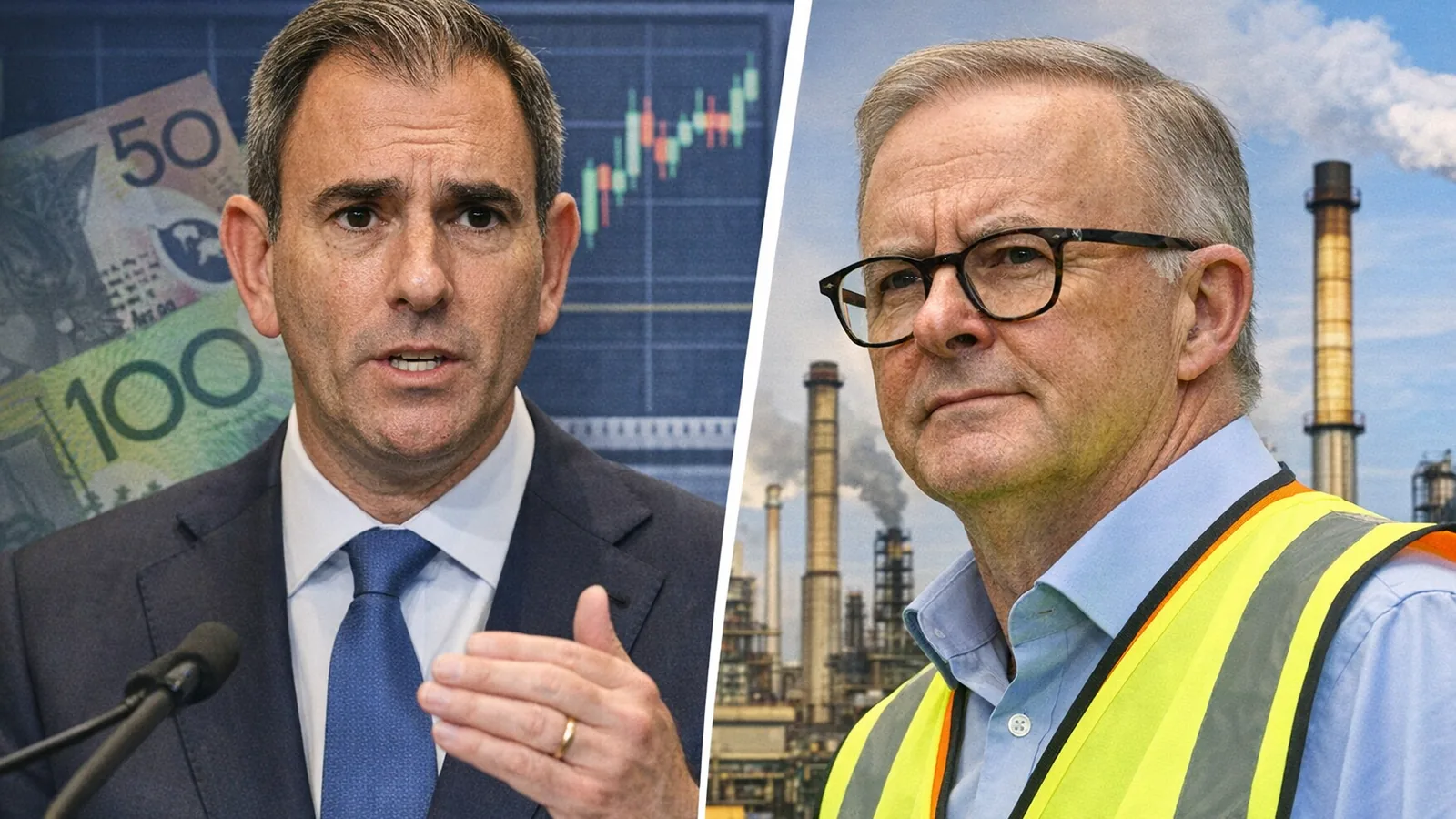
The Albanese government is starting to show two economic instincts at once. One is cautious, budget-focused and clearly worried about inflation. The other is activist, strategic and more willing to use government money to reshape parts of the economy.
That matters well beyond Canberra.
For property investors, homeowners and anyone watching rates, the real issue is not just whether the next budget includes spending cuts or tax reform. It is whether Labor can seriously talk about fiscal discipline while also backing a more intervention-heavy model built around subsidies, local industry and economic self-reliance.
Here’s what matters. The Treasurer is talking like a government that knows inflation is still dangerous. The Prime Minister is talking like a government that thinks the old free-market playbook no longer fits the world we are in.
Those two messages can sit together for a while. But not without tension.
Signal vs noise
What matters
Jim Chalmers is laying the groundwork for tighter spending, productivity reform and tax changes.
Anthony Albanese is making the case for a new economic model that leans more heavily on industry support and national resilience.
Treasury is clearly worried that a prolonged oil shock could keep inflation higher for longer and leave a lasting drag on growth.
For investors, this is not abstract policy talk. It goes straight to rates, sentiment, business investment and the broader cost environment.
What doesn’t
This is not yet proof of a dramatic fiscal crackdown.
It is also not confirmation that major capital gains tax changes are locked in.
For now, the signal is direction, not final policy.
What’s driving it
Chalmers appears to understand that the inflation fight is not over. That is the practical starting point here.
When a government keeps spending heavily in an economy that is already dealing with price pressure, labour constraints and external shocks, it adds to demand. That does not mean public spending is the only inflation driver. But it does mean Canberra cannot pretend it has no role in the problem.
That is why the Treasurer is now talking more openly about budget repair, spending restraint and reforms that make the economy more productive. Productivity matters because it is one of the few clean ways to grow without automatically adding inflation pressure. In plain English, productivity means getting more output from the same workers, capital and time.
Now, the part most people miss.
This is not just about economics. It is also about political room. If Labor wants to keep backing big strategic programs, whether that is energy, manufacturing or fuel security, it needs to find savings somewhere else or risk looking like it is feeding the very inflation problem the Reserve Bank is trying to contain.
That is where Albanese’s message becomes more complicated.
The Prime Minister is effectively saying the Hawke-Keating era cannot be copied into today’s world. His case is that global trade conditions have changed, strategic competition is sharper, supply chains are more fragile and Australia needs to make more things at home. That is the logic behind support for domestic industry, intervention in strategic sectors and extra help for assets seen as nationally important, such as refineries.
There is a policy logic to that argument. A more unstable world does make resilience more valuable.
But resilience is rarely free.
Government support for selected industries can protect capacity, preserve capability and reduce certain external risks. It can also mean more spending, more market distortion and harder trade-offs elsewhere in the budget. So while Albanese is making a strategic case, Chalmers is left managing the arithmetic.
That is the split.
One side of government is saying Australia needs a stronger private sector, tighter spending and reform that lifts efficiency. The other is saying government must do more to shape the economy directly. Both views may be politically saleable. Running both at the same time is the hard part.
Why the oil shock matters more than the politics
The article’s most important economic warning may not be the internal Labor tension at all. It may be the inflation scenario tied to oil.
If oil prices stay elevated because of conflict in the Middle East, the effect is not limited to petrol bowsers. Higher energy costs flow through freight, logistics, household budgets, business margins and inflation expectations. Once that happens, the Reserve Bank has less room to relax even if parts of the economy are already slowing.
So what does that mean in plain English?
A short-lived oil shock is painful but manageable. A prolonged one is different. It can leave a scar across the economy because households keep paying more, businesses keep absorbing cost pressure, and policymakers lose flexibility.
That is particularly relevant for housing because property responds less to headlines than to the interaction between rates, credit and confidence. If inflation proves stickier than hoped, borrowing costs stay restrictive for longer. Even if rates stop rising, the gap between expected relief and actual relief can still change buyer behaviour.
The tax reform watch
The other live wire is tax.
Chalmers is again signalling that the tax system is dated and unfair in ways that increasingly fall across generations. That language matters because it broadens the frame beyond simple revenue collection. It suggests Labor wants to make the case that reform is not just about plugging budget holes, but also about incentives, sustainability and who carries the burden over time.
The discussion around capital gains tax fits inside that frame.
Here’s the catch. For property investors, the detail matters far more than the headline. A broad warning that CGT concessions may be reviewed is one thing. Actual policy design is another.
There is a major difference between trimming a flat discount, indexing gains for inflation, changing treatment across asset classes, or altering thresholds and timing rules. Those choices would affect investor behaviour very differently.
That is why sweeping conclusions would be premature. But it is also why investors should not dismiss this as background noise. Once a government starts openly describing the tax system as outdated and intergenerationally uneven, investment tax settings come into focus very quickly.
Second-order effects for property
Property investors should watch this through four lenses.
The first is inflation persistence. If budget settings become more disciplined, that is modestly helpful for the inflation outlook. If government also expands support for favoured industries and strategic sectors, some of that restraint can be diluted.
The second is rates. The Reserve Bank does not set policy based on political messaging. It responds to inflation, demand and labour market conditions. But fiscal choices still feed into that backdrop. A looser budget makes the Bank’s job harder. A tighter one gives it more room.
The third is confidence. When government messaging splits between restraint and intervention, households and businesses can struggle to price the direction of policy. That uncertainty matters because investment decisions often stall before they reverse.
The fourth is tax risk. Even before any rule changes arrive, debate itself can alter behaviour. Some investors pause. Others rush. Markets can get jumpy on the possibility of reform before the reform is even designed.
I’ve seen this play out when policy discussion becomes the story. People stop asking what the actual cashflow, yield and holding risk look like, and start reacting to speculation. That is usually where mistakes begin.
Who wins and who feels the pressure
If Chalmers succeeds in tightening spending without crushing growth, that would help borrowers who need inflation to cool and rates to eventually ease.
If Albanese succeeds in building more domestic capacity in strategically important sectors, parts of industry may benefit from stronger support and more policy certainty.
But households do not get the upside immediately. They feel the transition first.
That can mean higher near-term uncertainty, sticky living costs, a slower path to lower rates and more debate about who should absorb the adjustment. Investors with thin buffers should pay close attention to that. Entry price matters, but holding power matters more when inflation is stubborn and policy is shifting.
Risk check
The base case is that Labor tries to sell a budget that looks disciplined on the surface while preserving room for strategic spending underneath it.
That would be politically neat. Economically, it may only partly solve the problem.
What could break this view?
A bigger and longer oil shock than Treasury hopes.
A fresh lift in inflation that forces rates to stay restrictive longer than markets expect.
A meaningful tax change that hits investor sentiment harder than Canberra anticipates.
A weak growth patch that makes spending cuts politically harder to maintain.
State governments continuing to spend aggressively, which blunts any federal effort to look fiscally tight.
The rule of thumb for investors
Do not read this as a simple pro-property or anti-property moment.
Read it as a policy environment where inflation, rates and tax settings are all still live variables.
That means the smartest lens is not ideology. It is serviceability, cashflow buffer and policy sensitivity. Investors who can absorb slower relief on rates and avoid overpaying into uncertainty are in a stronger position than those relying on a clean, quick return to easier conditions.
The bigger signal is that Canberra knows the old script is under strain. Chalmers is talking about discipline because inflation leaves him little choice. Albanese is talking about a new model because geopolitics gives him cover to intervene more heavily.
Both messages are now on the table.
The next question is whether the budget can carry both without making either one look less credible.