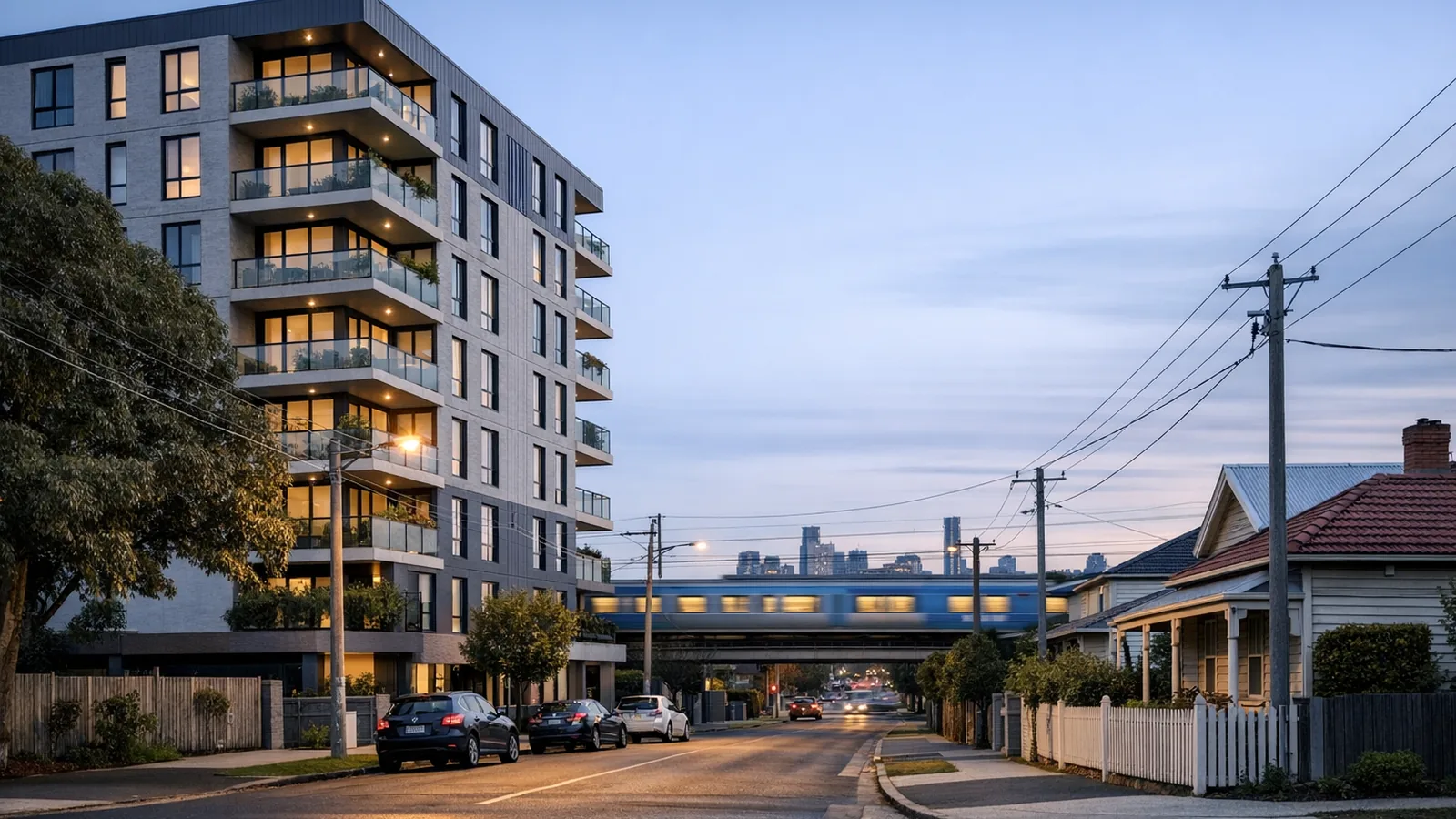
Victoria is tightening the gap between planning approval and construction by stripping back objection rights for some apartment projects up to six storeys. For the Allan government, that is the point. If a development meets the new mid-rise code, it moves faster. For residents, the change lands differently. A process that once gave neighbours a stronger pathway to challenge projects at VCAT will now be narrower.
This is not a small technical edit. It is a direct attempt to shift the balance of power in favour of housing delivery, especially in established suburbs where governments want more homes but local resistance often slows outcomes.
So what does that mean in plain English? Victoria is saying that in areas already zoned for four to six-storey buildings, a compliant project should not get bogged down in the same drawn-out fight. The state wants speed, predictability and more medium-density housing near transport, jobs and services. That is the theory. The harder part is what happens on the ground.
Signal vs noise
The signal is clear. Victoria is not just talking about more housing supply. It is changing the approval mechanics to force it through faster.
What matters most is this. A compliant project in the eligible height range can move through the system with less delay. That matters because time is money in development. The longer a project sits in planning, the more holding costs, financing pressure and uncertainty build up. When those costs rise, fewer projects stack up.
What matters too is where this applies. The policy does not suddenly rezone every suburb for mid-rise buildings. It applies in places where four to six-storey development is already permitted. That limits the immediate reach of the change, but it still matters because it affects how quickly those sites can now be turned into actual housing.
What matters less is the political packaging. Labor is framing the move as pro-housing and anti-NIMBY. The opposition is framing it as a removal of community voice. Both lines are politically useful. Neither, on its own, tells you whether the change will deliver enough housing to materially shift affordability.
What’s driving it
The government is chasing the so-called missing middle. That is the band between detached houses and high-rise towers, usually townhouses, low-rise and mid-rise apartments. In planning terms, it is often the hardest housing to deliver because it lands in suburbs where people want amenity, access and liveability, but where local opposition can be intense.
Here’s the catch. Governments across Australia have spent years talking about more supply near transport corridors and activity centres, yet delivery has remained slow. The blockage is often not a lack of policy language. It is friction in the approval system, design disputes, objections, appeals, infrastructure concerns and the simple cost of waiting.
By creating a code-based pathway, Victoria is trying to reduce that friction. The message to the market is straightforward: if you follow the rules, you should get a faster answer. That improves certainty for developers and lenders. Certainty matters because apartment projects are already exposed to tight margins, construction cost pressure and fragile buyer demand.
Now, the part most people miss. Faster approval times do not automatically mean a flood of new apartments. Planning is only one constraint. Developers still need sites at the right price, finance that works, build costs that do not blow out, and enough buyer or investor demand to get projects out of the ground. If those pieces do not line up, a quicker approval process helps, but it does not solve the whole problem.
That said, five months saved on approvals is not trivial. In a higher-cost environment, cutting months off the front end can be the difference between a marginal project failing and a workable project proceeding. The main benefit here is not magic affordability. It is improved feasibility.
Why the political fight matters
This is also an election-year housing line in the sand. The Allan government wants to be seen as the side willing to override local resistance in order to build more homes. The opposition wants to argue that Labor is pushing density without the roads, public transport capacity, schools and services needed to support it.
Both sides are speaking to real anxieties.
Residents worry about congestion, overshadowing, parking pressure and losing control over neighbourhood change. Governments worry that if every compliant project can be delayed through prolonged challenge pathways, supply targets become political theatre rather than reality.
That is the real trade-off here. Faster approvals usually mean fewer points of intervention. More points of intervention usually mean slower supply. There is no perfect answer. The question is which problem Victoria thinks is more urgent right now. Its answer is obvious: supply delay.
Second-order effects
If the reforms work as intended, the first winners are developers with sites in already-permitted mid-rise zones. They get more certainty, lower delay risk and a clearer runway through planning.
The next group that could benefit is buyers who are priced out of detached housing in established suburbs but still want access to train lines, tram routes and employment hubs. Mid-rise housing often sits in that middle band where location is strong but the price point is below a family home on its own block.
There could also be a benefit for the rental market over time if more apartment stock is completed in well-located areas. More supply does not fix rents overnight, but it can ease pressure at the margin, especially where demand is concentrated around transport and services.
On the losing side, nearby residents have less power to slow or challenge projects that comply with the code. That will feel like a democratic loss to many communities, even if governments argue the broader housing need justifies it.
Councils may also find themselves squeezed. When state governments move toward code-based approval systems, local planning discretion tends to narrow. That can create tension between local expectations and state housing targets.
And then there is the market effect many homeowners will watch closely. Not every suburb will suddenly transform, but once a faster pathway exists, land with mid-rise potential becomes more strategically valuable. Over time, that can change site values, development interest and neighbourhood expectations in the affected pockets.
The activity centre link
This reform does not sit in isolation. It lines up with the broader push to intensify development around activity centres and public transport corridors. That matters because planning reforms tend to work best when they are stacked. One code change on its own can help. A broader package that combines zoning certainty, transport-linked density and streamlined approvals has a better shot at changing actual supply.
In practical terms, Victoria is building a framework where more homes are expected to land in and around existing urban areas rather than relying only on fringe growth or CBD towers. That is the strategic logic behind the move.
For property investors and market watchers, the important point is not just that more apartments may be approved. It is where they may cluster. If policy keeps tilting toward transport-linked mid-rise development, the supply pipeline will matter suburb by suburb, not just citywide.
Risk check
The government’s base case is simple: reduce approval friction, improve project viability, get more homes built. That is plausible.
But several things could break that view.
The first is infrastructure strain. If density arrives faster than local services improve, backlash will intensify and political support can weaken.
The second is project economics. If build costs stay high and apartment margins stay thin, faster approvals may still not produce the volume of supply policymakers want.
The third is buyer depth. In some markets, getting approval is one thing. Selling enough stock to finance construction is another. If purchasers remain cautious, supply may still lag.
The fourth is design quality. A fast-track system only holds public legitimacy if the product is decent. If residents see poor design outcomes being waved through, resistance will harden quickly.
The fifth is policy spillover. Once governments see code-based planning as a useful tool, they may keep expanding it. That could further reshape the role of objections, councils and local planning processes over time.
What changes, and what doesn’t
What changes is the level of certainty for compliant mid-rise projects in eligible zones. The planning pathway gets cleaner and faster. Objection leverage gets weaker. The signal to the market is more pro-development than before.
What does not change is the fact that housing delivery still depends on feasibility. Planning reform can open the gate, but it cannot force builders, lenders and buyers to walk through it.
It also does not erase site-specific constraints. Heritage and flood controls still matter. And projects that miss the code do not get the shortcut.
That is why this reform should be seen for what it is: not a complete housing solution, but a meaningful shift in the planning system’s bias. Victoria is choosing speed over process in a specific slice of the market and betting that more supply, or at least more buildable approvals, is worth the political cost.
The APReview take
This is a serious pro-supply reform, but it is also a test of public tolerance. If it lifts approval speed without obvious quality trade-offs, it strengthens the case for more code-based planning. If it produces ugly outcomes, infrastructure stress or visible community anger, it could become a political liability.
For now, the cleanest read is this: Victoria is trying to make mid-rise housing normal in more established suburbs by removing part of the friction that has slowed it down. Whether that leads to better affordability is still uncertain. Whether it changes the planning conversation is not.