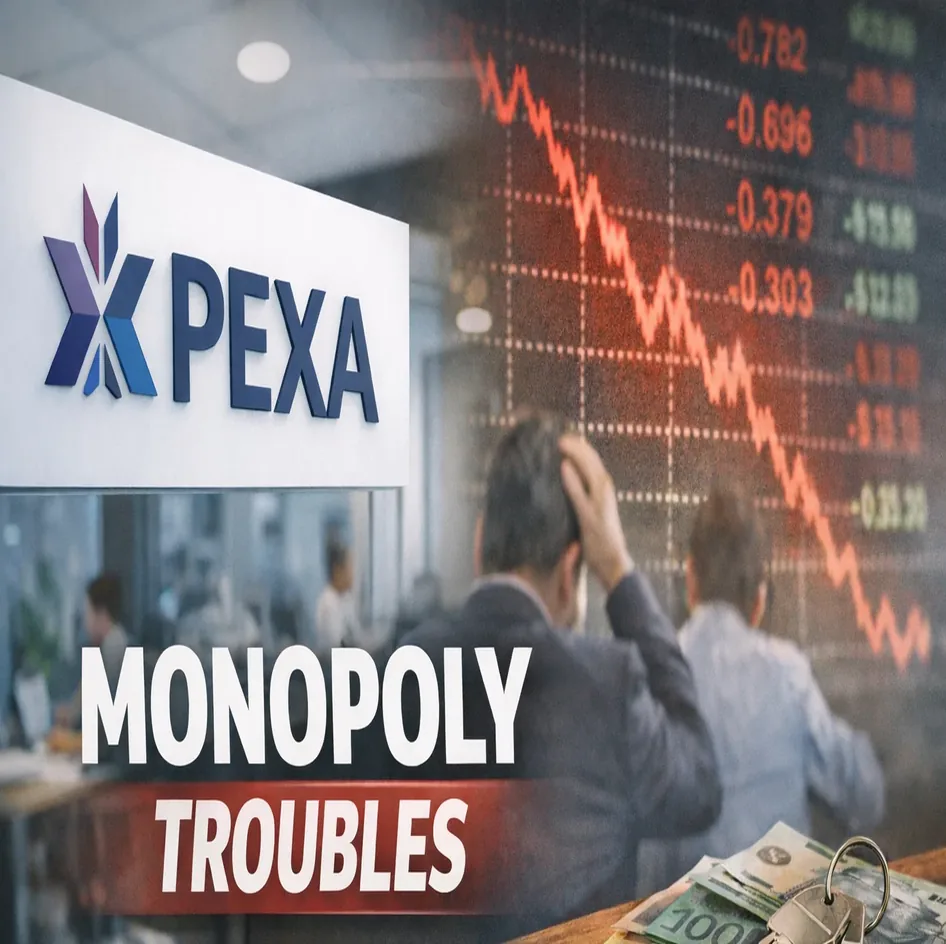
PEXA should have had a clean win.
The company emerged this week with its dominant position in electronic conveyancing still intact, after regulators and state decision-makers stepped back from forcing the system to open up more fully to rivals. On paper, that looks like a positive for a business that touches a huge share of Australian property settlements.
But the market read it differently.
Instead of celebrating, investors pushed the stock lower. That matters because markets are usually less interested in the headline victory than in the next problem it creates. In PEXA’s case, the message looks fairly clear: keeping the moat may not protect the earnings story if tougher fee scrutiny is coming next.
And for anyone in property, from investors to brokers to conveyancers, this is not just a corporate story. PEXA sits inside the plumbing of the housing market. When pressure builds there, it can eventually show up in costs, process friction and regulatory intervention.
What changed and what didn’t
What changed is the immediate threat.
PEXA appears to have avoided, at least for now, a more aggressive push to make its systems interoperable with competitors. That removes one obvious risk. A monopoly is usually worth more when it is not being forced to share the rails.
What did not change is the deeper issue: monopoly businesses do not escape scrutiny. They often attract more of it.
That is the part the market seems to be focusing on. If competition is not going to do the disciplining, regulators may try to do it through price controls, fee reviews or tighter operating oversight. For investors, that can be just as uncomfortable, and sometimes worse, because it goes straight to margins.
Now, the part most people miss: monopoly protection can solve one problem while creating another. It can preserve market share, but it can also strengthen the case for regulators to ask whether customers are paying too much.
The sell-off says the market is worried about more than competition
The sharp fall in PEXA’s share price suggests investors are not simply trading off this week’s policy headline. They appear to be looking at a bundle of risks together.
One is pricing regulation. Another is management stability. A third is the company’s relationship with the officials and agencies that shape its operating environment.
That combination matters.
A business with strong internal cohesion and trusted external relationships can often manage a policy dispute. But when senior departures start piling up at the same time regulatory tension rises, the market tends to assume the risk is not isolated.
That does not automatically mean the business is broken. Executive churn can happen after leadership changes. New chief executives often reshape teams, alter expectations and push different operating cultures. Some turnover is normal.
Still, volume matters. When departures appear across strategy, technology, risk, legal and people functions, investors start asking whether this is ordinary transition or a sign of deeper strain.
The real issue is pricing power
At the centre of the story is a simple question: how much freedom should a near-monopoly have to raise fees inside a system that most market participants cannot realistically avoid?
That question has become more sensitive after the dispute over transaction charges and the company’s run-in with the NSW Registrar General. Even if PEXA is right on the detail of that disagreement, the episode appears to have sharpened attention on how the business uses its position.
This is where the market’s logic becomes easier to understand.
If PEXA had lost ground to new competition, investors would worry about volume and market share. If it keeps the field largely to itself, investors may instead worry about regulators leaning harder on fees. Either way, the old assumption of easy monopoly economics starts to look less comfortable.
In plain English, investors may be thinking this: PEXA can still dominate the lane, but it may not be able to charge through it as freely as before.
The catch
PEXA’s strategic win may have increased the odds of tighter fee regulation, not reduced them.
That is the paradox here. Keeping competitors out can make a business look stronger in theory, while making it more exposed in practice if policymakers conclude customers need protection from that strength.
Why this matters beyond one stock
It would be easy to file this away as an ASX story. That would be too narrow.
PEXA is tied to the mechanics of property transfer. If regulatory pressure leads to lower allowable fees, that may be good news for users of the platform. If the conflict instead leads to more legal wrangling, slower reform or a more defensive posture from the company, that can create second-order effects across the transaction chain.
Conveyancers, lenders, lawyers and brokers all rely on predictable settlement infrastructure. Property investors and owner-occupiers may never think about the platform underneath the process, but they do notice higher transaction costs and more friction when things go wrong.
That is why this matters for the broader property market. The issue is not only whether PEXA remains dominant. It is whether the system around it remains efficient, fairly priced and trusted.
What could derail the next phase
There are a few ways this story could shift from here.
The first is that pricing regulation ends up being softer than the market fears. If that happens, the sell-off may prove overdone.
The second is that management churn settles and the company restores confidence that the internal reset is under control. Markets can forgive disruption when they believe it leads to a stronger operating model.
The third is the opposite. If more senior departures follow, or if the company’s relationship with regulators deteriorates further, the concern will move from a margin debate to a governance and execution debate.
That would be harder to wave away.
Bottom line
PEXA may have protected its position, but it has not protected itself from a harder question about how that position should be regulated.
That is why the market’s reaction matters. Investors appear to be saying the risk has not gone away. It has changed shape.
For property readers, the practical takeaway is simple: watch the pricing review, not just the monopoly headline. The next chapter is less about whether PEXA keeps its moat and more about what regulators decide that moat is worth.