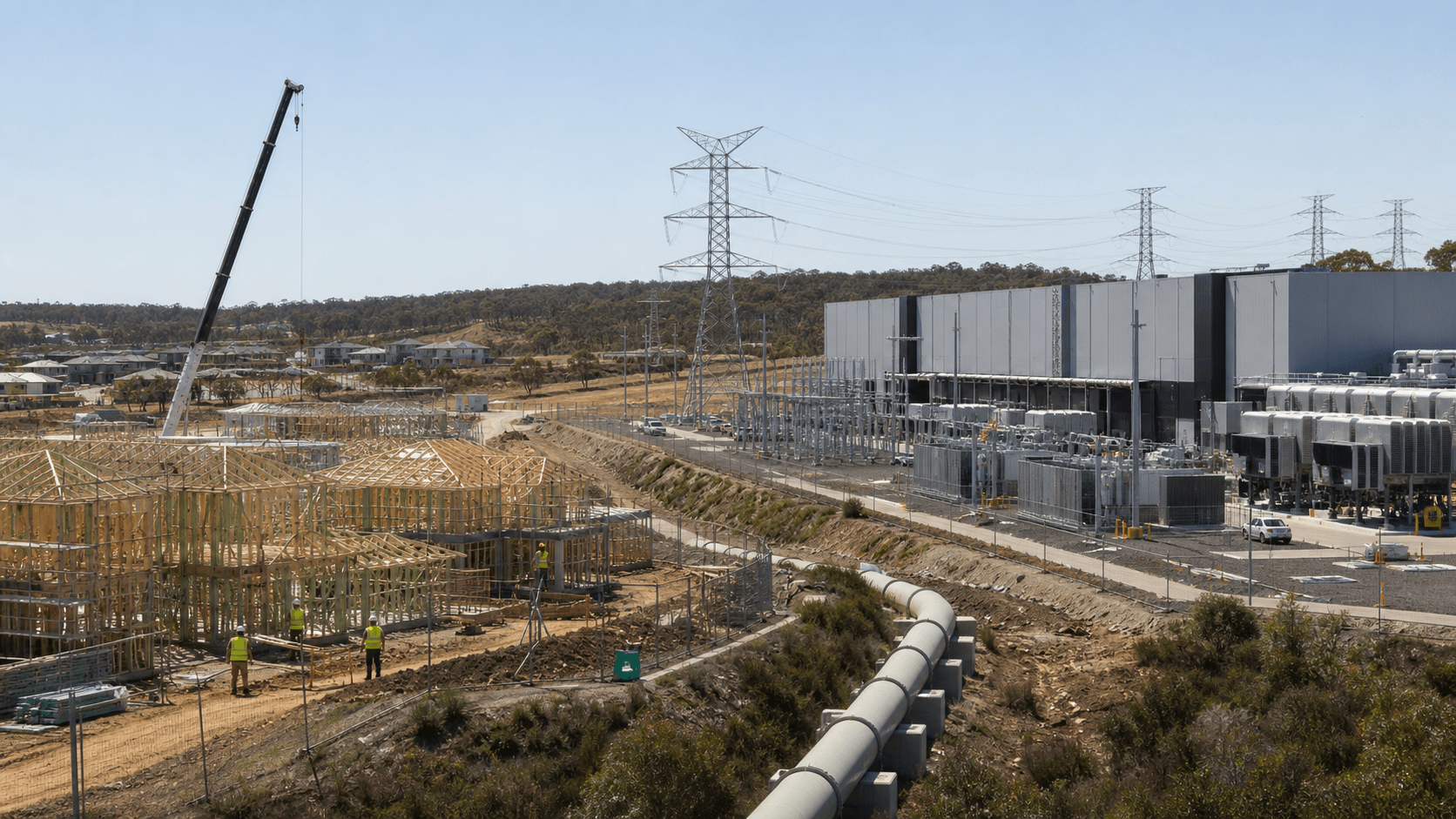
Australia’s data centre boom is running into an uncomfortable constraint: the industry needs many of the same scarce resources required to build new homes.
The Housing Industry Association has warned that data centres are competing with housing developments for land, electricity, water and supporting infrastructure. It says some large data centre projects are also moving through planning systems faster than residential developments.
That does not mean data centres will derail Australia’s housing targets on their own. Planning delays, construction costs, financing pressure and weak productivity remain larger barriers.
But fast-tracking one infrastructure-heavy industry while housing projects wait for connections risks adding another obstacle to an already fragile supply pipeline.
In plain English
Data centres are not taking every future housing site. The bigger concern is that they can secure scarce electricity, water and infrastructure capacity ahead of residential projects. If additional capacity is not built, nearby housing can become slower or more expensive to deliver.
The new contest for land, power and water
Modern data centres require large sites, reliable electricity, extensive telecommunications infrastructure and significant cooling capacity.
Housing developments have a similar dependency on serviced land and essential infrastructure. New estates cannot proceed at scale without electricity connections, water, sewerage, roads and other public services.
The overlap creates a problem where infrastructure capacity is already limited.
HIA chief executive Simon Croft said land previously earmarked for housing in parts of NSW and Victoria had instead been fast-tracked for data centres.
The association is not calling for data centres to be stopped. It wants housing to receive the same urgency in planning and infrastructure decisions.
That distinction is important. Australia can accommodate both industries, but only if investment in electricity, water and transport capacity keeps pace with development approvals.
Faster approval does not create more capacity
The HIA says a data centre covering many hectares could conceivably receive approval faster than a single home under existing fast-track mechanisms.
The comparison is striking, although the two developments usually pass through different planning pathways.
A large data centre may be assessed as a strategically important project. A home or residential development can face local planning rules, objections, design requirements and multiple layers of approval.
Approval speed is only one part of the problem.
A planning decision does not automatically produce spare grid capacity or accelerate a delayed water upgrade. If a data centre secures a major electricity connection first, housing projects relying on the same network may face longer waits or higher infrastructure costs.
Those effects can spread through the housing pipeline:
- Developers may pay more for electricity and water connections.
- Holding costs can rise while projects wait for infrastructure.
- Marginal apartment and land projects may no longer be financially viable.
- Fewer sites may progress from approval to construction.
- Higher delivery costs may flow into new-home prices.
This is why a rise in dwelling approvals does not necessarily mean Australia’s housing supply problem is being solved. Approved projects still need finance, infrastructure, labour and a builder before they become completed homes.
The housing shortage has deeper causes
Data centres did not create Australia’s housing shortage.
The undersupply was already being driven by slow planning decisions, elevated construction costs, labour shortages, limited serviced land and weak building productivity.
Higher interest rates have added another constraint. Developers must carry finance costs while land is acquired, approvals are obtained and construction proceeds. A delay can turn a viable development into one that no longer produces an adequate return for the risk involved.
Australia’s financial system is also better at funding the purchase of existing homes than financing the construction of new ones. Development finance carries construction, cost, sales and completion risks that do not apply to a standard mortgage over an established property.
The relevant question is therefore not whether every data centre site could have become housing.
Some industrial locations would be unsuitable for homes because of zoning, noise, transport movements or surrounding land uses.
The real test is whether a data centre consumes land or infrastructure capacity that could realistically have supported nearby residential development.
Construction productivity adds another warning
The Business Council of Australia has separately criticised the federal government’s proposed capital gains tax reforms, arguing they could weaken investment, productivity and economic growth.
Its submission to Treasury objects to the construction of infrastructure being omitted from a proposed CGT carve-out for innovative start-ups.
Under the preliminary proposal, businesses would need to meet several tests to qualify, including annual turnover below $50 million, high growth potential, access to international markets and evidence of a competitive advantage.
The BCA argues that excluding construction innovation is difficult to justify when productivity in the sector is already lagging the wider economy.
That matters for housing.
Australia will not close its supply gap through rezoning and faster approvals alone. The construction sector must also find ways to build more homes with the available workforce, capital and materials.
A tax concession is not guaranteed to produce that improvement. Broadening an exemption could encourage investment, but it would also reduce tax revenue and make it harder to define which businesses genuinely qualify as innovative.
The trade-off deserves scrutiny rather than a simple assumption that every concession will generate additional housing.
Making data centres carry their infrastructure cost
The federal government has indicated that new rules could require data centre developers to support their own energy needs, reduce consumption when the grid is under strain and use water more efficiently.
That approach is more credible than either unrestricted approval or a blanket restriction on new data centres.
The detail will decide whether it works.
A requirement to underwrite energy supply should result in additional generation, storage or network capacity. It should not simply allow a developer to secure electricity that would otherwise serve homes and existing businesses.
Water requirements should also reflect local conditions. A project in a water-constrained area may need closed-loop cooling, recycled water or another system that limits demand on drinking-water supplies.
Governments could require major data centre proposals to disclose:
- Expected electricity and water consumption
- The source of additional energy capacity
- Required grid, water and transport upgrades
- Housing projects relying on the same infrastructure
- Who will pay for new capacity
- How consumption will be reduced during periods of system stress
The principle should be straightforward: projects creating additional infrastructure pressure should fund the capacity needed to manage it.
Three ways the squeeze could play out
The effect on housing will depend on how governments handle the next wave of investment.
Base case: Data centre development continues, creating local pressure on land and utilities. Housing delays occur in some growth areas, but planning, construction costs and finance remain the main supply constraints.
Better case: Data centre developers fund new renewable generation, storage, water systems and network upgrades. The additional capacity supports the projects and provides wider economic benefits.
Worse case: Governments fast-track data centres without expanding infrastructure. Residential developments are pushed further back in connection queues, costs rise and more projects become unviable.
Higher financing costs would amplify the downside. As Australian Property Review has examined, interest rate rises can reduce housing supply by making development projects harder to finance.
That can eventually affect renters as well as buyers. Fewer completed homes mean fewer properties entering the rental market, particularly in growth corridors already recording tight supply.
What buyers and investors should watch
A nearby data centre is not automatically good or bad for property values.
It may create employment, infrastructure spending and commercial activity. It may also increase pressure on electricity networks, industrial land and local roads.
The practical question is whether the surrounding area has enough infrastructure capacity for both commercial and residential growth.
Before buying in a major growth corridor, check:
- Whether planned housing estates already have funded infrastructure
- Expected electricity and water connection time frames
- Proposed data centre or industrial developments nearby
- Changes to zoning or state fast-track planning rules
- Whether developers must fund additional network capacity
- The gap between local housing approvals and completions
A useful rule of thumb is that a data centre becomes a housing issue when it competes for infrastructure that cannot be expanded quickly.
The next step is to review the local council development pipeline and the relevant electricity distributor’s connection plans. Those documents will provide a clearer picture of future housing delivery than national targets alone.
General info, not financial advice.