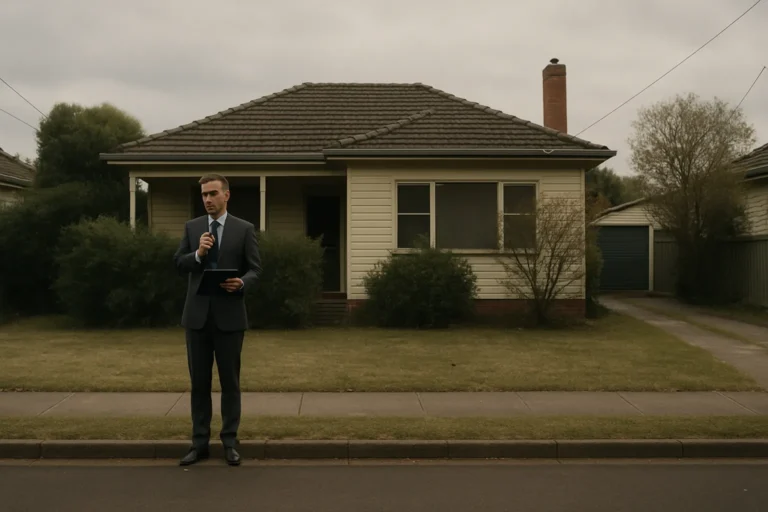
A new pattern is emerging across Australian property markets: buyers with finance already approved are choosing to walk rather than settle, betting they can save hundreds of thousands by timing a deeper correction.
One Sydney couple recently withdrew from a $1.2 million house purchase despite having finance locked in, convinced prices would drop another 15 to 20 per cent. They forfeited their deposit rather than complete the deal.
Brokers report the behaviour is spreading beyond distressed buyers who cannot secure finance. These are purchasers who can settle but choose not to, recalculating the cost of forfeiture against potential savings if the market falls further.
The shift matters because it introduces a new source of settlement risk for vendors and developers who counted on deals closing. When buyers with approved loans start walking away, it signals a deeper confidence problem than affordability stress alone.
What the numbers actually show
National dwelling values fell 0.3 per cent in July, with Sydney down 0.6 per cent and Melbourne off 0.4 per cent. Brisbane and Adelaide recorded their second consecutive monthly declines.
Those are real falls, but context matters. Analysis of the past 40 years shows the combined capital city market experienced 10 downturns lasting at least three months. All but three resolved in under 12 months.
The largest decline across that period: 8.2 per cent between 2017 and 2019.
Buyers expecting 15 to 20 per cent falls are banking on an outcome roughly double the worst correction in four decades. Possible, but not supported by the base case.
Key numbers
- National dwelling values fell 0.3% in July
- Sydney down 0.6%, Melbourne off 0.4% for the month
- Largest 40-year correction: 8.2% over two years (2017-2019)
- Buyers walking from deals expect 15-20% falls, more than double historical peak decline
- Most downturns since 1984 resolved in under 12 months
The mechanics of walking away
Forfeiting a deposit on a $1.2 million property typically means losing $60,000 to $120,000, depending on the deposit structure and contract terms.
For that loss to make sense, the buyer needs to believe the same property will be available later at a saving greater than the forfeited amount, after accounting for holding costs and the risk that prices stabilise or reverse.
On a $1.2 million purchase, a 15 per cent fall would deliver a $180,000 saving. A 20 per cent drop saves $240,000. Against a $60,000 to $120,000 deposit loss, the bet pays off if prices fall hard and fast.
The catch: if the market steadies at a 5 to 8 per cent correction, the buyer loses the deposit and gains nothing. If prices rise again within 12 months, the loss compounds.
Who is holding and who is folding
Experienced investors are not walking away. They are using softer conditions to negotiate harder on price, but completing deals on quality assets they plan to hold long-term.
The walk-aways are concentrated among first-time buyers and upgraders who entered contracts during the peak and now see headlines about falling prices every week. The psychology flips from fear of missing out to fear of overpaying.
Vendors who need to sell, motivated by divorce, relocation, financial stress, are adjusting price expectations to close deals. Those who can wait are pulling listings rather than chasing the market down.
The result: a thinner market with fewer transactions, longer selling times, and a growing cohort of buyers on the sidelines waiting for a signal that may not come.
What happens to the deals that collapse
When a settlement fails, the property returns to market. If the vendor is a developer or investor with holding costs, they face pressure to re-list quickly, often at a lower price to reflect the new sentiment.
If the vendor is an owner-occupier with no urgency, they may withdraw entirely and wait for conditions to improve. That reduces active supply but does not solve the demand problem.
The risk for developers is acute. Projects with multiple presales that unravel face not only re-marketing costs but potential financing issues if lenders require a minimum presale threshold to release construction funds.
One settlement failure is manageable. A cluster of walk-aways in the same building or suburb starts to look like a repricing event.
Pressure points in the next six months
Spring listings will test whether vendors are willing to accept the new price reality or hold out for a recovery that may take years. More stock without more buyers means continued downward pressure.
Interest rates remain the wildcard. If cuts arrive sooner than expected, buyer confidence could return quickly, leaving the walk-aways worse off. If rates stay elevated longer, the correction extends and the gamble pays off.
Unemployment and wage growth will dictate how long buyers can afford to wait. A stable job market supports the sidelines strategy. Rising unemployment forces decisions.
Watch settlement failure rates in Sydney and Melbourne over the next quarter. If they climb above historical norms, vendors will panic-list ahead of further falls, accelerating the correction the walk-aways are betting on.
The practical question
If you are finance-approved and considering walking away from a contract, pressure-test the assumptions: what fall is priced in already, what additional decline is probable versus possible, and what is the cost if you are wrong.
A 5 to 8 per cent correction from peak is playing out now. Betting on another 10 to 15 per cent on top requires a view that unemployment spikes, rates stay high for years, or a supply shock floods the market. None of those are base case.
If you are holding a property with a settlement at risk, know that re-listing into a falling market with a visible failed sale attached makes the next negotiation harder. Price to the new reality, not the old contract.
For vendors who do not need to sell, pulling the listing and waiting 12 months is a legitimate option if holding costs are manageable. Chasing the market down rarely ends well.
Subscribe to the newsletter for weekly signal on what is moving and what is noise.
General info, not financial advice.