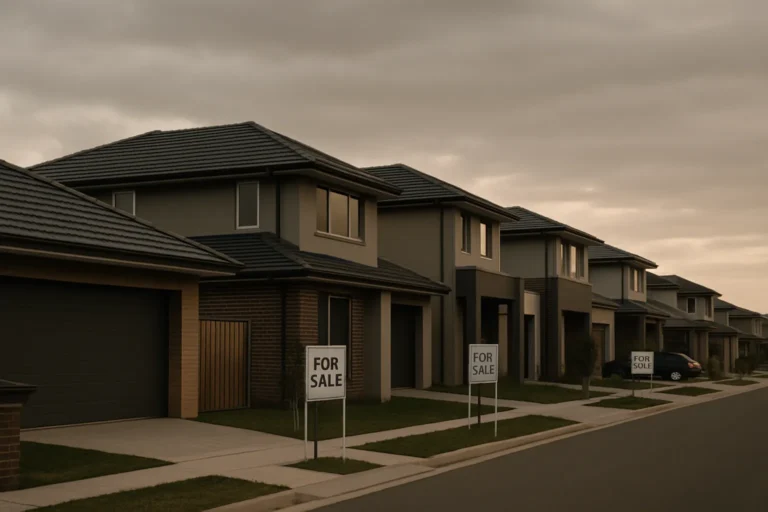
Suburban rate rise pain is not spread evenly across Sydney and Melbourne. It lands hardest on households who borrowed close to their limit in the outer rings, where prices were lower but loan-to-income ratios often ran high.
That is the pattern worth testing against data, rather than relying on anecdote. This piece uses general market mechanics and does not rely on figures from any single report.
Why outer suburbs feel a rate rise first
Outer-suburban buyers tend to be younger, on one or two incomes, and often first-home buyers. They borrowed at high loan-to-value ratios (LVRs) and then watched repayments rise as the cash rate moved up.
Three features stack the risk:
- Higher LVRs. Less equity means less room to absorb a price dip.
- Larger loans relative to income. Each rate rise takes a bigger bite out of household cash flow.
- Fixed-rate expiries. Borrowers who locked in cheap rates and are now rolling onto higher ones face a sharp step up, not a gradual one.
How serviceability sets the ceiling
Serviceability is the lender’s test of whether you can afford repayments. In plain English: your income, minus living costs, has to cover the loan with a buffer built in.
APRA’s buffer means new borrowers were assessed at a rate well above the actual rate. That helps. But the buffer applies to the borrowers who were approved. It does not protect people who were approved under lower rates and are now managing a repayment far higher than the one they first signed up for.
For a rough rule of thumb, a household spending more than about 30 to 35 per cent of gross income on repayments is usually considered stretched. Past 40 per cent, there is little room left for a second shock, such as a job loss or a rent-free period ending.
How close is the forced-selling line?
Higher repayments alone rarely force a sale. Lenders prefer hardship arrangements, extended terms or temporary interest-only periods. Forced sales usually need a combination of three things:
- Sustained repayment stress, not a single bad month.
- A fall in income, such as job loss or reduced hours.
- Little or no equity, so a sale cannot clear the debt.
The third point is where negative equity matters. If values soften in the outer rings and a buyer paid near the peak with a small deposit, the loan can exceed the home’s value. That limits options: selling crystallises a loss, and refinancing becomes difficult because the new lender sees the same gap.
With a cash buffer, a stable job and some equity, most households can ride this out. Without them, the pressure builds.
What the data should tell us
To separate real risk from noise, the useful numbers are:
- The share of loans with LVRs above 80 per cent, by postcode.
- Arrears rates, split by outer and inner suburbs.
- The volume of fixed-rate loans due to roll over in the coming quarters.
- Listings and days on market in the outer rings, a leading signal of distressed selling.
If arrears stay low while listings climb, that points to households choosing to sell early. If arrears and listings rise together, that is the more worrying combination.
The wider market context
Outer suburbs do not move in isolation. Supply decisions shape how much room prices have to fall or hold. Our look at suburban landbank unlocking covers how new land release affects the price pressure on existing outer-ring stock.
It also helps to compare this cycle with earlier ones. We examined which past downturn 2026 resembles, and the answer depends heavily on how much leverage was added at the peak.
Key numbers
- Repayments above roughly 30 to 35 per cent of gross income signal stretch.
- High-LVR loans (above 80 per cent) carry the thinnest equity buffer.
- Fixed-rate expiries create step-up shocks, not gradual ones.
- Arrears and listings rising together is the warning combination.
The catch
Averages hide the real exposure. A suburb-wide median price tells you little about the borrower who bought last, at the top, with a 5 to 10 per cent deposit. Risk concentrates in recent buyers, not in the suburb as a whole.
It also cuts the other way. Long-term owners in the same streets, with big equity and small loans, are barely affected. Treating whole postcodes as distressed overstates the problem.
What to do if you are exposed
If you hold a high-LVR loan in an outer suburb, talk to your lender early, before arrears start. Ask about a rate review, a loan restructure or a temporary hardship arrangement. Lenders generally respond better to borrowers who come forward first.
Compare your current rate with what the market is offering, and check whether a refinance is possible at your current equity level. Then build or protect a cash buffer of at least three months of repayments.
If you want the weekly signal, subscribe to the free newsletter.
General info, not financial advice.