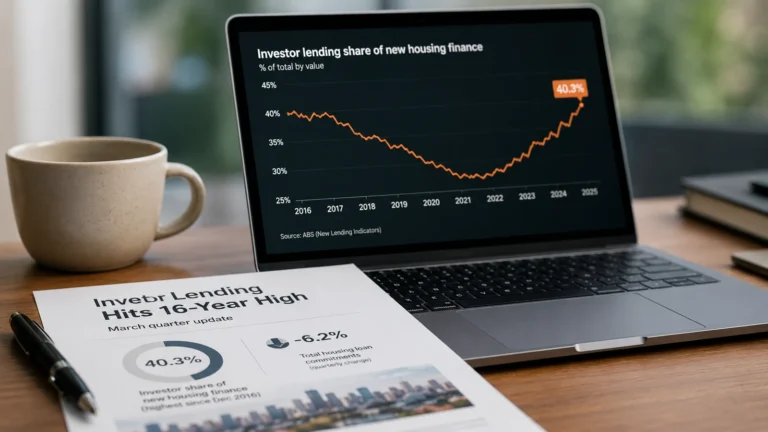
Australian property investors are paying more to borrow from lenders that are not banks. That sounds irrational until you look at what the banks now require and what the budget changes did to investor cashflow.
The shift is real enough to be reshaping how investment loans get written. The harder question is whether it is a sensible workaround or a pocket of credit risk building out of view.
Why a higher rate can still be the better deal
Banks assess a loan on serviceability. That means testing whether you can still make repayments if rates rise by a set buffer above the actual rate. When rental deductions shrink, the income that counts toward that test often shrinks too.
Non-bank lenders do not hold deposits, so they are not bound by the same prudential rules. Many use different assessment methods, treat rental income more generously, or apply a different buffer. The result is that some investors who fall short at a bank can qualify elsewhere.
The trade-off is the price. Non-bank loans commonly carry a higher rate and sometimes extra fees. For an investor the choice is often not cheap versus expensive. It is a higher-cost loan versus no loan at all.
What the negative gearing changes did to borrowing power
Negative gearing lets investors offset rental losses against other income. When those settings tighten, the after-tax cost of holding a geared property rises. Lenders see weaker cashflow, and the investor sees less room to borrow.
Our negative gearing, CGT and investor tax guide sets out how the mechanics work. The point for borrowing is simple: lower tax relief means lower serviceability, and lower serviceability means a smaller bank loan.
This is the gap non-bank lenders are filling. Some of that demand is investors who are fine on paper but caught by a conservative bank test. Some of it is investors who are stretched.
A rational response, or a risk moving off the books?
Both readings can be true at once.
- The rational reading: a well-capitalised investor with solid equity and stable income uses a non-bank to bridge a rule that does not fit their situation. They pay a premium, hold a buffer, and carry on.
- The risk reading: a thinner-margin investor uses a non-bank because the bank said no for good reason. Higher repayments leave less room if rents soften or rates rise again.
The difference is hard to see from the outside. Lending standards at non-banks are not identical to bank standards, and the data on how these loans perform is thinner and later to arrive. That is the catch. Arrears tend to show up with a lag, so a problem can build for months before it appears in the numbers.
For context on how fast this segment is growing, see our report on non-bank lender growth hitting 16% as brokers shift volume. Brokers are a major route into these lenders, which helps explain the pace.
What it means for investor demand
If non-banks keep absorbing investors the banks decline, investor demand holds up better than bank lending data alone would suggest. That matters for prices and for rental supply.
But it is demand with a higher cost base. A buyer paying more to borrow has less capacity to outbid others, and less buffer to ride out a soft patch. That tends to make this slice of demand more sensitive to rate moves than the average borrower.
Credit conditions more broadly are already under strain. Our coverage of mortgage applications collapsing 20% as a rate war breaks out shows how quickly volume can swing when pricing shifts.
Where arrears could show up first
If stress does emerge, expect it in a few places:
- Investors who needed a non-bank to qualify and have little spare cashflow
- Loans taken on interest-only terms that are now rolling to higher repayments
- Properties with softer rental demand, where income does not cover the higher interest cost
None of this is a forecast of a wave of defaults. It is a list of where to look. The base case is that most of these borrowers keep paying. The downside is a concentrated pocket that is under-observed because it sits outside the bank data most people track.
What investors should check before borrowing this way
If a non-bank is on the table, run the numbers on the worst case, not the best one.
- Test repayments at a rate meaningfully higher than today’s
- Confirm the fees, exit costs and whether the rate is fixed or variable
- Hold a cashflow buffer of several months of repayments
- Ask why the bank declined, because the reason tells you something about the risk
A higher rate is a cost you can plan for. A loan you can only service in good conditions is a risk you cannot.
Subscribe to the newsletter for the weekly read on credit, rates and what they mean for investors.
General info, not financial advice.