A household can be stretched on repayments and still be fine. Sell the house, repay the loan, walk away with something. Take that last part away and a stressed borrower becomes a trapped one. That gap is what matters now that a third-quarter 2026 index counts 450,539 Australian households under mortgage stress across 77 ranked postcodes.
The headline numbers are not small. The count rose by 31,318 over three months, roughly 7.5 per cent, and by 79,072 over the year, about 21 per cent. That is three quarterly rises in a row. But a stress count measures cash flow. It tells you who is struggling to pay this month. It does not tell you who will be forced to sell at a loss next year.
Two different problems with one label
Cash-flow stress is about income against repayments. It responds to rates, wages and living costs, and it can ease if any of those turn. Balance-sheet stress is about the loan against the property’s value. It responds to prices, and it does not ease just because rates fall.
The two feed each other. A borrower who can no longer afford repayments has one exit: sell. If the sale price covers the debt, the story ends quietly. If it does not, the lender and the borrower are both stuck. That is why arrears alone are a weak predictor of a default wave. Arrears plus negative equity is the combination that forces losses.
For a fuller primer on how missed payments are measured, see our mortgage stress and arrears guide.
Key numbers
- 450,539 households under mortgage stress across 77 ranked postcodes
- Up 31,318 in three months (about 7.5 per cent) and 79,072 in a year (about 21 per cent)
- Victoria’s top ten postcodes: 104,325 households, up 10,501 (11 per cent)
- Tasmania recorded the fastest state rise, at 13.7 per cent
Where the cash-flow pressure is landing
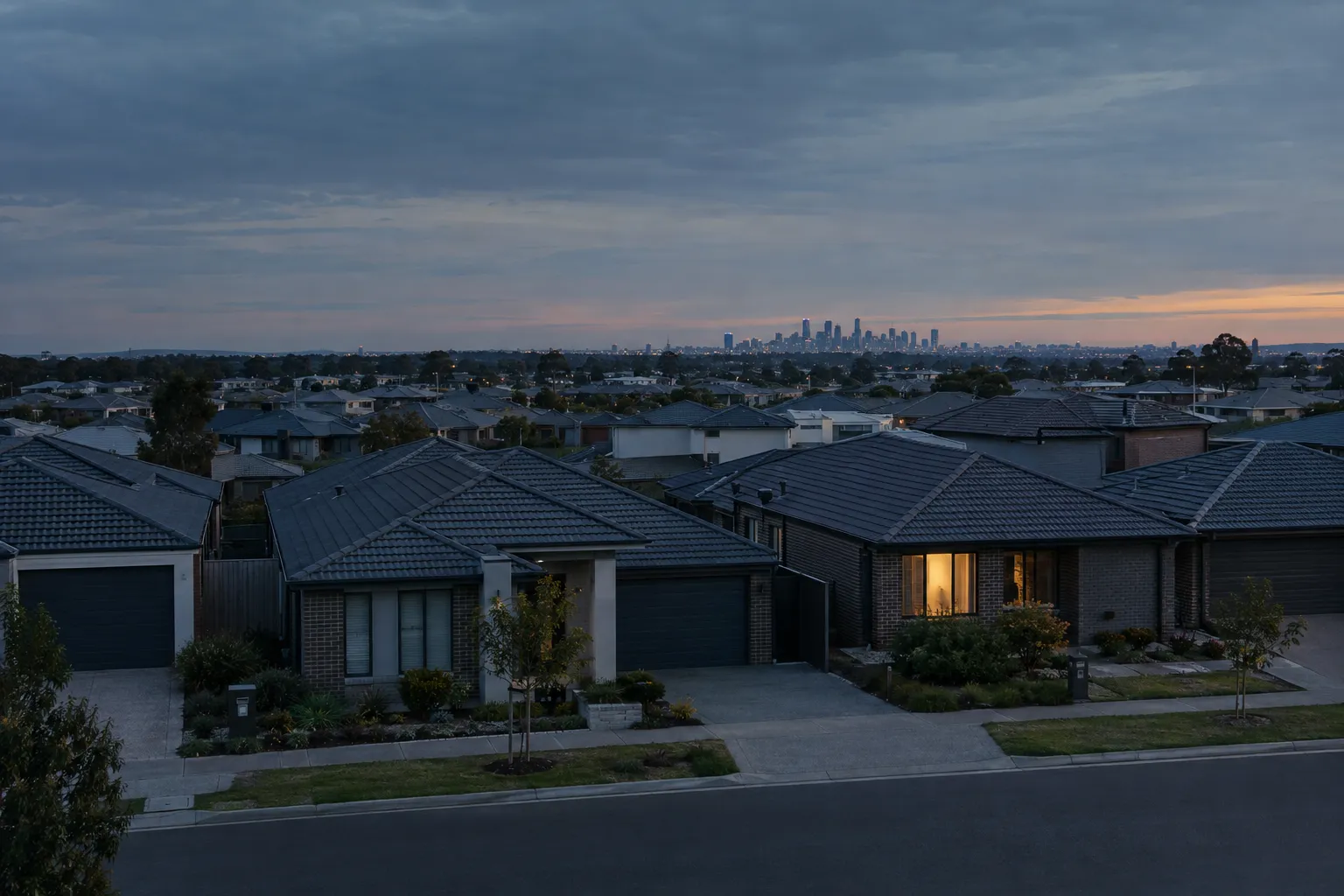
Melbourne carries the largest load. Victoria’s top ten postcodes added 10,501 stressed households, up 11 per cent, to reach 104,325, the biggest total and the biggest increase of any state. The index’s research head says the city’s western growth belt now matches the south-east, with Roxburgh Park in Hume overtaking the Casey corridor as Victoria’s main hotspot.
The sharpest percentage moves, though, are elsewhere. Cairns, Toowoomba and Launceston showed the fastest jumps, and Manunda in Cairns rose 156 per cent. Smaller markets move fast on small numbers, so treat those percentages with care. They show direction more than scale.
Affluent suburbs are the surprise
The most striking figures sit in wealthier postcodes. Drummoyne saw severe stress climb 610 per cent, while Hornsby recorded a 289 per cent jump. Elwood’s figure rose 256 per cent and Hawthorn’s went up 140 per cent. Across the Western Australian capital, Mount Claremont, Wembley and Cottesloe topped the state.
The starting base matters here. These areas had very few severely stressed households, so a big percentage can still be a modest count. But the pattern is worth noting. Larger loans on higher-priced homes leave less room when repayments rise, and these are also the suburbs where a price fall in dollar terms is largest.
That links to what we have covered on who is squeezed in Sydney and Melbourne.
The thin-deposit arithmetic
National prices have fallen for six months. For a buyer with a small deposit, that is where the second problem starts. Take a $700,000 purchase with a $35,000 deposit, which is five per cent down. A drop of five per cent in the home’s value wipes out every dollar of that equity. The buyer owes the full loan on an asset now worth $665,000, and selling costs come on top.
That is no longer a hypothetical for a large group. More than 100,000 first home buyers have used the expanded five per cent deposit scheme. A scheme that lets people in earlier also means they start with the thinnest possible cushion. None of that is a flaw in the scheme itself, and plenty of those buyers will be fine. But it concentrates exposure in one cohort at the moment prices are soft.
Who is most exposed, and who is not
The riskiest profile combines three things: a high loan-to-value ratio, a purchase near the recent price peak, and a household income with little slack. Buyers who got in before the price fall with a larger deposit hold a buffer. Owners who have been paying down loans for years hold a bigger one. Borrowers who can hold on, and who keep their jobs, may simply wait it out.
The danger is forced selling. A stressed borrower who can wait is a statistic. A stressed borrower who must sell into a falling market with no equity is a loss, and enough of them can push prices lower for everyone nearby. That loop is the cascade worth watching, and it is not the same as the arrears count rising.
What would change the picture
Three things matter more than the stress count itself. First, whether prices stabilise: if they stop falling, thin-deposit buyers regain breathing room. Second, whether rates ease enough to relieve repayments. Third, whether unemployment stays low, because job loss is what turns stress into forced sale. Our look at the property market crash and the buying window covers how those pieces could line up.
What readers can do now
If you hold a small-deposit loan, work out your equity at a few price scenarios and keep a cash buffer you can reach. If you are thinking of buying with a minimal deposit, price in a fall, not just today’s valuation. And if you are already stretched, talk to your lender early: hardship options exist, and they work best before arrears set in.
Subscribe to the Australian Property Review newsletter for weekly updates on rates, credit and prices.
General info, not financial advice.