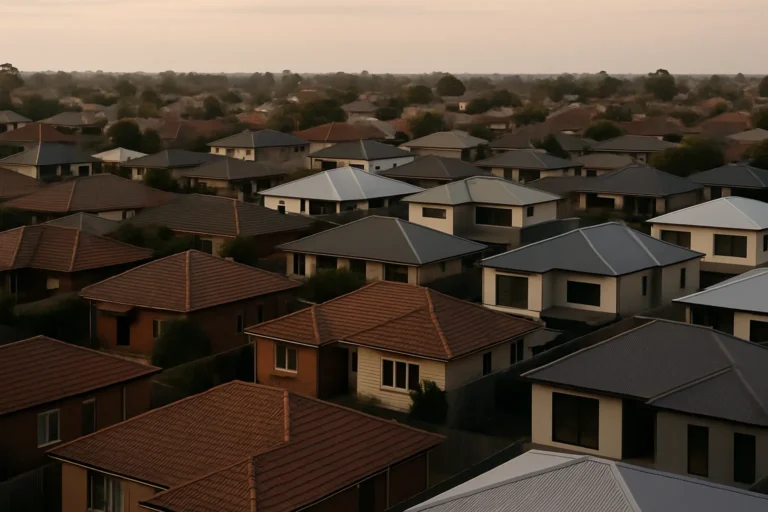
A major Australian lender has just cut its housing forecast hard. It now expects national values to finish about 14 per cent below their March peak, which would be the deepest fall since its monthly series began 45 years ago. Prices have already slipped 6.7 per cent.
That is a big claim, and big claims deserve a test. A forecast number tells you very little by itself. What matters is whether the conditions that have driven past corrections are actually showing up now.
The numbers behind the headline
The bank says the correction has been quicker and wider than it expected when it last updated on 1 September. For the combined five largest capitals, it sees a trough about 15 per cent below peak, with 8.2 per cent already gone.
The previous record fall was 8.6 per cent, during the 2017 to 2019 banking royal commission period. So the capitals are already close to that mark, and the forecast says the slide is not done.
Peak-to-trough forecasts by city:
- Brisbane: 18 per cent
- Perth: 18 per cent
- Sydney: 16 per cent
- Melbourne: 13 per cent
- Adelaide: 13 per cent
Brisbane and Perth have both already fallen further than the bank’s earlier projections. That is a sign the model has been playing catch-up, not leading.
Key numbers
- National fall so far: 6.7 per cent, forecast 14 per cent from the March peak
- Brisbane typical value: down about $199,040 to $906,740
- Sydney typical value: down about $195,200 to $1,024,800
- Perth, Melbourne, Adelaide: down about $147,600, $104,650 and $102,700
What actually drove past corrections
Historically, deep housing falls have needed one or more of three things: a sharp rise in borrowing costs, rising unemployment, and forced selling by people who cannot hold on.
The first is plainly in play. Our recent coverage of the RBA cash rate hikes shows how many increases borrowers have already absorbed, and the bank itself cites interest rate uncertainty as the reason it sees no meaningful rebound.
The second and third are less clear from the material available. The forecast does not, on its own, tell us unemployment is surging or that distressed selling has taken hold. Without those, a fall driven mainly by rates tends to be shaped by how much cushion households have left. That is why thinning mortgage buffers matter more to the outcome than any single forecast line.
Why commentary has split
Reaction to forecasts like this tends to divide along predictable lines. One camp treats the headline figure as a base case and works outward from there. The other says a single lender’s forecast is one scenario among several, and the real exposure sits with particular groups of buyers rather than the whole market.
Both have a point. The fair read is that the direction is credible, since prices are already falling faster than the bank thought. But the depth is a probability, not a promise. Forecast error is large when the rate path itself is uncertain.
Who is most exposed
The exposure is not evenly spread. People who bought recently with small deposits, near the March peak, have the least room if values keep sliding. Investors face a different squeeze, because falling values arrive alongside higher repayments.
Outright owners and those with large equity are in a very different position. A 14 per cent fall is uncomfortable for them, but it does not threaten their ability to hold. Our look at who benefits from rate rises covers that split.
The rental side is moving the other way
The bank also expects rental yields to rise from about 3.75 per cent before the Budget to about 4.75 per cent by late 2027. Falling prices lift yields on their own, because the same rent is measured against a lower value.
For investors, that is a partial offset, not a rescue. A higher yield helps cashflow, but it does not recover lost capital value or lower the interest bill.
What the stabilisation call really says
The bank expects values to steady in the latter part of 2027, but it does not expect a meaningful rebound. That is an important detail. A flat market after a large fall is a very different experience from the sharp V-shaped recoveries some owners remember.
It also means timing matters less than holding capacity. Anyone who can service their loan through a long flat patch is likely to be fine. Anyone relying on a quick recovery to refinance or sell may not be.
A practical way to use the forecast
Do not plan around the 14 per cent figure. Instead, stress-test your own position against a range. Work out what your repayments look like if rates stay where they are for another year, and what your loan to value ratio would be if your local values fell by a third more than they already have.
If that second number pushes you into a difficult conversation with your lender, start it early. Our house price downturn guide sets out what to check first.
If you want the weekly signal, subscribe to the free newsletter.
General info, not financial advice.