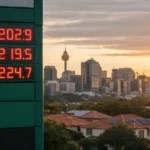
Australia’s auction market has lost momentum fast.
The national clearance rate fell to 56.9 per cent last weekend, according to the AFR’s report, marking the weakest result in more than 15 months outside the usual holiday slow patch. Separate coverage using Cotality data put the national result at just under 57 per cent, with Sydney around 55 per cent, telling much the same story: buyers have become harder to move, even as homes keep coming to market.
That matters because auctions are one of the clearest real-time reads on housing demand. When clearance rates slide while volumes stay elevated, it usually means one thing: buyers are still watching, but fewer are willing to stretch.
And right now, they have reasons not to.
Back-to-back rate hikes have pushed borrowing costs higher just as geopolitical risk is feeding fresh uncertainty into inflation, petrol prices and household confidence. The Reserve Bank said in its March 2026 Financial Stability Review that conflict escalation in the Middle East has increased risks to the global financial system and contributed to sharp market moves. The same review said most borrowers remain resilient, but some households will face growing pressure if conditions worsen.
So what does that mean in plain English?
It means the property market is not falling apart, but the part of the market that depends on confidence, leverage and emotional bidding is clearly under pressure.
What changed, and what didn’t
What changed is buyer conviction.
Cotality’s latest weekly auction previews show clearance rates fading as auction numbers rise. In the week ending 22 March, the combined capitals preliminary clearance rate slipped to 62.7 per cent, the weakest so far this year, while 2,857 homes went under the hammer. For the following week, more than 4,000 auctions were expected ahead of Easter, a seasonal peak for listings activity.
What did not change is supply behaviour. Sellers are still showing up.
That is the key tension in this market. Stock is building, but the bid depth is thinning. When that happens, homes can still sell, but it becomes harder to get multiple committed buyers into a fast-moving contest. The result is more passed-ins, more post-auction negotiations and more pressure on vendor expectations. The Guardian’s reporting, again drawing on Cotality data, described the recent January-to-March drop in clearance rates as the biggest for that part of the year since the pandemic.
Why buyers are stepping back
The first reason is simple: money got dearer.
Canstar estimated before the March move that a further 25 basis point hike would push the average owner-occupier variable rate to 6.01 per cent. It also said one additional hike could cut an average borrower’s maximum budget by roughly $12,000, or about $24,000 for a couple on two average incomes.
That sounds manageable until you remember how auctions work. A buyer does not need a huge borrowing hit to change behaviour. Even a modest reduction in capacity can mean stopping one bid earlier, refusing to chase a reserve, or staying home altogether.
Now add uncertainty.
The RBA has already warned that escalating geopolitical tensions could spill into Australia through higher financing costs, tighter credit conditions and weaker confidence if global markets reprice sharply. That does not automatically mean a housing downturn. But it does make households more cautious, especially when they are already recalculating repayments.
Now, the part most people miss: auction weakness is often less about distress than hesitation.
A softer clearance rate does not always mean forced selling. It can also mean buyers are refusing to pay last month’s price while sellers are still anchored to it.
The market is softer, but not equally soft everywhere
This is not one national market moving in one clean line.
Cotality’s weekly data shows conditions remain uneven across capitals. In the week ending 22 March, Melbourne’s preliminary clearance rate was 64.2 per cent, Sydney’s 60.8 per cent, Brisbane’s 65.3 per cent, Adelaide’s 65.4 per cent, and Canberra’s 53.0 per cent. That spread matters because it shows sentiment is weakening broadly, but not uniformly.
It also helps explain why broad national headlines can be misleading.
A tight, affordable family-home segment with finance-ready buyers can still perform reasonably well. A prestige or inner-city market that depends on discretionary upgraders can feel much weaker very quickly. Reporting this week suggested Sydney’s inner areas are already behaving more like a buyer’s market, while some outer suburban markets remain more resilient.
That is classic cycle behaviour. When credit gets tighter, the most rate-sensitive and expectation-heavy parts of the market usually wobble first.
Key numbers
-
National auction clearance rate: 56.9% in the AFR report.
-
Combined capitals preliminary clearance rate: 62.7% for the week ending 22 March.
-
Sydney preliminary clearance rate: 60.8% for that week, with separate reporting putting the latest final-style result near 55%.
-
Expected auctions in the week of 23 March: just over 4,000, the busiest pre-Easter stretch since late 2021.
-
Estimated average owner-occupier variable mortgage rate after March hike: 6.01%.
What could derail this view
There are three obvious swing factors.
The first is the RBA.
If rates hold from here and inflation fears settle, buyer confidence could recover faster than the current auction data suggests. A weak auction month does not lock in a weak year. On the other hand, if another hike lands in May, the current hesitation could turn into a more durable slowdown. Some market expectations and bank forecasts reported this week still point to another move higher.
The second is listings.
If sellers pull stock rather than meet the market, clearance rates can improve without much real improvement in demand. Auction metrics matter, but they do not tell the whole story on their own. Cotality notes that final clearance rates are revised as more results are collected, and withdrawn properties are counted in the denominator, which can drag the number lower.
The third is labour market resilience.
The RBA’s March review still says most borrowers are in a solid position and that the financial system is well placed to absorb shocks. That matters because housing downturns usually become more serious when higher rates meet rising unemployment. We are not clearly there yet.
What this means if you are actually making a decision
If you are a buyer, this is a market to stay disciplined in, not a market to fear.
Lower competition can create openings, especially at auction, but only if your finance is tight and your price limit is real. The mistake in a softer market is assuming every property will come back to you cheaper. Some will. Some will not. The right move is to know your ceiling before the campaign, not after the first passed-in result.
If you are a seller, the old playbook is getting riskier.
A busy campaign and a big crowd do not guarantee a strong outcome when borrowing capacity is shrinking. If the home is not scarce or unusually well-positioned, buyers may simply wait you out. That makes price guidance, reserve discipline and backup negotiation strategy more important than the theatre of auction day.
If you are an investor, keep your eye on second-order effects.
The big issue is not just whether rates stay higher for longer. It is whether a slower turnover market starts feeding into softer price growth, longer selling times and more vendor discounting in pockets that had been priced for perfection. That is where opportunity can appear, but only if the cashflow buffer is there.
The latest auction slump does not prove the housing market is rolling over.
But it does show the market has become more fragile.
Higher rates have reduced borrowing capacity. Geopolitical risk has added another layer of uncertainty. Sellers are still coming forward, but buyers are no longer bidding as though the only risk is missing out. That shift alone can change the tone of a market quickly.