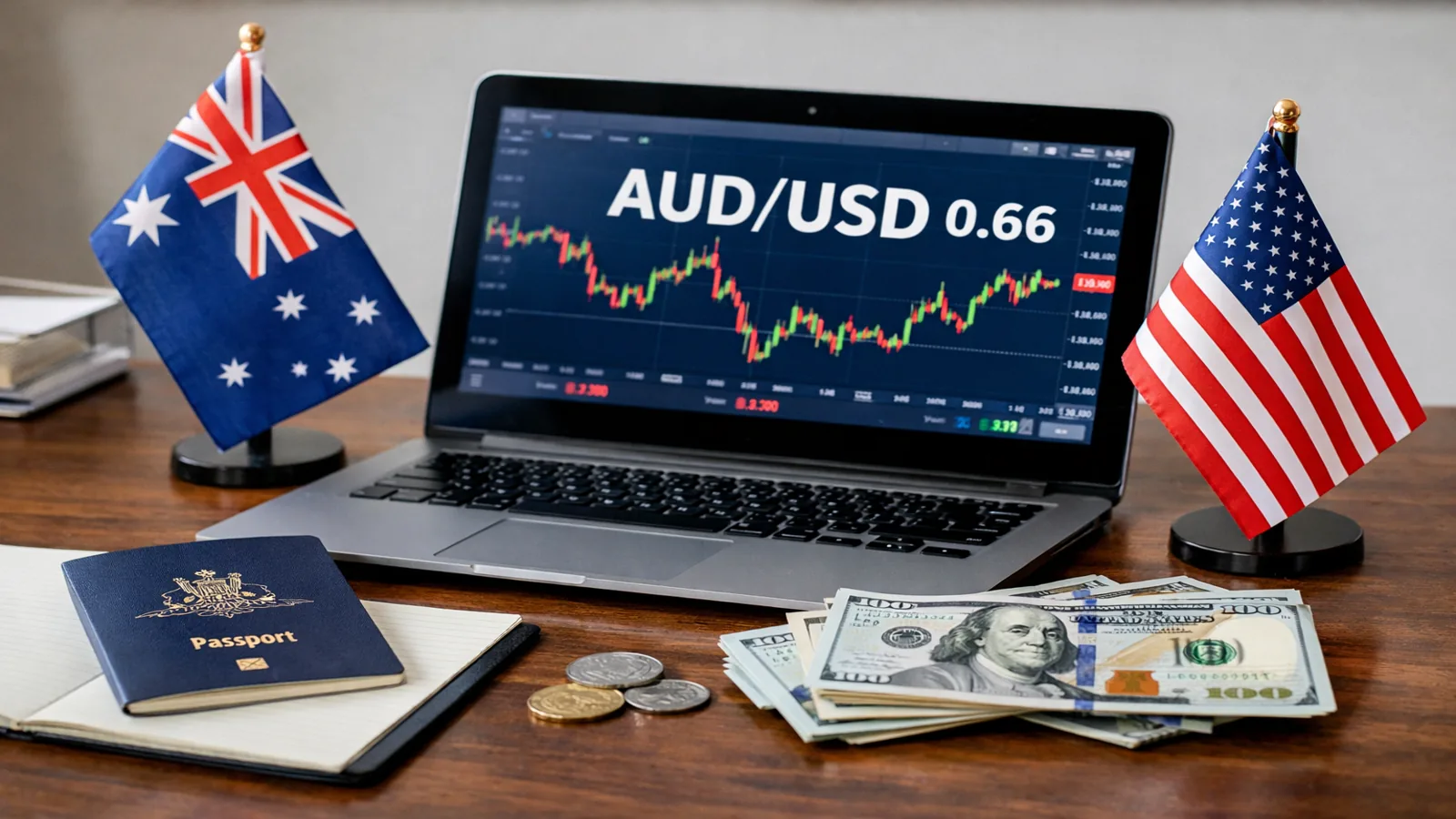
The Australian dollar has pushed above US70c, after sitting closer to the low 60s not long ago. As at 20 March 2026, the RBA’s published exchange rate had the Australian dollar at US$0.7088. At the same time, the RBA cash rate is 4.10% after its March decision, while the US Federal Reserve has kept its target range at 3.5% to 3.75%.
That move matters. Not because currency charts are exciting on their own, but because they quietly change the maths for Australian investors with US shares, offshore cash, global ETFs and future travel spending.
A stronger Aussie dollar can make Americans assets cheaper to buy today. It can also shrink what your offshore gains are worth when you bring them home.
That is the part many investors miss.
Signal vs noise
Signal: the Australian dollar has rebounded sharply and is now back around fair-value territory against the US dollar.
Noise: that does not automatically mean it keeps rising, and it does not mean every investor should rush to hedge.
The practical question is simpler: if you earn, spend and measure your wealth in Australian dollars, how much currency risk are you really carrying?
Why the Aussie dollar has lifted
Currencies usually move on relative strength, not absolute stories. The Australian dollar is not rising in a vacuum. It is rising against a US dollar that has lost some momentum, while Australia’s rate settings have moved in a more hawkish direction than many expected.
The RBA lifted the cash rate to 4.10% on 17 March 2026, while the Fed held steady on 18 March 2026. That interest-rate gap matters because higher rates can make a currency more attractive by improving returns on cash and short-term assets.
There is also the commodity angle. Australia still behaves, to a degree, like a resources-linked currency. When commodity demand, export income or terms of trade hold up, the Aussie can get support. That relationship is not perfect day to day, but it still matters over time. The RBA has also noted that the exchange rate can act as an automatic stabiliser for the economy when global conditions shift.
Now add the US side. Recent reporting shows markets are re-pricing the US dollar as the Fed signals caution rather than an aggressive tightening path, while other inflation and geopolitical pressures are moving global rate expectations around.
So the move is real. But that does not make it simple.
What it means for Australian investors
If you own US shares from Australia, you are taking two bets whether you realise it or not.
The first is the asset itself. Apple, Nvidia, Microsoft, the S&P 500, whatever you hold.
The second is the currency.
Here’s a plain-English example.
Say you bought a US share portfolio when the Aussie dollar was US62c. If the shares went nowhere, but the Aussie dollar later rose to around US71c, part of your gain in local terms disappears when you convert the money back to Australian dollars. That is because each US dollar now buys fewer Australian dollars than it did before. The RBA’s recent daily exchange-rate data shows the Aussie has traded around that US70c to US71c zone in recent days.
So yes, a stronger Aussie can help when you are buying US assets. But it can hurt when you are valuing or repatriating them.
That is the catch.
The catch investors keep underestimating
A lot of people treat currency as background noise until it hits performance.
That is a mistake.
If you hold offshore assets for years, exchange-rate moves can become either a tailwind or a drag on total return. In some periods, the currency effect is small and washes out. In other periods, it is material enough to overwhelm a decent chunk of the asset return.
The mistake is not just ignoring currency risk. It is also overreacting to it after the big move has already happened.
That matters now because the easy move may already be behind us. The Aussie has already done the hard yards from the low 60s back toward US70c. The further it rises from here, the more the market will need fresh reasons to keep pushing it higher.
Should you hedge your currency exposure?
Sometimes yes. Often, not fully.
A currency hedge is a strategy that tries to reduce the impact of exchange-rate movements on your portfolio. For everyday investors, that usually means choosing a hedged ETF rather than building your own options or forward contracts.
That distinction matters.
Large importers and exporters often use forward contracts because they have known future payments. Investors usually do not. Most retail investors are better off thinking in terms of portfolio construction, not trying to become a part-time currency trader.
There are really three broad choices.
1. Stay unhedged
This is the simplest approach.
You accept that the currency will move around, and you focus on the long-term asset return. For investors with a long horizon and regular contributions, this often makes sense. It keeps costs lower and avoids turning every market decision into a timing call.
2. Use partially hedged exposure
This is often the middle ground.
You keep some exposure to global markets, but reduce the size of the currency swing. That can make sense if your offshore allocation is large, or if you know you may need to bring money back to Australia in the next one to three years.
3. Fully hedge
This is the most defensive option on currency.
It may suit investors who are less interested in US-dollar exposure and more interested in the underlying asset return alone. But full hedging is not free. It can add costs, reduce flexibility and create frustration if the currency moves in your favour after you hedge.
So what does that mean in plain English?
Hedging is not just protection. It is also a bet on timing.
Rule of thumb
If the money is likely to stay invested for many years, simplicity usually beats precision theatre.
If the money may need to come back to Australia soon, currency risk matters more.
That is the decision checklist.
Why this matters for property-minded Australians
This is where the story becomes relevant to APReview readers.
Many Australian investors do not think of themselves as “currency investors”. But if you hold:
-
US ETFs in super
-
offshore shares in a brokerage account
-
cash sitting in US dollars
-
global managed funds
-
future borrowing or spending plans linked to offshore assets
you already have currency exposure.
And if your financial life is still based in Australia, the exchange rate can affect real borrowing capacity, portfolio value, renovation budgets, travel costs and cashflow buffers.
A stronger Aussie can help if you are sending money offshore to invest. It can also make imported goods, software, travel and some equipment relatively cheaper. But if you are counting on offshore gains to support a property deposit, debt reduction or cashflow here, the exchange rate becomes more than a market curiosity.
It becomes personal.
What could break this move
This is the risk check.
The current currency story relies on a few things continuing to hold:
-
Australia keeping a relatively firmer rates profile
-
commodity support remaining intact
-
the US dollar not regaining clear safe-haven momentum
-
markets not swinging hard back to a risk-off position
Any of those can change.
The Fed’s latest statement kept rates unchanged, but it also stressed that it will assess incoming data and risks carefully. That leaves room for the US dollar story to shift again.
On the Australian side, the RBA has tightened again, but that does not remove the risk of slower domestic growth, softer households or a policy rethink later if conditions weaken. Reuters also reported the March RBA hike was a close decision, which tells you this is not a one-way conviction trade inside the Board.
That is why treating US70c as a certainty, rather than a level the market is testing, would be lazy analysis.
Base case, upside, downside
Base case
The Aussie dollar spends time around current levels, with plenty of volatility but no clean breakout. For most long-term investors, that argues for calm rather than cleverness.
Upside case
The Australian dollar pushes further above US70c if local rates stay relatively firm, commodities hold up and the US dollar softens further. In that case, unhedged offshore portfolios face a larger currency drag in Australian-dollar terms.
Downside case
The US dollar firms again on global stress, geopolitics, growth concerns or a more hawkish US rates path. In that case, investors who rushed to hedge late may discover they paid for protection at the wrong time.
Probabilities, not certainties.
The practical take
If you have a small offshore allocation and a long time horizon, there is a strong case for doing very little. Currency swings can look dramatic in the moment but often matter less than asset quality, behaviour and time in the market.
If you have a large offshore portfolio, or you expect to use that money in Australia within the next few years, review whether your exposure still fits the job you need it to do.
Start with three questions:
-
What percentage of my investable wealth is exposed to foreign currency?
-
When might I need this money back in Australian dollars?
-
Am I investing, or am I quietly speculating on exchange rates?
That third question is the one that cuts through the spin.
Bottom line
The stronger Aussie dollar is not just a headline about travellers getting better value overseas. It is a real shift in the return profile for Australians holding offshore assets.
The risk is not that the currency moved. The risk is reacting to that move too late, with too much confidence, and too little regard for costs, timing and trade-offs.
For most investors, the smartest response is not to become a currency trader. It is to know where the exposure sits, decide whether it still matches the plan, and avoid confusing a tactical hedge with a long-term strategy.
If you want the weekly signal, not the noise, subscribe to Australian Property Review.