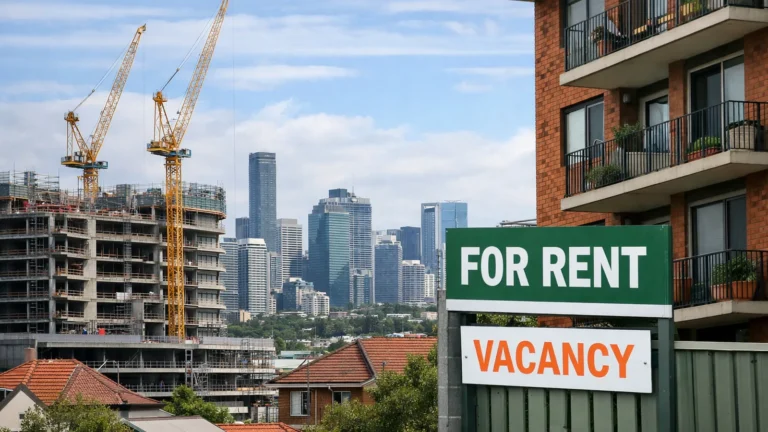
Australia housing affordability has moved into a more uncomfortable phase.
The latest State of the Housing System 2026 report from the National Housing Supply and Affordability Council shows two things can be true at once.
The supply outlook has improved.
Affordability has still gone backwards.
That is the tension buyers, renters and investors need to understand. More homes are expected than previously forecast, but not enough to quickly undo the pressure already sitting in rents, prices and household budgets.
The national story is not “nothing is working”. It is sharper than that. Some supply indicators are finally moving in the right direction, but the relief is arriving slowly while housing costs are still moving through household budgets now.
The number renters cannot ignore
The clearest pressure point is rental affordability.
The Council says the share of median household income needed to rent a new lease rose to 33.1 per cent in the December quarter of 2025. That was above the 10-year average of 29.1 per cent and the worst level recorded in the report’s affordability measure.
In plain English, the median renter looking for a new lease is being asked to hand over about one-third of gross household income before other costs are considered.
That matters because advertised rents affect people at the point of decision. They hit the household that has to move, the family facing a lease renewal, the worker relocating for a job and the first-home buyer still trying to save a deposit while renting.
Regional renters are under even more pressure. The report puts the rent-to-income ratio for new leases at 35.4 per cent in regional areas, compared with 31.4 per cent in capital cities.
That does not mean every regional town is unaffordable. It means the old assumption that regional Australia is automatically the cheaper escape route is weaker than it used to be.
Key numbers
- New-lease rent-to-income ratio: 33.1 per cent nationally in December 2025
- Regional rent-to-income ratio: 35.4 per cent
- Capital city rent-to-income ratio: 31.4 per cent
- Years to save a 20 per cent deposit: 11.2 years for a median-income household
- Estimated gross new housing supply over the Accord period: 980,000 homes
What changed, and what did not
What changed is the supply outlook.
Before recent global disruptions to commodity prices and supply chains, the Council estimated Australia was on track to deliver about 980,000 gross new homes over the five-year National Housing Accord period. That is 42,000 more homes than its previous State of the Housing System 2025 forecast.
That is a real improvement.
Building approvals and commencements picked up through 2025, and the Council points to zoning reforms in New South Wales and Victoria as part of the supply story. Higher prices also helped project feasibility in some markets, because stronger end values can make new developments easier to justify.
What did not change is the scale of the shortfall.
The Accord target is 1.2 million new homes by June 2029. The Council’s early 2026 outlook suggested that target would not be reached until the September quarter of 2030, a little over a year late.
That is the part most people miss.
A better forecast is not the same thing as a solved housing shortage.
Australian Property Review has already looked at the gap between approvals and actual homes in Dwelling approvals jumped, but Australia’s housing fix still looks shaky. The same logic applies here. Approvals are helpful, but households do not live in approvals. They live in completed homes.
Why affordability keeps getting worse
The mechanics are not complicated.
Australia has had strong housing demand for years, driven by population growth, income growth, household formation and the preference for living near jobs, schools and services. Supply has not kept up cleanly enough, especially in places where people most want to live.
When supply is tight, rents rise.
When supply is tight and borrowing capacity improves, prices can rise too.
The Council says national dwelling prices rose 8.8 per cent over 2025, then another 2.1 per cent over the first three months of 2026. Rent growth eased from the recent peaks, but remained historically high.
That is why Australia housing affordability can worsen even when some indicators look better.
A renter does not feel better because future supply might improve in 2028. A buyer does not get a cheaper deposit hurdle because a project was approved last month. And an investor does not automatically get safer cashflow because national vacancy rates might gradually lift later.
Timing matters.
Buyers face a deposit problem, not just a repayment problem
The report says home purchase affordability also deteriorated.
A median-income household needed 11.2 years to save a 20 per cent deposit in the December quarter of 2025, assuming it could save 15 per cent of gross income each year.
That is a brutal hurdle.
Mortgage repayment affordability improved slightly in 2025 after interest rate cuts, but the Council still puts the new mortgage repayment-to-income ratio at 45.9 per cent nationally.
So the buyer problem has two layers.
First, getting the deposit together takes longer.
Second, even after buying, the repayment load remains high.
For first-home buyers, this is where policy can get messy. Deposit schemes can help some households enter earlier. But when supply is tight, demand-side support can also push more buyers into the same lower-price band.
Australian Property Review has covered that broader pressure in Australia Is Short 262,000 Homes. Will Prices Surge Again?, where the key issue was not just the size of the shortage, but how policy support can interact with tight stock.
The rule of thumb is simple: buyer support helps most when supply can respond. When supply is slow, support can turn into extra competition.
The construction risk sitting behind the forecast
The supply outlook is better, but it is not clean.
The Council warns that construction costs, project feasibility, labour shortages and global shocks could still derail delivery.
Its report models two scenarios linked to higher fuel and petrochemical costs from the Middle East conflict.
In the shorter-term scenario, a 6 per cent peak increase in construction costs could reduce dwelling completions by around 10,000 over the Accord period.
In the more prolonged scenario, a 10 per cent peak increase in construction costs could reduce completions by around 33,000.
These are not predictions to treat as guaranteed. They are stress tests.
The point is that higher construction costs can turn viable projects into marginal projects. That matters most for apartments and higher-density housing, where financing, labour, materials and time risk are harder to manage.
Here’s the catch.
Australia needs more higher-density homes in well-located areas, but those are often the projects most exposed to feasibility pressure.
That is why construction costs are not just a builder problem. They are a rental market problem, a buyer affordability problem and a government delivery problem.
Who feels it first
Renters feel it first because lease prices adjust faster than new supply.
First-home buyers feel it next because they compete in the same lower-priced segments where affordability pressure is strongest.
Investors feel it through cashflow, yields, maintenance costs and vacancy risk. A tight rental market can support rents, but that does not remove the need for a buffer. Insurance, strata, land tax, repairs and interest costs can still eat into returns.
Developers feel it through feasibility. If sale prices, rents or government support do not justify the build cost, projects can be delayed, redesigned or shelved.
Governments feel it politically, because the gap between targets and completions is now easy to measure.
The tax debate is not going away
The Council also says governments should review whether tax settings are affecting how households buy, sell or rent homes.
That is not a small point.
Stamp duty can discourage people from moving. Investor tax settings can shape rental supply and demand. Land tax changes can alter investor behaviour. First-home buyer concessions can lift purchasing power but also add heat to the entry-level market.
None of this means one tax change fixes housing affordability.
It means the tax system is part of the machine.
Australian Property Review has unpacked this wider issue in Property tax perks and housing affordability. The practical point is that investors should stop treating tax reform as background noise. It can change returns, holding costs and buyer behaviour.
What could derail the better supply story
There are four risks worth watching over the next 6 to 12 months.
First, approvals may not convert into completions quickly enough. That is the classic supply pipeline problem.
Second, construction costs could rise again, especially if transport, fuel, materials or labour pressures worsen.
Third, interest rates could keep feasibility under pressure. Higher finance costs affect buyers, builders and developers.
Fourth, demand-side policies could add competition before supply arrives. That can support prices while doing little for affordability.
The base case is that supply improves gradually, but not fast enough to deliver quick relief.
The upside case is that approvals keep rising, projects remain viable and vacancy rates slowly normalise.
The downside case is that costs rise, completions disappoint and renters remain stuck in a tight market for longer.
Bottom line
Australia housing affordability is not improving just because the supply forecast looks better.
The important distinction is timing.
The system may be moving in a better direction, but households are making decisions in the present. Rents are already high. Deposit hurdles are already stretched. Mortgage repayments are still elevated. And the national housing target still looks late.
For readers, the practical next step is to pressure-test any property decision against slower relief, not instant relief.
If you are renting, assume competition remains tough and build a moving-cost buffer.
If you are buying, test repayments at higher rates and do not rely on future capital growth to fix today’s stretch.
If you are investing, model your numbers with conservative rent growth, higher holding costs and a vacancy allowance.
Start here: run your next property decision on a downside case, not the headline forecast.
Subscribe to the free Australian Property Review newsletter for the weekly signal
General info, not financial advice.