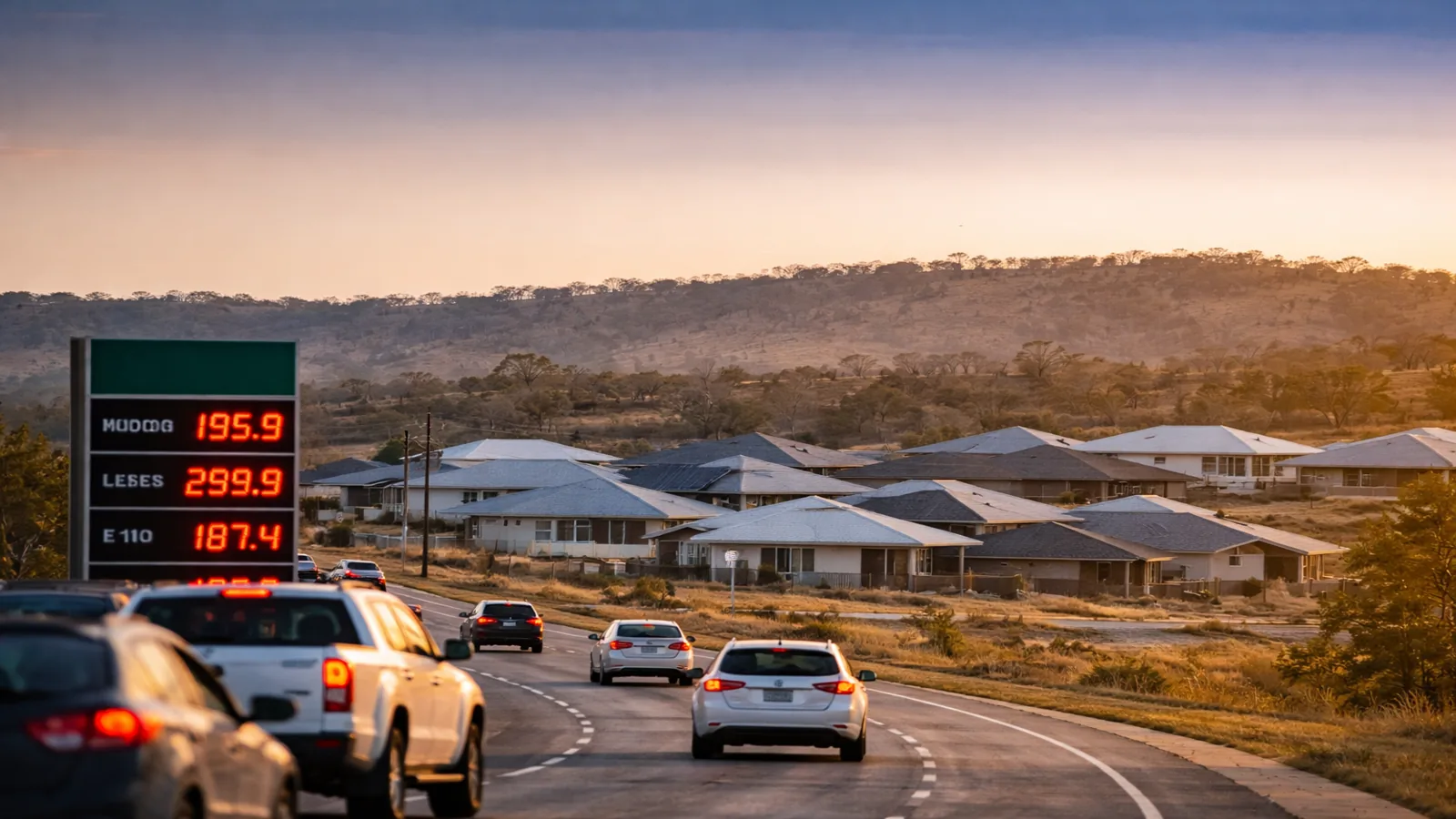
Regional Australia has sold one of the strongest property stories of the past few years: more space, lower entry prices, lifestyle appeal and, for a while, a work-from-home tailwind that made distance from the CBD feel less important.
For investors, the pitch looked even better. Strong population inflows supported demand. Some coastal and lifestyle markets posted outsized price growth. Tenants followed owner-occupiers into markets that once looked secondary and started behaving more like established metro fringes.
Now comes the pressure-test.
The regional boom was never only about housing. It was also about transport, fuel, commute patterns and whether households could absorb the hidden costs of living further away from major services. When petrol and diesel prices jump, that trade-off starts to look very different.
That matters for property because affordability is not just the mortgage. It is the full weekly cost of holding a life together.
The part the market may have underpriced
A lot of regional demand was built on a simple equation: cheaper homes offset the inconvenience of distance.
That worked when credit was easier, fuel was manageable and buyers still felt they were getting a clear discount to city prices. It also worked when households believed flexible work would remain common enough to reduce the pain of long drives.
But some of the most popular regional markets are no longer cheap in any meaningful sense. In several lifestyle corridors, prices have risen to levels where the gap with capital cities has narrowed sharply. Once that discount shrinks, the carrying cost of regional living matters more.
Now add high fuel costs to the mix.
For many households in regional Australia, driving is not discretionary. It is the school run, the supermarket trip, the commute, the sport pickup, the medical appointment and the link to the nearest major centre. In other words, transport is not a lifestyle extra. It is a fixed household expense.
That is where the catch sits for investors. A market can still look attractive on a headline median, but if tenants and owner-occupiers are facing rising non-housing costs every week, the amount they can comfortably devote to rent or repayments gets squeezed.
Why this matters for investors, not just owner-occupiers
It is easy to read fuel stress as a household issue and stop there. Property investors should not.
When a market is highly car-dependent, fuel prices can act like a second interest rate. They reduce household cashflow, weaken perceived affordability and can change how buyers rank one location against another.
That can hit investment performance in three ways.
First, buyer demand can soften at the margin. The next purchaser may still like the region, but become more price-sensitive once the real cost of distance becomes obvious.
Second, tenant budgets come under pressure. That does not automatically mean rents fall, especially in tight markets, but it can cap how far rents can keep rising before resistance builds.
Third, the quality of demand matters. A market driven by necessity and local incomes behaves differently from one driven by optimism, migration and lifestyle aspiration. When the aspirational buyer steps back, momentum can fade quickly.
This does not mean every regional market is about to roll over. It means investors should stop treating “regional” as one story.
What changed, and what did not
What changed is the cost backdrop.
The regional investment case was easier to make when mortgage stress, fuel bills and infrastructure gaps felt manageable. A fuel shock changes the psychology as much as the budget. Once households start worrying about availability, queues or repeated price spikes, they reassess the whole value proposition of where they live.
What has not changed is the underlying infrastructure problem.
Many high-growth regional corridors still depend heavily on private vehicles because public transport is limited, fragmented or simply not practical for daily life. In plain English, the growth arrived faster than the transport system did.
That is not a small policy failure. It shapes housing demand, household resilience and long-run property values.
If population growth keeps running ahead of transport investment, then part of the recent regional price strength may prove less durable than recent performance suggests.
Some regional markets may have enjoyed a “lifestyle premium” without fully pricing in a “transport risk discount”.
That discount tends to stay invisible until fuel costs spike, commuting becomes harder, or buyers realise city convenience was worth more than they thought.
Not every region wears the same risk
This is where investors need to get more specific.
A well-connected regional city with diverse jobs, solid local services and improving transport links is different from a lifestyle market that depends on long car trips for almost everything.
Likewise, a region with strong local employment is different from one that still relies heavily on commuters, retirees or inward migration from the capitals to support demand.
The more a location depends on private vehicles, the more exposed it is to prolonged fuel stress. The more stretched prices already are relative to local incomes, the less room there is for buyers to shrug that off.
That does not kill the regional thesis. It narrows it.
The strongest regional investment story from here is likely to be in places where buyers are not just purchasing amenity, but also buying into decent access to schools, jobs, health services and transport options. That is less romantic than the sea-change dream, but usually more durable.
What could derail the bearish case
There are clear offsets.
If fuel prices ease quickly, this pressure may fade before it has a meaningful impact on prices. If rate cuts improve cashflow, households may absorb the extra transport cost more easily. If migration into selected regional hubs stays strong, demand may remain firm despite cost pressures.
There is also the rental shortage factor. In some markets, low vacancy can keep rents supported even when household budgets are stretched.
That is why this is not a call to write off regional property. It is a reminder to separate markets with real economic depth from markets that have been riding momentum.
Investors should think in scenarios, not headlines.
Base case: demand cools, but quality regional centres remain resilient.
Downside: stretched lifestyle markets lose momentum as affordability and transport costs bite together.
Upside: fuel stress proves temporary and regional demand stabilises once cost pressures ease.
The practical take
If you are looking at a regional investment property now, do not stop at yield, vacancy and recent growth.
Pressure-test the transport reality.
Look at how far tenants need to drive for work, school and essentials. Check whether the suburb functions with one car or requires two. Ask whether the local economy supports demand without relying on constant inflows from metro buyers. And most importantly, model the location as if higher fuel costs persist longer than expected.
Now, the part most people miss: when a market looks affordable on paper but expensive to live in, that gap eventually matters.
The regional boom was built on more than lifestyle. It was built on a cost equation. If the transport side of that equation breaks, investors cannot assume recent gains will keep doing the heavy lifting.