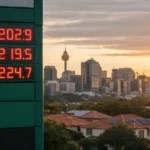
Australians are being hit from both sides of the household ledger.
On one side, everyday costs are climbing again. Petrol is jumping, grocery bills are already higher, dining out is getting pricier and utility costs remain stubborn. On the other, incomes are not keeping up. That is the part that matters most. Inflation hurts. Inflation with weak wage growth hurts more.
For property investors, homeowners and anyone trying to hold a family budget together, this is not just another cost-of-living story. It is a warning about what happens when an oil shock leaks into everything else.
The immediate pressure starts at the bowser. But it rarely ends there.
Higher fuel costs raise transport bills, freight costs and business overheads. That flows into supermarket shelves, restaurant menus and delivery networks. Add higher mortgage repayments and elevated rents, and the squeeze stops looking temporary. It starts looking structural.
That is why the latest warnings matter. Treasury modelling has opened the door to inflation pushing higher again if oil stays elevated. Some analysts think the oil market could remain under pressure for longer if conflict persists. If that happens, the pain will not be limited to commuters filling up once a week. It will move across food, services and housing, hitting the same households from multiple directions.
And that is where the political problem begins.
A government can talk about resilience, moderation and long-term reform. Households live in weekly cash flow. They do not experience inflation as a theory. They experience it as a grocery trolley with less in it, a fuel tank that costs more to fill, and a mortgage repayment that does not care what Treasury hoped would happen six months ago.
Now, the part most people miss.
This kind of inflation shock does not land evenly. It lands hardest on households already carrying the least margin for error. Lower-income families spend more of their pay on essentials. Recent home buyers have less room to absorb higher repayments. Families in outer suburbs and regional areas often drive more, spend more on transport, and have fewer easy substitutes when fuel jumps. In plain English, the people with the thinnest buffers usually get hit first and hardest.
That matters for the property market too.
When essential costs rise faster than wages, borrowing power weakens in practice even before banks formally change anything. A household might still qualify for a loan on paper, but feel much less willing to stretch. That can soften demand at the margin, especially in price-sensitive suburban markets. It can also keep pressure on arrears risk, household savings and consumer confidence.
This is why the inflation story cannot be separated from rates.
If price pressures stay sticky, the Reserve Bank has less room to ease. If rates stay high for longer, mortgage stress lingers. If mortgage stress lingers while wages disappoint, consumption weakens. And when consumption weakens, the economy slows just as households are paying more for basics. That is a nasty mix. Not a collapse scenario, but a squeeze scenario, and those can drag on longer than people expect.
The other second-order effect is behavioural. Households cut back where they can. Dining out is usually one of the first casualties. Big-ticket purchases get delayed. Subscriptions get reviewed. Family budgets become more defensive. That may sound sensible, and often it is, but at scale it also means weaker discretionary spending for small business, weaker turnover in parts of the economy, and another feedback loop into slower growth.
The core problem is not just higher prices. It is higher prices arriving while wage growth fails to keep pace and interest-rate pressure remains alive.
For investors, that does not automatically mean panic. But it does mean the story has changed.
The old habit in Australian property was to treat inflation as broadly supportive for hard assets and assume housing would eventually power through. Sometimes that is true. But inflation driven by an external energy shock is messier. It lifts costs before it lifts confidence. It can keep rates restrictive. And it can weaken household demand in exactly the markets where affordability is already stretched.
So what does that mean in plain English?
It means this is a cash-flow environment first, and a capital-growth environment second. Investors carrying thin buffers should be pressure-testing their repayments, vacancy assumptions and maintenance budgets now, not later. Owner-occupiers should be looking at every recurring cost with fresh eyes, because the easiest savings are often hiding in plain sight: banking, power, insurance, phone plans, fuel habits and supermarket routines.
The practical politics are harder. Households do not care whether inflation comes from oil, war, supply chains or modelling assumptions. They care whether the weekly budget still works. That is why broad reassurance will not cut through if the lived experience keeps getting worse.
This is also where a centre-right, household-budget lens matters. Families in suburban and regional Australia do not need polished language about temporary pressure. They need policymakers to understand that every extra dollar on petrol, food and power strips flexibility out of the rest of the household balance sheet. When that happens at the same time as higher repayments and weak real wage growth, the burden is not abstract. It is immediate.
What changed is clear enough: petrol has become the new trigger point in a broader inflation problem. What has not changed is just as important: households were already under strain before this latest shock arrived.
That is the catch.
This is not a fresh crisis landing on a healthy household sector. It is an extra weight added to a budget already carrying mortgage stress, rent pressure and slower real income growth. That is why even modest further price increases can do outsized damage.
The base case is not that every household falls over. It is that more households are forced into harder trade-offs. Fewer meals out. Less discretionary spending. More refinancing. More demand for bill relief. More pressure on businesses exposed to consumer weakness. And in property, a market that stays more sensitive to bad news than many sellers would like.