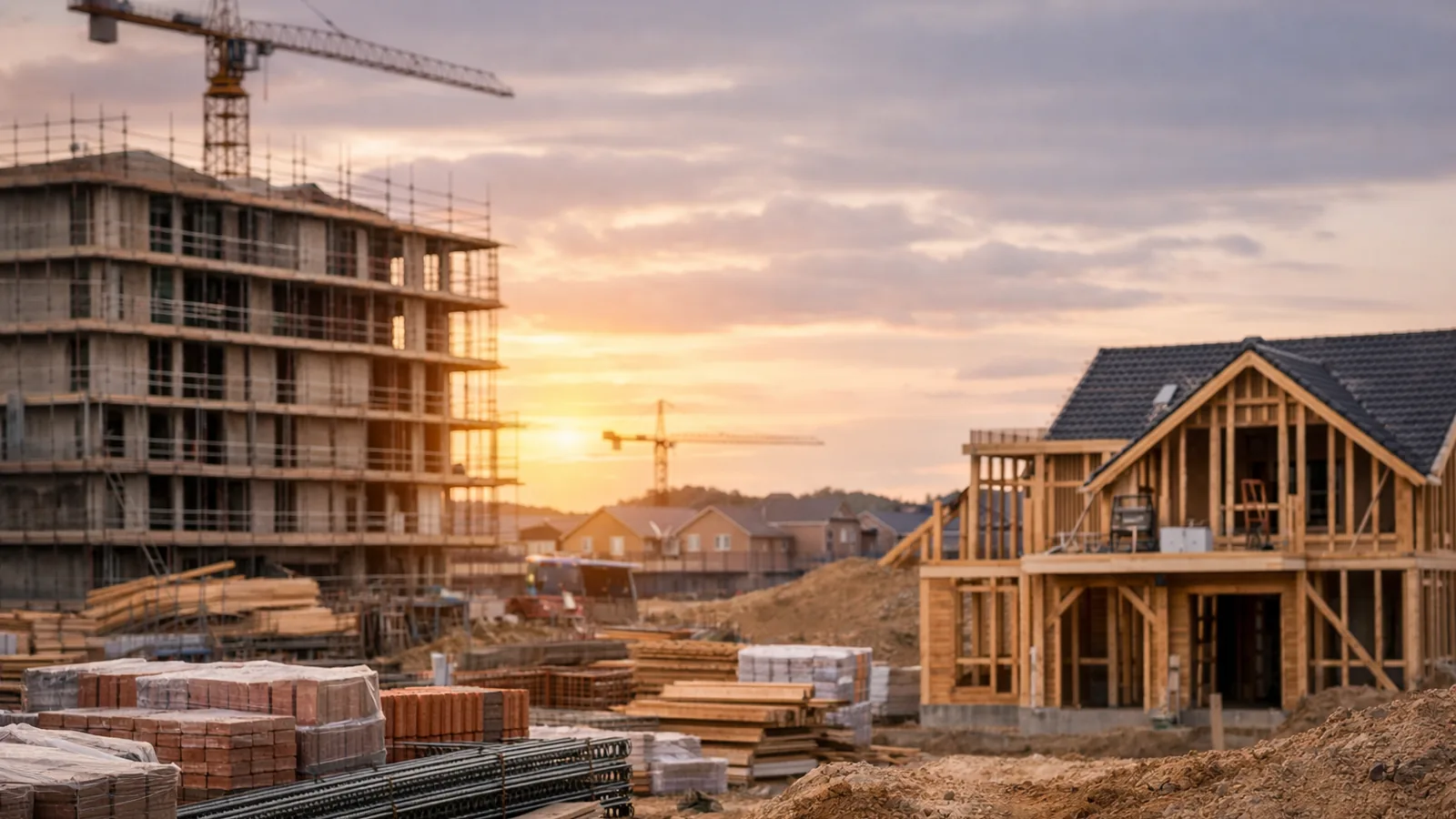
Labor built a lot of political weight around housing. The pitch was simple enough: lift supply, ease affordability pressure and prove government could move beyond slogans. The problem now is that the numbers are moving the other way.
Australia’s target of 1.2 million new homes was always ambitious. It needed planning systems to work faster, builders to stay solvent, projects to stack up financially and states to keep land, infrastructure and approvals moving at speed. That was before new pressure hit construction costs again.
Now the target is drifting further out of reach, and not by a small margin.
Industry forecasts are pointing to a miss of more than 200,000 homes. That matters because housing policy is not judged by press releases or summits. It is judged by completions. If homes are not being built fast enough, the promise starts to look more like a headline than a plan.
What changed, and what didn’t
What changed is the size of the gap. The housing target was already under pressure from weak productivity, labour shortages and planning delays. Now builders are warning that fresh supply chain strain and higher transport costs could make a bad pipeline worse.
What has not changed is the core problem. Australia still does not have enough homes coming through the system, especially where people actually want to live. The supply pipeline remains tight, project feasibility is fragile and higher-density construction is still struggling to fire at the scale the target assumes.
That is the part Canberra cannot spin away. A target is only credible if the delivery system underneath it is credible too.
The numbers are starting to tell a harder story
The most uncomfortable part for Labor is that this is no longer a theoretical risk. It is showing up in the gap between political ambition and physical output.
The latest warnings suggest the country is running well behind the pace needed to hit the Accord target. That should not be dismissed as routine industry lobbying. Even allowing for some advocacy in the numbers, the direction is clear: the pipeline is not strong enough, and the margin for error is getting smaller.
NSW is a good example of the strain. It carries a huge share of the national housing task, yet delivery has not kept pace with what is needed. When the largest state is behind, the national target quickly becomes harder to defend.
And here’s the catch. Housing misses are cumulative. If you fall behind early, you do not just need to keep going. You need to speed up later in a system that already struggles to do ordinary volumes efficiently.
Why the pipeline is weakening
This is not just a story about one war, one budget or one bad quarter. It is a story about a housing system that was already stretched before the latest shock arrived.
Builders are dealing with thin margins, financing pressure, labour scarcity and regulatory friction. Apartment projects are especially vulnerable because they are more complex, more capital-intensive and more sensitive to shifts in costs. That matters because detached houses alone were never going to carry a 1.2 million-home target.
Now add another layer. If fuel and freight costs rise, packaging, transport and materials costs usually follow. Even when the increase looks manageable on paper, it can be enough to push borderline projects from viable to delayed, or from delayed to dead.
I’ve seen this play out in property cycles before. Projects do not always collapse in dramatic fashion. More often, they just stop making sense. A developer waits. A builder reprices. A lender tightens. A site sits there longer than expected. That is how targets quietly slip.
This is where the political risk lands
Labor wanted housing to be a proof point. Instead, it risks becoming a vulnerability.
That is because the government is being squeezed from both sides. On one side, younger buyers and renters want more supply and lower pressure. On the other, the industry wants settings that make projects commercially possible. If neither side sees enough progress, frustration builds quickly.
The government can point to funding commitments, housing programs and productivity promises. But voters are unlikely to care much about policy architecture if the lived result is the same: not enough homes, built too slowly, at prices too high for too many households.
For a government that made housing central to its pitch, that is a serious problem.
The target is not failing because Australia forgot it needs more homes. It is failing because the country still cannot build enough of them fast enough, cheaply enough and predictably enough.
That is the mechanics in plain English. Demand has been strong for years. Population growth has added pressure. But the real bottleneck is supply capacity. Land release, approvals, infrastructure, labour and project economics all have to line up. Right now, they don’t.
The budget now matters more than the rhetoric
The next federal budget is shaping as a test of whether Labor is willing to prioritise actual housing delivery over housing language.
If the government is serious, it needs to focus less on branding and more on constraints. That means faster approvals, more enabling infrastructure, a bigger skilled construction workforce and tax settings that do not scare off private capital when private capital is still doing most of the building.
That last point is politically awkward, but important. You do not solve a supply problem by making new projects less attractive to fund. If policymakers want more housing, they need more builders building and more investors backing projects that can get out of the ground.
This is where the ideological fight starts. Labor wants to sound pro-supply while keeping its broader political coalition together. But housing is one of those areas where trade-offs cannot stay hidden for long. If policy settings reduce confidence, supply suffers. If supply suffers, affordability suffers too.
What could derail this even further
Several risks could push the shortfall wider over the next six to twelve months.
The first is cost volatility. If freight, fuel or imported materials keep rising, builders will stay cautious and more projects will stall at the feasibility stage.
The second is productivity. Australia’s construction sector has been underperforming for years. If that does not improve, simply throwing more announcements at the problem will not produce more homes.
The third is state execution. National targets rely on state planning systems, local approvals and infrastructure delivery. That chain is only as strong as its weakest link.
The fourth is policy confusion. If governments send mixed signals on tax, migration, regulation or investment returns, capital will wait on the sidelines. In housing, hesitation is enough to slow the pipeline.
What this means
If you are an investor, homeowner or buyer, the practical takeaway is straightforward: do not assume a big jump in supply is about to rescue affordability in the near term.
That does not mean prices only go one way. It means the supply relief story is weaker than the political messaging suggests. In many markets, that keeps a floor under rents and supports established housing where new stock remains constrained.
For investors, the rule of thumb is simple. Watch the supply pipeline in your specific market, not the national slogan. A city can miss a national target and still have local pockets of oversupply. The reverse is true as well.
For owner-occupiers, the main lesson is to pressure-test borrowing decisions against a world where affordability stays tight for longer than expected. Betting on a rapid surge in new housing to fix the market is not a strategy. It is hope.
Labor’s housing target is now facing the kind of test politicians hate most: reality.
The promise was bold. The delivery is lagging. And with costs rising again and the construction system still constrained, the gap is getting harder to close, not easier.
The political argument from here will be noisy. The economics are simpler. Australia cannot hit ambitious housing numbers without making it easier, faster and more profitable to build. Until that changes, the target remains vulnerable.