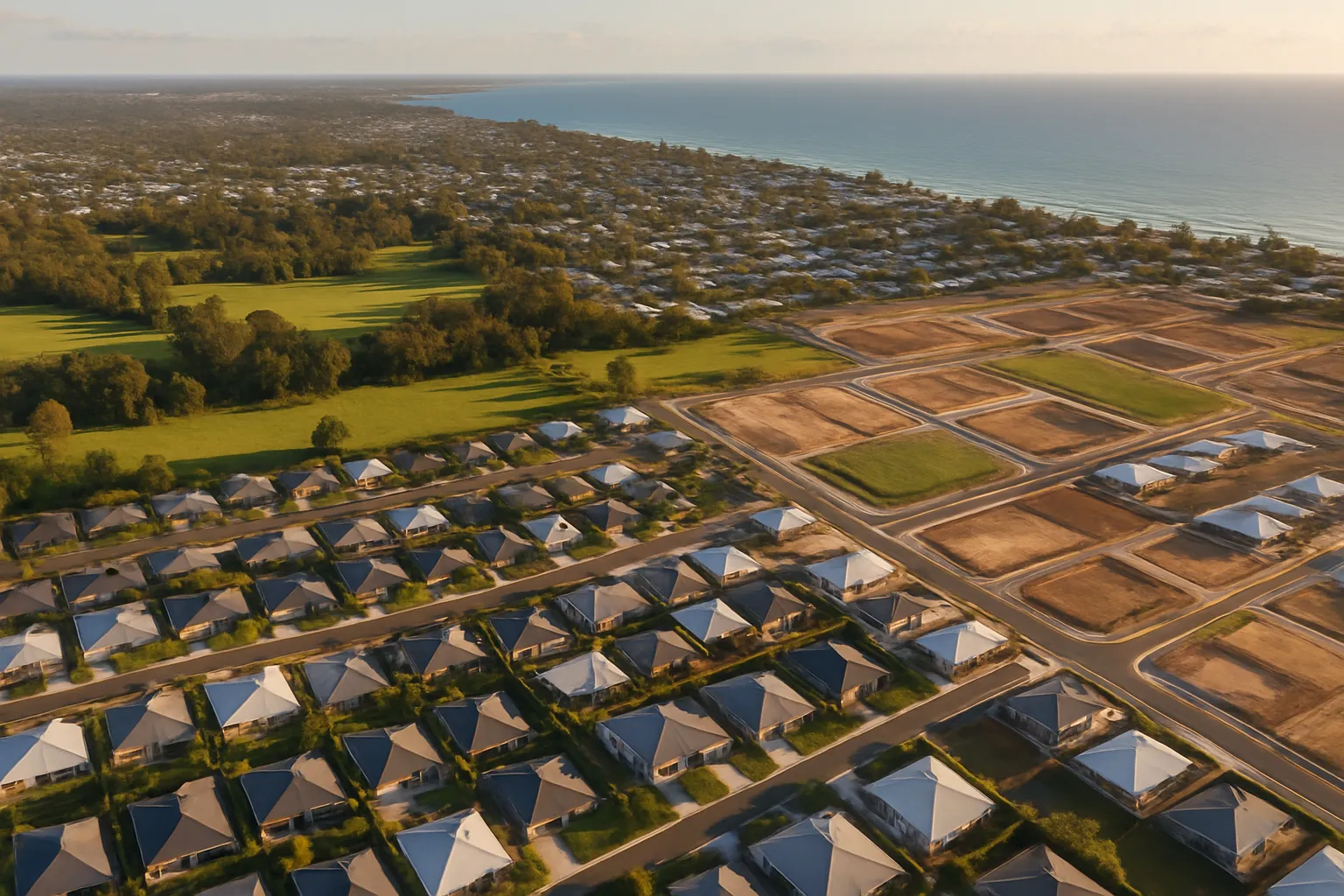
Queensland has committed $99.86 million to five infrastructure projects across the Fraser Coast, removing capacity constraints for 14,647 new dwellings. The funding targets sewerage treatment, water security and road upgrades in Hervey Bay, Maryborough and surrounding growth corridors north of Brisbane. It is the state’s largest single infrastructure partnership with a regional council, delivered through the second round of the Residential Activation Fund.
The package front-loads public capital to unlock private residential development in areas where utilities and transport have hit hard limits. Whether this model scales beyond Queensland’s growth hotspots depends on execution speed and the actual delivery rate once shovels hit the ground.
The five projects and what each removes
The bulk of the funding addresses two core constraints: sewerage treatment capacity and water network resilience.
- Pulgul Creek Sewerage Treatment Plant upgrade: $50 million, supporting capacity for 4,983 homes. The existing plant cannot handle the wastewater load from planned residential estates in Hervey Bay’s growth corridors.
- Fraser Coast Water Grid: $40.4 million, unlocking 5,530 homes. Connects Hervey Bay and Maryborough water supply networks, reducing single-point-of-failure risk and allowing both centres to draw from a shared resource pool during dry periods.
- Fraser Lakes Project: $7.46 million, enabling 4,000 homes. Infrastructure for a master-planned community that stalled on drainage and internal road delivery.
- Alice and Palmer Streets intersection upgrade: $2 million, supporting 100 homes. Removes a traffic bottleneck limiting residential subdivision approvals.
- Oakhurst road and electrical infrastructure: $460,000, unlocking 17 homes. Small-scale enabling works for infill sites.
The projects address genuine bottlenecks rather than speculative capacity. Developers hold land with approvals in principle but cannot proceed without upgraded sewer, water and access infrastructure that councils cannot fund from rates revenue alone.
Timeline and delivery risk
The Residential Activation Fund was announced in Queensland’s 2025 state budget. Round 1 allocated $1 billion across 98 projects, with the state claiming capacity for 98,000 homes unlocked. Round 2 doubled from $500 million to $1 billion, bringing total claimed capacity to over 155,000 homes statewide in under 18 months.
That pace raises two questions: how much capacity was genuinely constrained versus already in the pipeline, and when do the first homes actually settle.
Sewerage treatment plant upgrades typically take 24 to 36 months from funding announcement to commissioning. Water grid connections move faster but still require 18 to 24 months for pipeline construction and integration. Developers cannot lodge final subdivision plans until infrastructure is operational, adding another 6 to 12 months before first titles issue.
Base case: earliest dwelling settlements in late 2027, with volume ramping through 2028 and 2029. Upside scenario shaves six months off that timeline if approvals and procurement compress. Downside adds another year if labour shortages or wet-season delays hit civil works.
In plain English
This is not 14,647 homes in 2026. It is removing the infrastructure ceiling so private developers can build those homes over the next five to seven years, assuming demand holds and construction finance remains available.
What this model relies on
Public funding for enabling infrastructure is not new. What distinguishes the Residential Activation Fund is speed of allocation and the explicit link between dollars committed and dwelling capacity unlocked.
The model works when:
- Councils have shovel-ready projects with firm costings and alignment between planning approvals and infrastructure scope.
- Developers hold land and are genuinely constrained by utilities rather than demand risk or margin pressure.
- State and local governments can move from funding announcement to contract execution in under six months.
- Construction labour and materials supply can absorb the pipeline without blowing budgets.
It breaks when demand softens mid-construction, leaving councils with upgraded infrastructure and developers pulling back on lot releases. Or when projects overrun on cost and timeline, forcing councils to either tip in more local funds or accept partial delivery.
Fraser Coast has structural tailwinds: affordability gap to Brisbane, retirement and sea-change migration, existing amenity in Hervey Bay. But it also faces headwinds common to regional markets: thinner buyer pools, higher interest-rate sensitivity, and less rental-yield support if investors stay cautious. Recent data shows investor loan applications down 28 percent nationally, which flows through to who funds new dwelling construction in outer growth areas.
Replication beyond Queensland
Other states face identical constraints: growth corridors where residential demand exists but councils cannot fund trunk infrastructure from rate bases designed for mature, low-growth suburbs.
New South Wales runs its own versions through regional growth funds and local infrastructure contributions, but without the centralised allocation speed Queensland has achieved. Victoria’s Growth Areas Infrastructure Contribution operates on a user-pays model, shifting upfront cost to developers and buyers rather than the state balance sheet.
The trade-off: front-loading public capital accelerates supply but transfers demand risk to government. If the homes do not sell or settle at the forecast rate, the state wears the cost of oversized infrastructure. User-pays models slow delivery but keep demand risk with the private sector.
Queensland’s approach works politically in a state targeting one million new homes by 2044 and facing acute rental supply pressure. Whether it scales depends on state fiscal capacity and willingness to wear the risk of building ahead of the curve. Housing demand shifts already baked in by 2050 suggest front-loading infrastructure now defers much larger shortfalls later, but only if construction finance and buyer appetite hold up through the delivery window.
What could stall this
Three pressure points over the next 24 months:
- Construction cost blowouts: civil works are price-sensitive to diesel, concrete and labour. If project budgets breach by 20 percent or more, councils face hard choices between scaling back scope or finding co-funding.
- Demand pullback: if Fraser Coast dwelling sales soften before infrastructure is live, developers delay lot releases and the capacity sits unused.
- Execution bottlenecks: procurement delays, wet-season interruptions, or workforce shortages push commissioning dates right, compressing the window before the next rate-rise cycle or credit squeeze.
Base case assumes projects deliver within 10 percent of budget and 6 months of schedule, demand remains steady, and the first wave of settlements validates the capacity assumptions. Any one of those failing does not kill the program but stretches the timeline and raises the cost per dwelling unlocked.
If you’re tracking regional supply
Fraser Coast is a case study in how public infrastructure funding translates to private residential delivery. The model is replicable but not automatic. Watch for:
- Funding-to-commissioning timelines across Round 1 and Round 2 projects. If execution lags or costs overrun, it signals limits to how fast this approach can scale.
- Dwelling settlement volumes in 2027 and 2028. If actual delivery undershoots capacity unlocked, it points to demand constraints or financing gaps the infrastructure alone cannot solve.
- Other states adopting similar models. If New South Wales or Victoria shift toward front-loaded public infrastructure funding, it confirms Queensland’s approach as the new baseline for addressing growth-corridor constraints.
Start here: if you are a developer, investor or council officer in a constrained growth corridor, map your local infrastructure ceiling and compare funding timelines under user-pays versus upfront public capital models. The gap between those two determines whether supply can respond to demand or stays stuck behind a fiscal bottleneck.
Subscribe to the newsletter for weekly coverage of policy moves, infrastructure funding and regional supply dynamics.
General info, not financial advice.