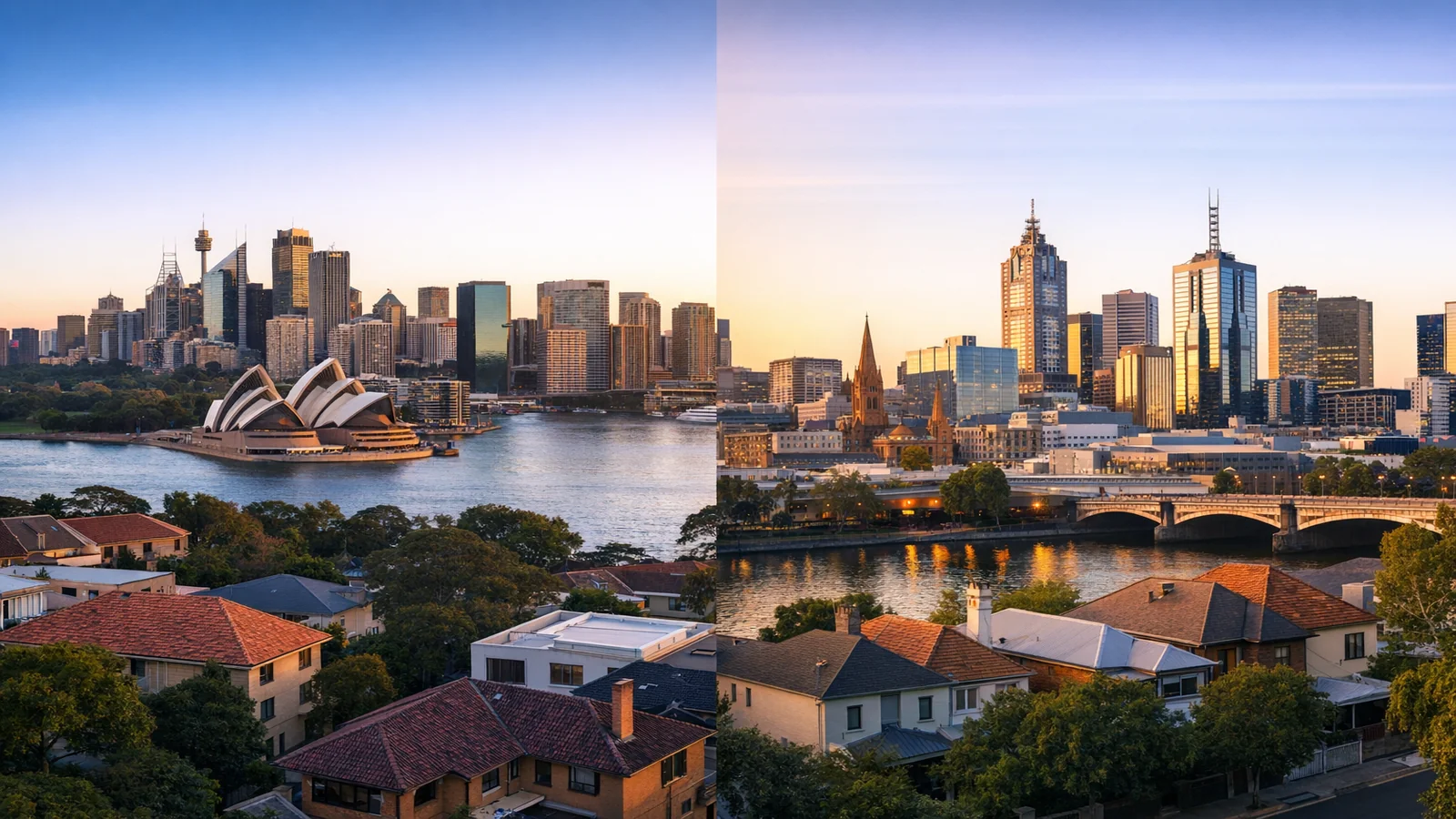
Sydney and Melbourne are starting to look like the weak points in Australia’s housing cycle again.
That does not automatically mean a national crash is coming. It does mean the two markets that usually set the tone for property sentiment are losing momentum at the same time rates, inflation and household nerves are all pulling in the wrong direction.
That matters because housing rarely turns all at once. It usually starts at the most rate-sensitive end of the market, then spreads through borrowing power, confidence and auction activity. Right now, that pressure is showing up first in Sydney and Melbourne.
The change is small on paper so far. The message underneath it is bigger.
What changed and what didn’t
The immediate shift is clear enough. Sydney and Melbourne have started posting softer value results while buyer caution is building. Auction performance has weakened, open home traffic has eased and economists are openly debating how many more rate rises the Reserve Bank may need to deliver.
At the same time, not every market is rolling over.
Brisbane, Perth, Adelaide and Darwin are still showing stronger price momentum, at least for now. Tight vacancy, limited supply and exposure to mining and energy-linked income are helping those cities hold up better. So this is not yet a clean national downturn story. It is a split-market story.
That distinction matters. When people say “the housing market”, they often mean Sydney. Sometimes Melbourne. But Australia’s property cycle is not moving in lockstep.
Why Sydney and Melbourne are under more pressure
The simple version is this: bigger, more expensive markets feel rate pressure earlier.
Sydney and Melbourne rely heavily on financed buyers. When interest rates rise, banks test borrowers at higher serviceability levels, which means many households can borrow less even before they change their mind about buying. That hits top-end borrowing power fast. In plain English, the same buyer suddenly has less firepower.
Now add inflation. When essentials cost more, households feel less secure. Even buyers who can still qualify for a loan may decide to sit out for a few months rather than stretch into a volatile market. That is how softer sentiment becomes softer prices.
This is why clearance rates matter. They are not just a sales statistic. They are an early read on confidence, urgency and bidding depth. When they drop, it often means buyers are still there, but they are less willing to chase.
Now, the part most people miss: demand can stay structurally strong while prices still weaken in the short term. Australia can have tight housing supply, low vacancy and long-term undersupply, and still see prices dip if borrowing conditions tighten fast enough.
The unit market is telling a slightly different story
One useful wrinkle in this cycle is the split between houses and units.
Detached houses appear to be feeling more of the pressure. Units, especially at the more affordable end, are proving more resilient. That makes sense. When budgets get squeezed, buyers do not always leave the market altogether. Many simply trade down their expectations.
A first-home buyer who cannot stretch to a house in middle-ring Sydney may still bid on an apartment. The same goes for borrowers trying to enter Melbourne without taking on a dangerous level of debt. Affordability support and lower entry pricing can keep that end of the market moving even while headline sentiment turns cautious.
For investors, this is a reminder not to read the cycle through one asset type alone. “Property” is not one thing. A premium house market, an investor-grade apartment market and an owner-occupier unit market can all behave differently under the same rate setting.
The real pressure point may be construction costs
Falling prices get attention. Rising build costs may matter more over the medium term.
If construction costs keep climbing, the cost of replacing housing stock rises too. That puts a floor under supply over time because fewer projects stack up, fewer homes get built, and the shortage problem deepens later. So even if established dwelling prices soften now, the supply pipeline can tighten again underneath the surface.
That is one of the big trade-offs in this market. Higher rates can cool demand, but they do not solve supply constraints on their own. In some cases, they make them worse by slowing new development.
For policymakers, that is awkward. For buyers, it means a short-term price wobble does not automatically translate into long-term affordability relief.
Sydney and Melbourne are not necessarily heading for a crash. They are showing classic early signs of a rate-driven slowdown: weaker confidence, softer buyer activity and patchy price results.
But other capitals are still running on different fuel. That is why the national story remains uneven.
What could derail the next call
The biggest unknown is still the RBA path from here.
If rates rise only modestly from here, the slowdown could remain contained. Sydney and Melbourne may drift lower or flatline while stronger cities simply cool from very high growth rates. That is the softer landing scenario.
If rates rise more aggressively, the risk grows. Not just because loans become dearer, but because the broader economy starts to feel it through confidence, consumption and employment. Housing downturns become more serious when they collide with rising job losses. That is when forced selling becomes a bigger issue.
There is also the global backdrop. Oil shocks, geopolitical conflict and sticky inflation can keep pressure on central banks even when domestic growth is already slowing. That makes policy mistakes more likely. And housing markets do not need a catastrophe to weaken. They only need enough uncertainty for buyers to wait.
What this means for investors and homeowners
If you are an investor, this is the time to pressure-test the loan, not just the property. Ask what happens to your cashflow if rates stay higher for longer. Check your buffer. Check your refinancing options. Look at vacancy risk suburb by suburb, not city by city.
If you are an owner-occupier, the question is less “Will prices crash?” and more “Can I comfortably hold this loan through the next 12 to 24 months?” That is the more useful lens.
If you are trying to buy, patience may finally have some value again. In a hot market, urgency dominates. In a slowing market, preparation matters more than speed. Finance quality, suburb selection and negotiating discipline start to matter more than simply getting in before the next jump.
I have seen this play out when the market mood shifts: buyers who stay active but selective often do better than buyers who freeze entirely or rush based on headlines.
Bottom line
Sydney and Melbourne look the most exposed because they are the most sensitive to borrowing costs, sentiment and stretched affordability.
That does not mean the whole country follows them down. It does mean the national market is becoming more uneven, and that the next move depends less on supply slogans and more on the cash rate, inflation and confidence.