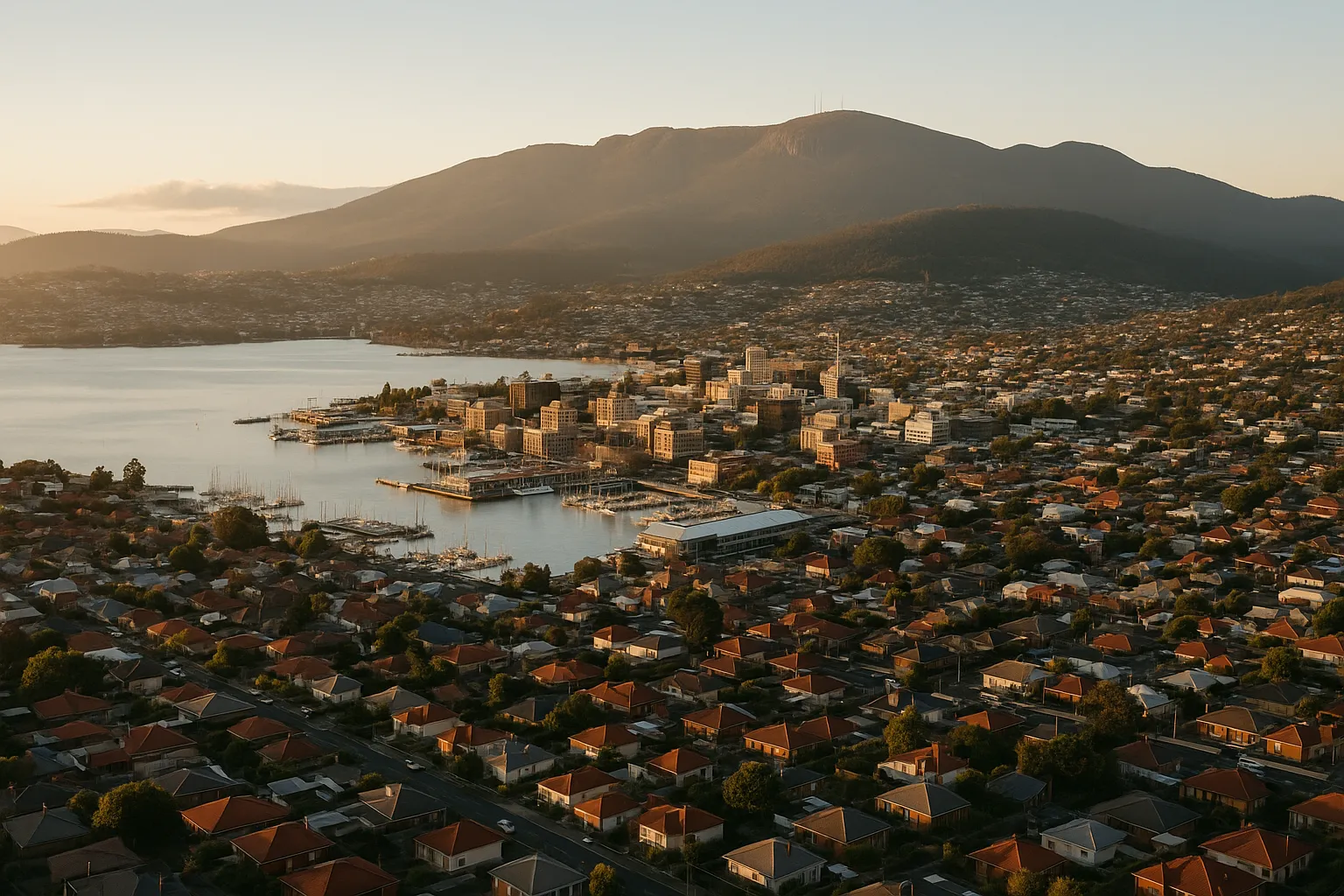
Tasmania’s three main centres, Hobart, Launceston and Devonport, posted annual dwelling price growth between 9 per cent and 15 per cent over the past twelve months, a sharp contrast to flat or falling values in Sydney, Melbourne and Canberra. Hobart’s median now sits at $757,000, up 9.3 per cent year-on-year and within 0.7 per cent of its March 2022 peak. Launceston and Devonport both recorded 12 per cent to 15 per cent annual increases, pushing medians to the $598,000–$675,000 and $618,000 ranges respectively.
The data raises a practical question: is Tasmania’s strength a function of genuine supply-demand fundamentals, or is it a regional lag that will eventually converge with the national slowdown?
What’s driving the numbers
Three factors appear in the mix. First, relative affordability: even after recent gains, Hobart’s median remains roughly half Sydney’s, and Launceston and Devonport sit lower again. That gap matters when interstate buyers compare borrowing capacity and lifestyle trade-offs.
Second, rental demand. Hobart posted 8 per cent annual rental growth, third highest nationally after Darwin and Perth, and a 4.3 per cent gross yield. Tourism Tasmania reported 1.4 million visitors in the year to March, up 4.8 per cent, with spending climbing 7.8 per cent to $3.8 billion. Higher short-term accommodation demand and interstate arrivals both tighten long-term rental supply, which supports rents and yields.
Third, infrastructure pipeline. Tasmania’s construction pipeline sits near $40 billion. Hobart Airport’s $200 million terminal expansion completes in early 2028, with the latest arrivals area opening in recent weeks. The $1.13 billion Macquarie Point stadium broke ground last month. Devonport’s $493 million QuayLink project, designed to accommodate two larger Spirit of Tasmania vessels, reaches its first milestone in October. Launceston’s $130 million UTAS Stadium redevelopment and $43 million Princess Theatre and Earl Arts Centre upgrades are underway. Infrastructure spending typically signals confidence and can support local employment and population inflow, both of which underpin housing demand.
The case for durability
If you believe Tasmania’s outperformance is structural rather than cyclical, the logic runs like this: interstate migration, driven by remote work, lifestyle preference and cost arbitrage, continues to exceed housing supply. Rental vacancy remains tight, yields stay elevated, and construction activity (boosted by public and private infrastructure) keeps employment stable. In that scenario, price growth moderates but doesn’t reverse, and Tasmania remains a relative outperformer even if national conditions soften further.
Supporting evidence: Hobart’s median is only 0.7 per cent below its 2022 peak, suggesting resilience through the broader downturn. Regional cities like Launceston and Devonport, which typically lag capital city cycles, are posting stronger growth than Hobart itself, hinting at genuine demand spread rather than speculative concentration.
The case for mean reversion
The sceptical read: Tasmania’s recent strength reflects a delayed response to national stimulus and migration patterns that have already peaked. Interstate arrivals may slow as remote-work flexibility normalises and cost-of-living pressures, interest rates, inflation, tax, reduce mobility. Infrastructure projects, while real, take years to complete and employ transient workforces; the construction phase supports demand, but post-completion demand can soften if population inflow slows.
Rental yield, at 4.3 per cent gross in Hobart, looks healthy compared to Sydney or Melbourne, but gross yield doesn’t account for maintenance, rates, insurance or vacancy. Net yield, what investors actually pocket, is lower, and if rates stay elevated or rental growth slows, cashflow buffers thin quickly. Construction costs set a floor under house prices, but that floor doesn’t prevent prices falling to meet it if demand weakens.
Finally, the tourism story cuts both ways. Visitor spending growth of 7.8 per cent is strong, but tourism is discretionary and cyclical. A national or global slowdown, higher airfares or a weaker Australian dollar could reduce interstate and international arrivals, which would soften short-term accommodation demand and ease rental pressure.
Pressure points to watch
Three variables will determine whether Tasmania’s run continues or stalls over the next twelve months.
Interstate migration data. If net inflows from Victoria and New South Wales hold or increase, demand stays firm. If they plateau or reverse, particularly among working-age cohorts, rental and purchase demand both soften. The ABS releases state-level migration figures quarterly; the next update will show whether recent strength is sustained or fading.
Rental vacancy rates. Hobart’s vacancy has been below 1 per cent for extended periods. If it rises toward 2 per cent or higher, rental growth slows, yields compress, and investor appetite cools. Watch the monthly rental reports from the Real Estate Institute of Tasmania and national aggregators.
Construction completion versus population growth. Tasmania’s building pipeline is large relative to population, but completion lags approvals by twelve to eighteen months. If supply from current projects hits the market faster than population grows, vacancy rises and price growth moderates. Conversely, if infrastructure-driven employment and interstate arrivals outpace supply, tightness persists. The gap between dwelling approvals and completions, tracked by the ABS, will signal which scenario is unfolding.
Who benefits and who loses
Owner-occupiers who bought in Hobart, Launceston or Devonport over the past two to three years have seen equity gains even as Sydney and Melbourne buyers went backward. Investors with property in these centres have benefited from both capital growth and relatively strong yields, assuming they bought before the recent run-up.
First-time buyers face a tougher equation now. Median prices have risen 9 per cent to 15 per cent annually, eroding affordability gains that initially attracted interstate migrants. Serviceability at current rates means borrowing capacity is stretched, and if prices plateau or fall, recent buyers face the risk of negative equity if they need to sell within the next few years.
Renters are caught in the middle: rents up 8 per cent annually, wages likely not keeping pace, and vacancy near record lows limiting choice. The infrastructure pipeline may eventually ease supply pressure, but completion timelines mean relief is two to three years out at best.
What would change the outlook
Three scenarios over the next twelve months, ranked by probability.
Base case (60 per cent probability): Interstate migration slows but doesn’t reverse, rental vacancy edges up modestly, price growth moderates to low single digits. Hobart stays flat to up 2 per cent, Launceston and Devonport post 3 per cent to 5 per cent as they continue to lag and catch up. Yields compress slightly as rental growth slows, but remain above Melbourne and Sydney. Infrastructure projects proceed on schedule, keeping employment stable.
Upside (20 per cent probability): Remote work and lifestyle migration prove more durable than expected, interstate inflows hold, and rental vacancy stays below 1.5 per cent. Price growth continues at 6 per cent to 8 per cent annually, supported by genuine supply-demand mismatch. Infrastructure completion attracts further private investment, reinforcing the cycle.
Downside (20 per cent probability): National downturn deepens, interstate migration reverses as job security concerns rise, and rental vacancy climbs above 2.5 per cent. Prices fall 5 per cent to 10 per cent as investor demand evaporates and owner-occupiers pull back. Infrastructure projects face delays or budget cuts, weakening employment and confidence. Tasmania converges with the national cycle rather than outperforming it.
What this means for decisions
If you’re considering a purchase in Tasmania, the fundamentals, relative affordability, rental yields, infrastructure pipeline, are stronger than in most capitals, but that doesn’t mean risk is absent. Assume price growth moderates from here, stress-test your serviceability at current rates plus 1 per cent to 2 per cent, and budget for the possibility that prices could fall 5 per cent to 10 per cent if migration slows or vacancy rises.
If you’re an investor holding Tasmanian property, monitor rental vacancy and interstate migration data quarterly. If vacancy climbs above 2 per cent or migration turns negative, consider whether your cashflow buffer can handle lower rents and whether you’d sell into a softer market or hold through a cycle.
If you’re renting and weighing a move, Tasmania’s recent strength has likely priced in much of the lifestyle and cost arbitrage that made it attractive two years ago. Run the numbers on whether the rent-versus-buy trade-off still works at current prices and rates, and factor in the possibility that rental growth slows if supply catches up.
If this analysis helped, subscribe to Australian Property Review’s weekly newsletter for data-led breakdowns of what’s moving markets and what it means for your next decision.
General info, not financial advice.