A lot of business owners tell themselves the same story.
Work hard, grow the business, sell it later, and use the proceeds to fund retirement.
On paper, it sounds logical. In practice, it can be one of the most fragile retirement strategies in the country.
That is not because building a business is a bad wealth move. Often it is the opposite. A successful business can create income, flexibility, equity and optionality that salaried workers may never get. But the mistake is turning that upside into a single-point retirement plan.
Here’s the catch. A business is not just an asset. It is also a risk concentration. Your income may depend on it, your borrowing capacity may depend on it, your day-to-day cashflow may depend on it, and if you are not careful, your retirement may depend on it too.
That is a lot riding on one vehicle.
The appeal is obvious, which is why the trap is common
It is easy to see why owners think this way.
When you are self-employed or running a small business, cash has a job to do. It covers wages, stock, rent, marketing, tax, interest, equipment and the next growth push. Super often falls to the bottom of the list because it feels distant and optional compared with the urgent needs of the business.
That logic can hold for a while. Reinvesting in the business may produce higher returns than parking extra money elsewhere. In the early years especially, preserving cashflow is often more important than optimising a long-term retirement structure.
But a sensible short-term trade-off can quietly harden into a dangerous long-term habit.
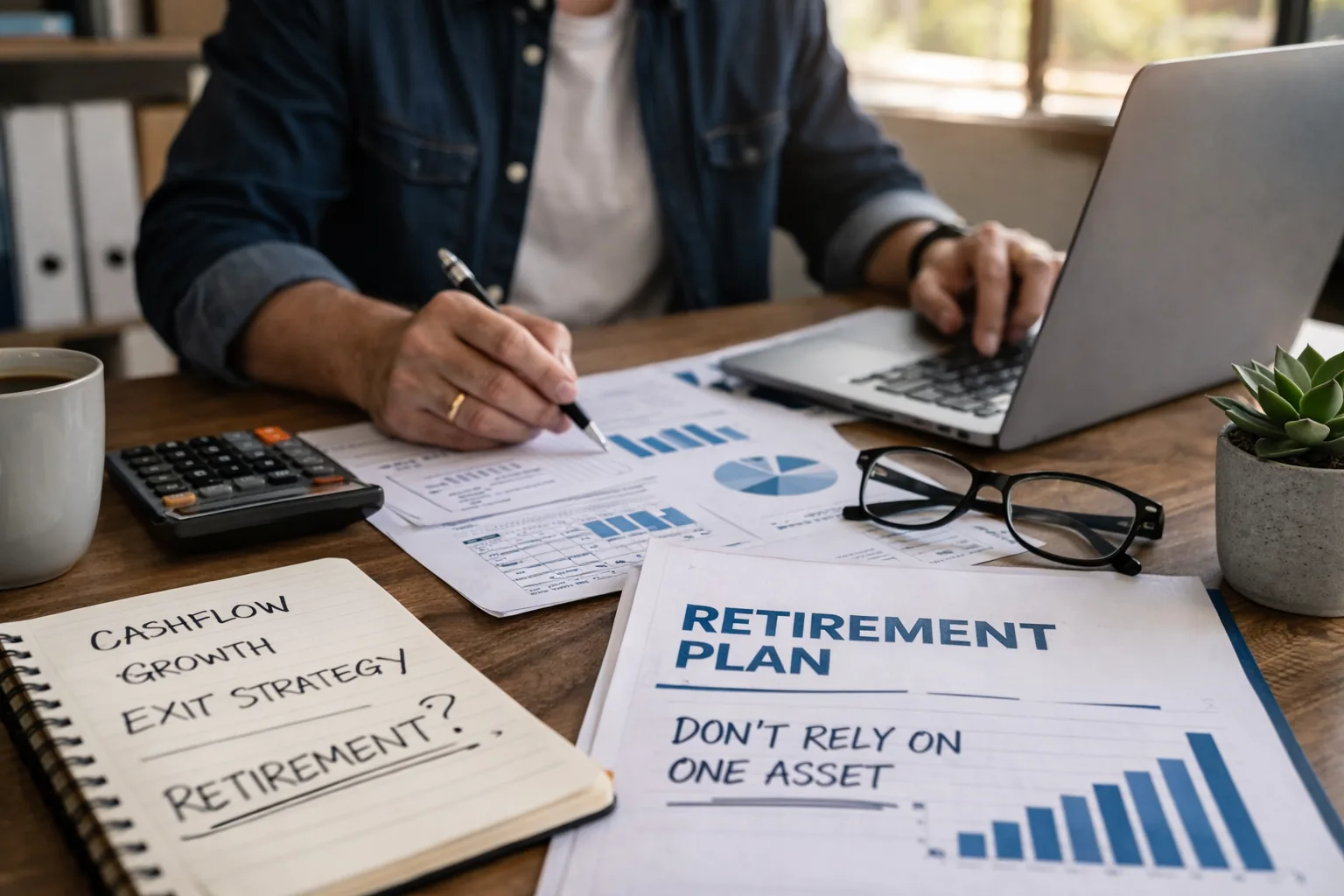
Years pass. The business grows. Revenue improves. The owner gets used to telling themselves that the business itself is the retirement fund. No separate system gets built. No diversified pool of assets takes shape. No proper super strategy gets attention. The whole plan becomes “sell well later”.
That is where the risk begins to compound.
A business is not cash in the bank
One of the biggest errors owners make is confusing paper value with usable retirement money.
A business may be worth a meaningful number on paper, yet still be hard to sell, hard to value, or highly dependent on the owner staying involved. A buyer may not see the business the same way you do. Earnings may fall at the wrong moment. Industry conditions may change. Finance may tighten. A once-hot sector may cool. What looked like a retirement windfall can shrink very quickly when converted from story to transaction.
This matters because business owners often build emotional value into the number as well as financial value.
They remember the sacrifice, the hours, the years of reinvestment, the stress, the identity tied to the thing. All of that is real. None of it guarantees a buyer will pay what you need when you need it.
Retirement planning built on a future sale only works if the sale actually happens, at a viable price, on a workable timeline.
That is a much shakier foundation than many owners admit.
The property parallel is worth noticing
APReview readers will recognise the pattern here because it is not unique to business ownership.
It is the same basic error investors make when they rely on one asset class, one suburb, one development outcome or one refinancing assumption to carry the whole plan. Concentration can work beautifully until it does not. Then there is no buffer.
For business owners, the concentration risk is often worse because the business is not just an investment. It is also the source of labour income. In other words, your earnings and your endgame can both be tied to the same asset.
If the business slows, you do not just face a lower exit value. You may also face weaker income at the same time. That is exactly the kind of double hit retirement planning should avoid.
Quick take
If your business is your only real retirement plan, you do not have a retirement plan yet. You have a future sale assumption.
Why super still matters for owners
This is where many owners switch off too early.
They assume super is mainly for employees on automatic contributions, while business owners are better off keeping capital inside the business. Sometimes that is true for a period. It is not true forever.
Super matters because it creates separation.
It builds a pool of assets outside the operating risks of the business. It can offer tax advantages. It can force discipline where business owners often rely too heavily on instinct and reinvestment. And most importantly, it reduces the risk that one commercial outcome determines the rest of your life.
That does not mean every owner should shovel money into super at the expense of the business. Cashflow still matters. Timing still matters. Debt still matters. But treating super as irrelevant because the business will “sort it later” is usually just another form of avoidance.
Now, the part most people miss: the owners most exposed here are not always the struggling ones. Sometimes they are the capable operators with decent revenue, solid growth and years of momentum behind them. Success can make the blind spot worse because it reinforces the belief that the exit will take care of itself.
What could go wrong from here
A few things tend to derail the one-business retirement model.
The first is overvaluation. Owners expect a multiple that the market will not pay.
The second is owner dependence. If the business revolves around one person, one relationship set or one rainmaker, the sale value can be far lower than expected.
The third is timing risk. You may need to exit when conditions are weak, not when they are ideal.
The fourth is illiquidity. Even if a buyer exists, deals take time, terms vary, and cash does not always arrive in a clean lump sum.
The fifth is life risk. Illness, burnout, divorce, dispute, regulation, technology shifts or industry disruption can all hit before the planned exit.
Any one of those can hurt. A few at once can destroy the retirement thesis.
What changed and what did not
What has changed in recent years is that more owners are being forced to confront how uncertain exits can be. Higher rates, softer deal conditions, tighter lending and changing buyer appetite have made the “I’ll just sell later” line less comfortable than it looked during easier money years.
What has not changed is the underlying principle. A business can be part of a retirement strategy. It should not be the whole strategy.
That is the distinction that matters.
A better way to think about it
The stronger framework is to treat the business as one wealth engine, not the only one.
That means building other pillars alongside it over time. Super is one. Personal investments may be another. Paying down non-deductible debt can be another. For some households, property outside the business may also play a role, provided it fits cashflow and risk tolerance.
The goal is not to weaken the business. The goal is to stop asking it to do every job at once.
Your business already has enough to carry. It does not need to be your income source, your identity, your borrowing case and your entire retirement answer.
Bottom line
A good business can absolutely help fund retirement. In some cases it will be the biggest contributor by far.
But relying on it alone is not confidence. It is concentration.
If you are a business owner and your plan begins and ends with “sell later”, the practical question is not whether that might work. It is what happens if it does not.