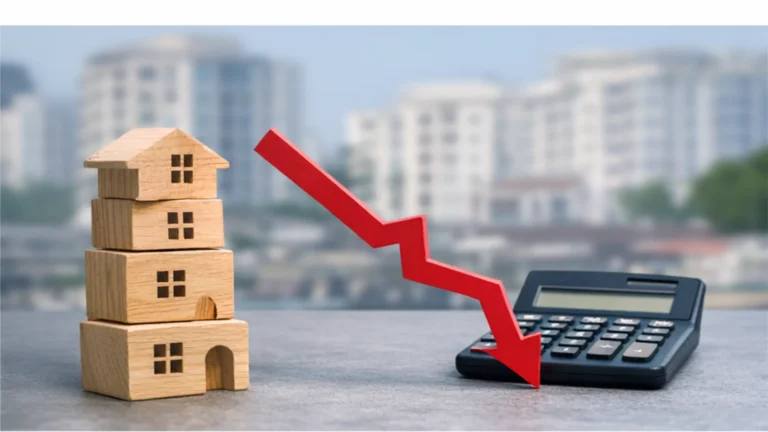
Commercial property investment is suddenly easier to understand as an escape route.
Residential investors are facing higher borrowing costs, a less certain tax outlook and years of being told their portfolio should already be producing more cashflow. Against that backdrop, a warehouse, medical suite, small retail tenancy or office with a stronger advertised yield can look like the obvious next move.
It may be the right move for some investors.
But here is the catch: a higher yield does not automatically mean a better investment. Commercial property places more weight on one tenant, one lease and one vacancy period. At a time when funding costs are high and business cashflow is under pressure, the income story needs more checking than the brochure usually allows.
This is not an argument against commercial property. It is an argument against buying it as a quick fix for a residential portfolio that feels too slow.
The residential-to-commercial pivot now has a new push
The attraction is not difficult to see.
Australian Property Review has already reported that the 2026–27 Budget tax package has changed the conversation around the after-tax return from residential property, trusts and other investments. Investors now have another reason to ask whether their next dollar belongs in housing at all. Read more: The Budget Tax Shock Now Spreading Beyond Property.
Meanwhile, higher rates have made weak residential cashflow harder to carry. The Reserve Bank of Australia lifted the cash rate target by 25 basis points to 4.35 per cent on 5 May 2026, saying inflation had picked up materially in the second half of 2025 and that risks remained tilted to the upside.
For an investor holding one or two residential properties with limited surplus income, the pitch is powerful: sell, refinance or redirect equity into commercial property and collect a larger yield.
What changed is the pressure investors feel.
What did not change is the test that matters: the asset still has to work when the tenant leaves, the lease costs money to replace, borrowing stays expensive or the building needs capital spent on it.
Commercial property investment yields are not the whole return
A commercial property marketed with a 5.5 or 6 per cent net yield can look far stronger than a residential property producing a lower gross rental yield.
The terms matter.
In commercial property, a “net” yield will usually reflect rent after certain operating outgoings that the tenant is required to pay under the lease. That does not mean the investor has eliminated every cost or every risk. Depending on the asset, lease and ownership structure, the investor may still face financing costs, stamp duty, land tax exposure, vacancy, leasing fees, incentives, non-recoverable maintenance, capital works and tax.
A lease can shift some expenses to a tenant. It cannot make a vacant property pay rent.
Take a simple illustration. A $1.5 million commercial asset producing a 6 per cent advertised yield generates $90,000 a year before debt and investor-level costs. If it suffers a nine-month vacancy once during a five-year hold, lost rent alone is $67,500. Across that five-year period, the average yield falls from 6 per cent to about 5.1 per cent before any leasing commission, rent-free incentive, fit-out contribution, repairs or interest costs are included.
That example is not a prediction of vacancy. It shows why the investor’s real question is not “what is the yield today?” It is “what return survives a realistic interruption to income?”
In plain English
A commercial yield is only as reliable as the tenant paying it. Before buying, model at least one vacancy period, reletting costs and a major repair rather than treating the advertised rent as permanent income.
A long lease can still carry a short-lived comfort
Commercial property investors often focus on the remaining lease term. Five years left on a lease sounds safer than a residential tenant who can move out with far less notice.
It can be safer. But only when the tenant is financially strong enough to keep paying.
A lease with a small operator is not the same risk as a lease supported by a major national tenant, government body or large healthcare provider. A local retailer, café, trades business or small service provider may be a good tenant for years. It may also be more exposed to wage costs, energy bills, interest rates, falling customer demand and overdue invoices.
That risk is not theoretical in the current cycle. CreditorWatch’s April 2026 Business Risk Index found late payments had reached their highest level in six years as rates, energy costs and soft demand squeezed business cashflow. Its reporting identified particular pressure across businesses where margins are already thin.
The Reserve Bank has also previously noted that the share of companies entering insolvency had risen sharply over recent years to the top of the range seen in the 2010s, while acknowledging part of the rise reflected a post-pandemic catch-up.
So what does that mean in plain English?
An investor does not only own a building. In practical terms, they are taking a view on the business occupying it. If that tenant struggles, the investor may inherit unpaid rent, legal costs, make-good arguments, an empty tenancy and a search for the next operator.
The lease term matters. Tenant quality matters more.
Why higher rates change the commercial maths
Commercial property values are heavily influenced by income and the yield buyers require for taking risk.
When interest rates are low and buyers accept lower yields, values can rise even without a dramatic lift in rent. When financing costs and bond yields are higher, buyers generally need a stronger return to justify risk. That can limit price growth or push asset values lower if income does not keep pace.
This matters because investors cannot assume the strong valuation gains enjoyed during falling-rate periods will simply repeat.
In its latest Australian market snapshot, Colliers said CBD investment activity moderated in the first quarter of 2026 and that yields had not adjusted during the quarter, with potential for some softening if government bond yields remained elevated.
CBRE’s 2026 outlook was not uniformly negative. It pointed to reduced new supply and expected leasing activity to lift through 2026 in parts of the market. But it also expected net effective rental growth outside premium locations to remain in the low single digits.
That is the balanced reading investors need.
Some well-located, tightly supplied commercial assets may still perform well. Industrial, essential retail, medical and selected mixed-use assets can have genuine demand drivers. But the broad market is not offering a simple replay of the period when falling interest rates did much of the valuation work.
Investors now need the income to be real, durable and priced appropriately for risk.
The comparison with residential is often too neat
A common reason investors consider commercial property is that residential assets can drain household cashflow, especially after a rate rise.
That concern is legitimate. Australian Property Review has previously covered how cashflow drag and serviceability can stall investors before they reach their second or third purchase. Read more: The Real Reason Investors Stall: It’s Not Deals, It’s Borrowing Power.
But comparing the monthly cashflow from one commercial purchase against one residential purchase can hide an important detail: commercial finance often requires a larger equity contribution and can come with different loan terms, valuation risk and lender requirements.
An asset will naturally look more cashflow-positive when the investor has contributed more cash and borrowed less against it.
Residential and commercial property also do different jobs in a portfolio.
Residential assets generally draw on a deeper pool of future buyers and tenants. A dwelling can appeal to owner-occupiers, investors and renters. A commercial property may appeal to a much narrower group, with value closely tied to lease terms, tenant quality, zoning, fit-out, location and required yield.
Commercial may produce better income in the right circumstances. Residential may offer greater liquidity and broader demand. There is no universal winner. There is only a trade-off that needs to be priced properly.
Commercial can make sense, but not as an escape hatch
The wrong conclusion is that investors should avoid commercial property entirely.
A well-capitalised buyer with a long holding period, strong cashflow buffers, access to specialist advice and a high-quality tenant may find commercial property suits their portfolio. Business owners purchasing premises for their own operations may also assess the decision differently from passive investors.
The more dangerous buyer is the investor making a rushed switch because a residential portfolio has not generated financial freedom after only a few years.
Property is slow. Equity, rent growth and debt reduction take time. Changing asset class does not remove that reality. It simply changes the risks.
A commercial property is not automatically passive income because the rent looks higher on day one. It can become a concentrated bet on a single tenant at exactly the time that small businesses are facing rising costs and tighter financial conditions.
That is the part most people miss.
Before swapping residential for commercial, pressure-test this
Investors considering commercial property should not begin with a sales listing or an advertised yield. They should begin with the downside case.
Ask what happens if the tenant leaves, if reletting takes months rather than weeks, if the next tenant requires incentives, if the roof or essential services need work, or if the lender values the asset more cautiously when the loan is reviewed.
Then look at the tenant rather than just the building. What business pays the rent? How dependent is it on local foot traffic, discretionary spending or one major customer? What security supports the lease? What will the property be worth without that tenant?
Finally, compare like with like. If the commercial purchase requires a much larger deposit, model what the same equity contribution would do for the residential portfolio, debt reduction or a diversified investment strategy.
The goal is not to find the asset with the most impressive headline yield.
The goal is to find the investment that remains holdable when conditions are less friendly than the brochure assumes.
Start here: before making a residential-to-commercial switch, ask a licensed adviser, commercial property solicitor and finance broker to model the deal with vacancy, reletting costs, capital works and higher-rate scenarios included.
General info, not financial advice.