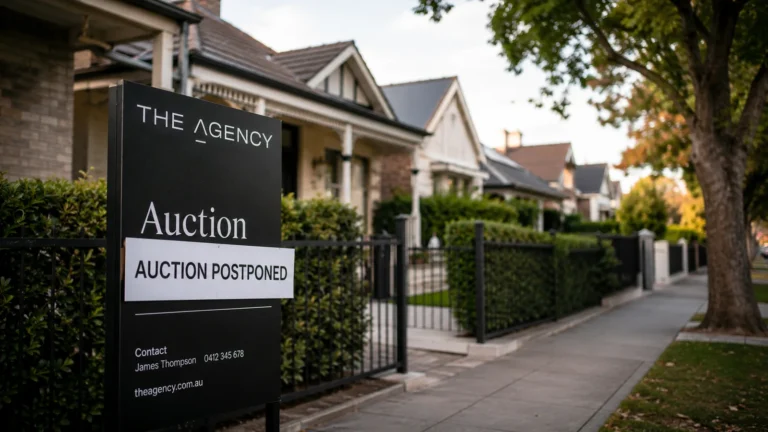
Australia house price correction risk is back at the centre of the market.
After years of buyers being told that housing only moves in one direction over the long run, the mood has shifted. Sydney and Melbourne are now under pressure, investor confidence has weakened, and higher interest rates are doing what higher interest rates usually do.
They make debt harder to carry.
That does not mean every suburb is about to fall sharply. It does mean the next phase of the housing cycle needs to be judged with more discipline than the last one.
A cheaper home is not always a safer home if your borrowing power, income buffer and exit options are weakening at the same time.
The warning signs are no longer theoretical
The latest market concern is not built on one soft monthly result.
The problem is the combination.
Sydney and Melbourne have been showing quarterly price falls, with some reported measures pointing to annualised declines that would look large if they continued for a full year. Nationally, the picture is softer than the boom years, but the pressure is not evenly spread.
Sydney matters because it is Australia’s largest housing market.
Melbourne matters because it has already been carrying weaker sentiment, tax pressure and affordability stress for longer than most capital cities.
Together, they set a tone for credit, confidence and investor behaviour.
This is why the phrase “correction” matters. A correction is not just a price fall. It is a repricing of risk.
Buyers start asking different questions. Banks become more cautious. Investors demand better yields. Vendors discover that last year’s price guide may not clear this year’s market.
Why prices can fall even when housing is still scarce
This is the part that confuses many people.
Australia can have a housing shortage and still have falling home prices.
Supply affects the long-term need for housing. Credit affects what buyers can pay today.
If interest rates rise, borrowing capacity falls. If banks apply tougher serviceability tests, borrowing capacity falls again. If investors lose confidence in after-tax returns, demand weakens further.
That is how a market can feel tight on the rental side but weaker on the sales side.
Australian Property Review has covered this split before in Australia Home Prices Fall As Investor Squeeze Gets Real, where the key point was simple: lower prices do not automatically improve affordability if credit is tightening at the same time.
Here’s the catch.
A buyer does not purchase with the national median price. They purchase with a deposit, an approved loan, a repayment buffer and a view on job security.
If those four things are under pressure, a lower asking price may not be enough.
What higher rates do to buyer behaviour
Interest rates work through the housing market in stages.
First, repayments rise.
Then borrowing power falls.
Then buyers reduce budgets or delay decisions.
Then vendors either meet the market, hold firm, or withdraw.
That last step is where price data can become messy. A market can look quiet before it looks weak because fewer transactions are happening. The price fall becomes clearer only when enough sellers accept lower bids.
For owner-occupiers, the pressure point is monthly repayment comfort.
For investors, it is after-tax cashflow.
For developers, it is whether pre-sales, funding and construction costs still work.
That is why the Reserve Bank of Australia remains central to the story. If inflation stays sticky and the RBA keeps monetary policy tight, housing cannot ignore it forever. The market can absorb some pressure. It cannot ignore a sustained reset in the cost of money.
Quick take
A housing downturn does not need panic to become serious.
It only needs three things to happen together:
- borrowing capacity falls faster than prices
- investor demand weakens because the after-tax return is unclear
- vendors become forced or motivated sellers in weaker pockets
That mix does not guarantee a crash. But it does change the rules for anyone buying, selling or refinancing.
Investor tax changes have made the market more fragile
Tax policy is now part of the housing correction debate.
Changes to negative gearing and capital gains tax settings can influence investor behaviour before the full effects appear in annual tax returns. Banks may adjust assumptions. Buyers may pause. Investors may ask whether the property still works without the same tax benefit.
That matters because investors are often the marginal buyer in many apartment, townhouse and established rental markets.
If the marginal buyer steps back, prices can move faster than people expect.
Australian Property Review explained this in Housing Investor Loans Face A New Budget Shock: tax policy can behave like credit policy when it changes the numbers lenders and borrowers use.
The key issue is not whether investors disappear.
They probably will not.
The issue is whether they demand a bigger discount, a stronger yield, or a better cashflow buffer before acting.
That is a very different market from one where investors buy because they assume capital growth will fix everything later.
Population growth is the demand lever to watch
For much of the past decade, population growth helped support Australian housing demand.
More people needed places to live. That supported rents, household formation and buyer competition, especially in the major capitals.
But if migration growth slows materially, the demand side changes.
This does not remove the housing shortage overnight. It does reduce one of the strongest tailwinds behind prices and rents.
The second-order effect is important.
If population growth slows while borrowing costs remain high and investor confidence is weak, the market loses three supports at once. That is when a normal correction can feel sharper in exposed suburbs.
The biggest risk sits in locations where prices were supported more by momentum than by income, yield or genuine scarcity.
Sydney and Melbourne may not tell the whole story
A national correction can hide very different local markets.
Sydney and Melbourne are the obvious pressure points because they are large, expensive and sensitive to borrowing capacity. But regional and smaller capital markets may behave differently depending on supply, employment, migration, local wages and investor yields.
Some areas may fall because buyers can no longer service the debt.
Some may hold because listings remain tight.
Some may look resilient until unemployment rises or investors decide the cashflow is not worth the risk.
This is why headline forecasts are useful, but only to a point.
A 10 per cent fall in one market and a flat result in another can both exist inside the same national story.
For readers comparing cities, Australian Property Review’s piece on Property Industry Confidence Has Turned Negative is worth reading because confidence often shifts before the hard numbers fully show it.
What would change the outlook
The downside case is clear enough: more rate rises, weaker confidence, slower migration and tighter investor demand.
But housing markets rarely move in a straight line.
A softer inflation print could reduce pressure on the RBA. Strong wage growth could support serviceability. A shortage of listings could slow price falls. Policy changes could also redirect investor demand toward new supply or higher-yielding markets.
The base case is not that every home falls by the same amount.
The more realistic case is a more selective market.
Quality assets with clear buyer depth may hold up better. Overpriced stock, weak-yield apartments, stretched investor assets and suburbs with too much new supply may face heavier scrutiny.
That is not a market for blind optimism.
It is a market for pressure-testing.
The practical take for buyers and investors
If you are buying now, do not start with the headline price fall.
Start with the stress test.
Ask three questions before making a decision:
- Would this property still work if rates rose another 0.5 to 1 percentage point?
- Would the numbers still work if the value fell 5 to 10 per cent after settlement?
- Could you hold the property through a weaker rental or resale market?
For homeowners, the priority is cashflow buffer.
For investors, the priority is after-tax cashflow, vacancy risk and exit strategy.
For first-home buyers, the question is not just “has the price dropped?” It is “has my real ability to buy improved?”
That is the part most people miss.
Lower prices help only if your finance, income and confidence hold up.
Bottom line
The Australia house price correction story is not just about whether Sydney or Melbourne fall by 5, 10 or 15 per cent.
It is about whether the assumptions behind the last cycle still hold.
Cheap debt is gone. Tax settings are less certain. Population growth may not carry the same force. Investors are more selective. Banks are still testing borrowers hard.
That does not mean housing is broken.
It means the market is moving from momentum to maths.
Start here: before buying, selling or refinancing, run the numbers under a higher-rate, lower-price scenario and make sure the decision still works.
Subscribe to the free Australian Property Review newsletter for clear property market analysis each week: newsletter.apreview.com.au
General info, not financial advice.