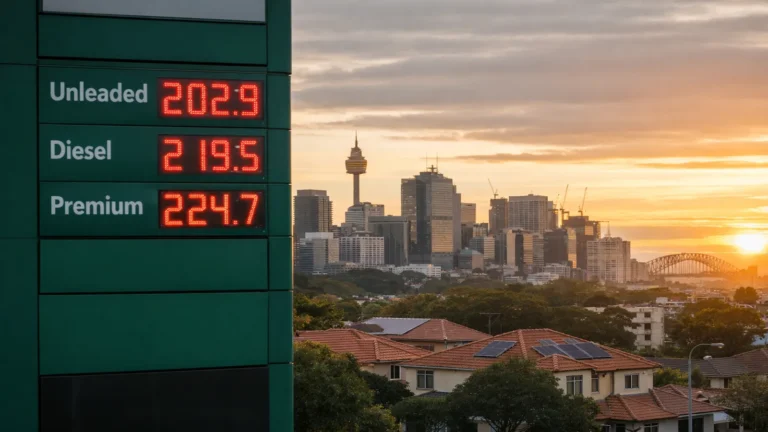
Australian property market recession risk is becoming harder to ignore as falling home prices, higher rates and weak confidence start pulling in the same direction.
The housing market is not the whole economy. But in Australia, it is close enough to matter.
When property prices rise, households tend to feel wealthier. They borrow more confidently, renovate more easily, upgrade more often and spend with fewer second thoughts.
When prices fall, that process can reverse.
That is the problem now facing the economy. The March quarter already showed weak momentum, with ABS figures putting GDP growth at just 0.3 per cent for the quarter and 2.5 per cent through the year. At the same time, June housing data showed national home prices slipping, with PropTrack reporting a 0.3 per cent monthly fall and all but one capital city recording a decline. (Australian Bureau of Statistics)
This does not mean Australia is locked into recession. It does mean the buffer is thinner.
The market is not crashing, but it is changing shape
The first point to get clear is this: a softer property market is not automatically a crisis.
A modest price fall can improve affordability, cool speculative demand and give first-home buyers more room to negotiate. After years of stretched prices, that is not all bad.
But the timing matters.
Housing is weakening while interest rates remain restrictive, construction costs are still elevated and household budgets are already under pressure. The RBA left the cash rate target at 4.35 per cent in June, after earlier tightening this year had already flowed through to mortgage repayments and borrowing power. (Reserve Bank of Australia)
That is why the latest fall in prices matters. It is not just about whether Sydney or Melbourne is down this month. It is about whether households, buyers and businesses start behaving as though the cycle has turned.
Australian Property Review recently looked at this confidence problem in Australia Property Market Has A Buyer Confidence Problem. The key point still holds: buyers do not need prices to collapse before they hesitate. They only need enough doubt to wait.
And once enough people wait, the market slows.
Why falling home values hit more than sellers
The direct loss from a falling property market is felt most sharply by recent buyers, especially those who purchased near the peak with high debt.
But the broader economic effect is more psychological.
A homeowner does not need to sell at a loss to feel poorer. If they believe their home is worth less, or likely to be worth less soon, they may cut spending, delay upgrades, postpone renovations or hold off on buying another property.
That is the wealth effect in plain English.
It means asset prices can influence spending behaviour, even when income has not changed.
In Australia, that link is stronger than in many economies because housing makes up such a large share of household wealth. A falling share portfolio may worry some households. A falling home value hits the asset most owners watch, borrow against and mentally rely on.
Here’s the catch: the housing downturn does not need to be dramatic to hurt growth. If households simply spend a little less, builders receive fewer enquiries, agents process fewer transactions, furniture stores lose momentum and trades feel the slowdown.
That is how a property wobble becomes an economic drag.
Quick take
The recession risk is not coming from one data point.
It is coming from the combination of:
- weaker home values
- higher mortgage costs
- cautious buyers
- slower transaction volumes
- policy uncertainty around property tax settings
- an economy already growing slowly
Individually, those pressures can be absorbed.
Together, they reduce the margin for error.
The transaction chain is where pain spreads
Most housing analysis focuses on prices. That misses the second-order effect.
A property sale usually triggers a chain of spending. Buyers may hire removalists, lawyers, conveyancers, pest inspectors, mortgage brokers, cleaners, painters, landscapers and tradies. They may buy furniture, appliances, curtains, flooring or a second car.
Investors may refinance, renovate or adjust their portfolio.
Sellers may use sale proceeds to upgrade, downsize, invest or retire debt.
When transaction volumes fall, that chain weakens.
This is why auction clearance rates and listing behaviour matter. Australian Property Review covered the same warning sign in Auction Clearance Rates Warn Property Sellers. A failed auction is one signal. A seller delaying the auction altogether can be a stronger one.
It suggests the market is not just softer. It is uncertain.
Uncertainty is the part that hurts activity. Buyers wait for a lower price. Sellers wait for a better bid. Investors wait for clarity. Developers wait for sales evidence. Lenders become more cautious around valuations.
Nobody has to panic for the market to slow. They only need to pause.
Rates are still doing most of the work
It is tempting to blame the latest weakness on tax changes alone. That is too simple.
Tax policy can shift investor behaviour, especially when it changes expected after-tax returns. If investors believe established property will become less attractive, they may demand a lower purchase price or redirect capital elsewhere.
But rates are still the heavier weight.
Higher interest rates reduce borrowing capacity, lift repayments and make cashflow harder to defend. For investors, they also change the yield equation. A property that looked acceptable at one interest rate can look thin at another.
For owner-occupiers, the pressure is simpler. Higher repayments leave less room for discretionary spending.
That matters because the economy does not move on house prices alone. It moves on household behaviour.
If rates stay high while prices fall, the pressure is two-sided. Borrowers feel less wealthy and less cash-rich at the same time.
For readers wanting the mechanics behind investor pressure, Property Tax Changes: Investor Workarounds Explained is worth reading next.
A technical recession is not the only risk
A technical recession means two consecutive quarters of negative GDP growth.
That is the headline definition, but it is not the only way households feel pain.
Australia can avoid a technical recession and still feel weak. If population growth keeps headline GDP positive while GDP per person goes backwards, many households experience something closer to recession conditions.
That is the per capita problem.
The economy can be bigger in total while the average person feels worse off.
This is where the property market becomes important again. If housing wealth falls, repayments stay high and wage growth does not fully offset living costs, households may reduce spending even if official GDP avoids two negative quarters.
That would still matter for investors.
A weak consumer economy can affect rents, arrears, small business income, job security and confidence. It can also change buyer psychology in suburbs where demand depends on discretionary income.
What would make the downside worse
The base case is not a property crash. The more likely path is a slower, more cautious market where buyers regain leverage and sellers adjust expectations unevenly.
But the downside case is clear.
The downturn becomes more damaging if several things happen at once:
- unemployment rises faster than expected
- banks become more conservative on valuations
- investors pull back from established housing faster than new supply can fill the gap
- construction activity slows further
- consumer spending weakens through winter and spring
- forced sales rise among recent buyers with thin buffers
The supply side still matters. Australia has not suddenly built too many homes. In fact, the long-running shortage remains a major reason prices may be cushioned from a deeper fall in some markets.
Australian Property Review has covered that structural issue in Housing supply gap: NSW hit as migration outruns homes and Australia’s Housing Shortfall and House Price Outlook.
That is the trade-off investors need to understand.
Weak demand can pull prices down in the short term. Weak supply can limit how far that goes over the medium term.
Both can be true.
What investors and homeowners should do now
This is not a market for heroic assumptions.
The practical move is to pressure-test your position against lower prices and softer income, not just higher repayments.
For homeowners, that means checking three numbers:
- Your repayment if rates rise another 0.25 to 0.50 percentage points
- Your cash buffer after essential expenses
- Your likely sale outcome if prices in your suburb fall another 5 per cent
For investors, add two more:
- Your true net yield after interest, insurance, rates, maintenance and vacancy
- Your ability to hold the property if rent growth slows or the tenant turns over
The common mistake is to look only at the property’s paper value.
In this part of the cycle, cashflow matters more.
A property can still be a good long-term asset and a bad short-term holding if the debt structure is too tight.
Bottom line
Australian property market recession risk is rising because housing weakness is arriving at a fragile point in the economic cycle.
The danger is not just that prices fall. It is that falling prices change behaviour.
Buyers wait. Sellers hesitate. Households spend less. Businesses linked to transactions lose momentum. Developers and investors become more selective.
That is how a housing slowdown can leak into the broader economy.
Start here: run your next property decision through a lower-price, higher-rate and slower-income scenario before you rely on the base case.
Want the weekly signal without the noise? Subscribe to the free Australian Property Review newsletter: newsletter.apreview.com.au
General info, not financial advice.