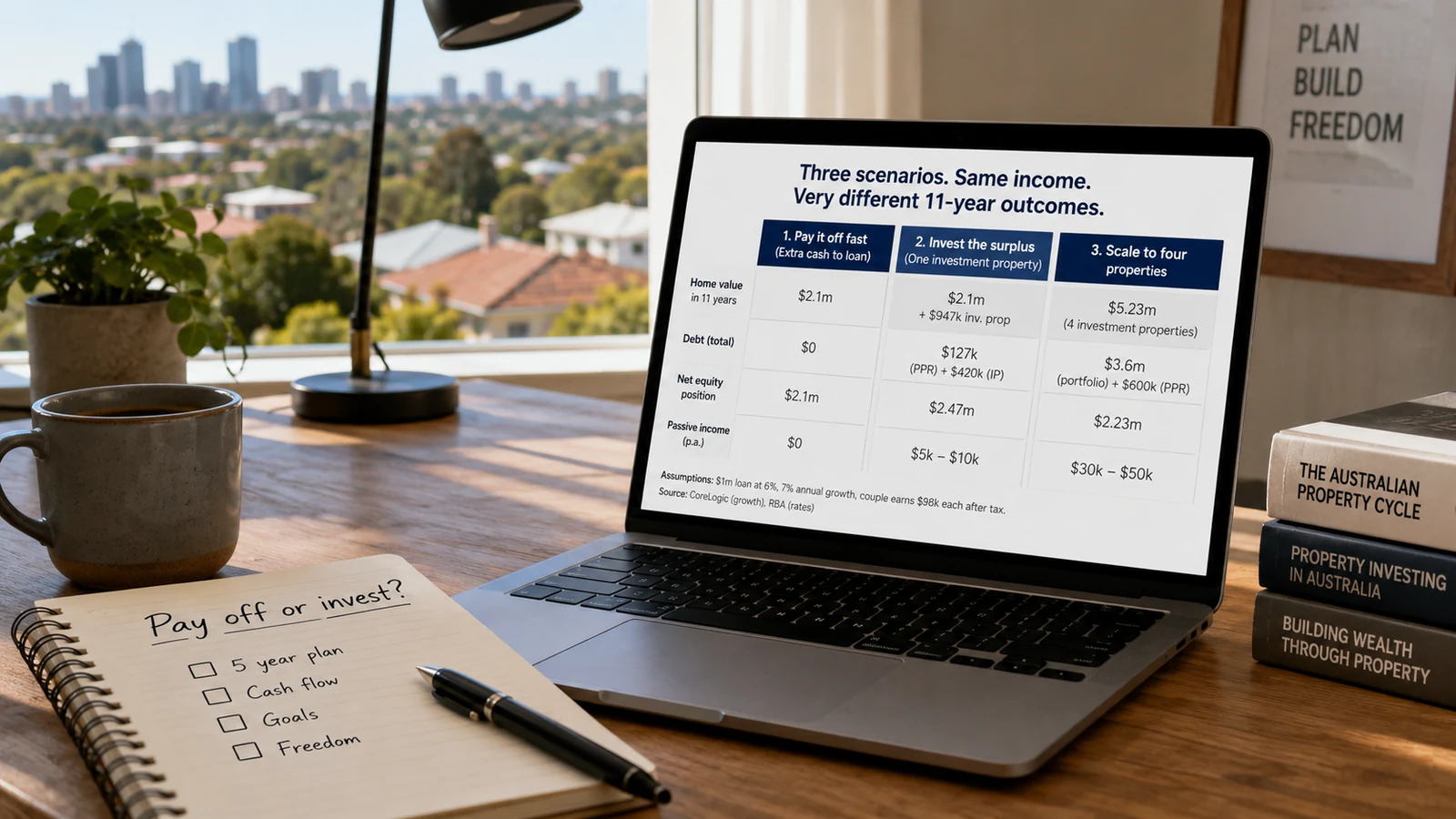
A mortgage can be cleared faster or used to fund another property. In today’s rate market, the wealthier path may also be the more fragile one.
Using home equity to invest has a simple appeal: instead of throwing every spare dollar at the mortgage, a homeowner uses part of their growing equity and savings to acquire another property.
Done well, that can expand an asset base earlier and give growth more time to compound.
Done badly, it can leave a household with more debt, thinner cashflow and less room when rates, rents or employment move the wrong way.
That trade-off has become sharper. The Reserve Bank of Australia’s cash rate is now 4.35 per cent, effective from 6 May 2026. At the same time, lenders are still required by the Australian Prudential Regulation Authority to test home loan applicants at an interest rate at least 3 percentage points above the product rate.
So this is no longer just a debate about optimism versus caution. It is a question of what the numbers can actually carry.
The pitch is appealing. The assumptions do the heavy lifting
The argument usually begins with a couple who own a $1 million home with a $1 million mortgage. Assume a 30-year principal-and-interest loan at 6 per cent.
The minimum repayment is about $5,996 a month. If the household can add another $55,000 a year, or roughly $4,583 a month, the total repayment rises to about $10,579 a month.
On those assumptions, the mortgage is cleared in about 10 years and nine months.
That is a meaningful outcome. A household entering its late 40s or 50s without a home loan has reduced its largest fixed expense and removed a major source of stress.
The alternative argument says those spare funds could first help buy an investment property, before the household returns to paying down the home loan. If both properties rise over time, the investor may end up with a larger asset base.
That is possible. It is not automatic.
The comparison depends heavily on four variables: capital growth, interest costs, rental cashflow and the household’s ability to keep borrowing.
One growth assumption can change the whole story
A common version of the investing case assumes residential property grows at 7 per cent a year for more than a decade.
At that rate, a $1 million home becomes worth about $2.10 million after 11 years.
But property growth is not a fixed return. It varies by city, property type, purchase price, supply, credit conditions and the period selected.
Using the same $1 million starting home, the difference is substantial:
|
Annual growth assumption |
Value after 11 years |
|---|---|
|
4% |
$1.54 million |
|
5% |
$1.71 million |
|
7% |
$2.10 million |
This is the part that can disappear in a confident property presentation. A strategy that looks compelling at 7 per cent growth can become far less convincing at 4 or 5 per cent, particularly once buying costs, selling costs, insurance, maintenance, land tax, vacancy and tax treatment are included.
The catch
Buying another property does not just increase exposure to growth. It increases exposure to debt, rate changes, vacancy, repairs, insurance, tax settings and the chance that life changes before the strategy pays off.
The right question is not whether property has built wealth over time. It has for many owners. The question is whether a particular household can hold a leveraged strategy through an ordinary, messy decade rather than an ideal one.
Paying down the home loan is not “doing nothing”
The fastest-mortgage route is sometimes framed as cautious to the point of missing out.
That overlooks one important point: interest avoided on an owner-occupied mortgage is a real financial benefit. It is not exposed to market falls, vacancies or selling costs.
For a borrower paying 6 per cent interest on a non-deductible home loan, reducing that debt produces an interest saving broadly equivalent to the loan rate, subject to loan structure and access arrangements.
There is also a middle ground. An offset account can reduce mortgage interest while keeping cash accessible. MoneySmart describes an offset account as a transaction account linked to a home loan, with the balance offset against the loan when interest is calculated.
That flexibility matters. A couple may be comfortable investing while both incomes are strong, then face parental leave, childcare, illness, a job change or a costly repair. Cash sitting in an offset can be more useful in that moment than equity that requires a new loan approval to access.
For a deeper comparison of offsets, redraw and investing, read Australian Property Review’s guide: Invest or Pay Off the Mortgage? A Straight-Up Guide for Aussies.
The bank may end the strategy before the market does
The most aggressive property playbooks assume an owner can keep repeating the process: buy, wait for equity growth, borrow again and acquire the next property.
The limiting factor is often not the deposit. It is serviceability.
Serviceability is the lender’s assessment of whether a borrower can afford repayments after allowing for income, expenses, existing debts and an interest-rate buffer.
That matters because an investor can be asset-rich on paper and still unable to borrow another dollar.
APRA has retained a mortgage serviceability buffer of 3 percentage points above the loan rate. It has also maintained limits allowing banks to make no more than 20 per cent of new owner-occupied and investment loans at a debt-to-income ratio of six times or more.
In plain English, lenders are not required to accept a growth story just because an investor has gained equity. They still need the borrower’s income and cashflow to stand up under tougher assumptions.
This is why the sequence matters. A first investment property with a heavy weekly cashflow shortfall can block the second purchase, even if the investor believes the long-term capital growth will be strong.
Australian Property Review has examined that constraint in The Real Reason Investors Stall: It’s Not Deals; It’s Borrowing Power.
The portfolio arithmetic needs to reconcile
There is another issue borrowers should not ignore: property strategy comparisons often spotlight asset values while giving debt and holding costs less attention.
Imagine a household scales into several properties and arrives at an investment portfolio valued at $5.23 million with $3.60 million of debt. That leaves $1.63 million of investment equity before tax, selling costs or transaction costs.
If the home loan still carries substantial debt, that debt must also be deducted before claiming a total net position. If the family home is included in the assets, its current value and remaining debt must both be shown clearly.
This sounds basic. It is also where many wealth projections become misleading.
A clean comparison should show, for every scenario:
- all properties owned and their assumed values
- every outstanding loan
- stamp duty and buying costs
- rental income and vacancies
- rates, insurance, management, maintenance and land tax
- interest rates and whether loans are principal-and-interest or interest-only
- tax treatment and selling costs
- household cash reserves after each purchase
Without those lines, a “net worth” figure is not enough to support a decision.
Leverage can create choice, but it can also remove it
The strongest case for investing rather than aggressively paying off a home loan is flexibility later. A growing investment asset could be sold, held for rental income or used as part of a longer-term retirement plan.
The strongest case against it is flexibility now.
Borrowing to invest magnifies outcomes in both directions. MoneySmart warns that investors must continue to repay debt and interest regardless of how the investment performs, and that rental income may be lower than expected. It also warns that where a home is used as security, the home can be put at risk if repayments cannot be maintained.
Now, the part most people miss: an investment property does not need to fall sharply to cause trouble. It only needs to be mildly cashflow-negative while rates remain high, insurance rises, repairs land at the wrong time, or a tenant leaves.
A household paying an extra $200 a week across several properties may cope comfortably. A household paying an extra $700 a week while also carrying a large home mortgage may find that the investment plan starts deciding their lifestyle for them.
The second-order effect is borrowing power. Higher holding costs reduce surplus income. Lower surplus income reduces the next loan approval. A strategy sold as expansion can quickly turn into consolidation.
A more honest way to make the choice
This is not a verdict that every borrower should clear the home loan first. Nor is it an argument that investment property should be avoided.
It is an argument for testing the decision under conditions that are less flattering than a sales example.
A homeowner considering using home equity to invest should run at least three scenarios:
Base case: the investment achieves moderate growth, rents rise gradually and interest rates remain close to current levels.
Downside case: growth is flat for several years, rates stay higher for longer, one major repair occurs and there is a vacancy period.
Personal shock case: one household income falls for six to 12 months because of job loss, parental leave, health or family commitments.
The investment case should survive all three without emptying the offset, relying on credit cards or forcing a property sale.
There is also tax structure to consider. The Australian Taxation Office says interest deductibility depends on the use of borrowed funds. Mixing private and investment borrowing can complicate deductions and record keeping. Before releasing equity, borrowers should obtain qualified tax and lending advice on loan splits and fund flows.
For more on the credit constraints building around leveraged buyers, see Australian Property Review’s analysis: APRA Debt-to-Income Limits: What Borrowers Need to Know.
Bottom line
Using home equity to invest can build wealth faster than paying down a mortgage alone, particularly when income is strong, buffers are healthy and the assets perform well.
But it is not a free upgrade from caution to freedom. It is a decision to exchange a certain reduction in non-deductible home debt for an uncertain leveraged investment outcome.
For many households, the sensible starting point is not “How many properties can I buy?” It is “How much debt could I hold calmly if rates remain high and one part of life goes wrong?”
Start here: before accessing home equity, model repayments, cashflow and borrowing capacity with lower growth, higher rates and one income interruption, then decide whether the extra risk is genuinely affordable.
Get independent property analysis without the sales pitch. Subscribe free to the Australian Property Review newsletter