Australia’s Housing Accord has a simple promise: build more homes, ease pressure on prices and give renters and buyers more breathing room.
The latest construction numbers make that promise harder to believe.
Australian Bureau of Statistics data for the March 2026 quarter shows total dwelling commencements fell 11.2 per cent to 48,012 homes. New private sector houses fell 3.5 per cent, while higher-density housing, the apartments and townhouses needed most in inner and middle-ring markets, fell 20.7 per cent.
That matters because the Housing Accord is not judged by speeches, targets or announcements. It is judged by dwellings that actually move from approval to construction, then from construction to completion.
Right now, that pipeline is under pressure.
The target is still there. The runway is shorter
The federal government’s Housing Accord aims to deliver 1.2 million new homes over five years.
In plain English, that requires about 240,000 homes a year, or roughly 60,000 a quarter. The March quarter result of 48,012 starts is well below that pace.
The problem is not just one soft quarter. The longer Australia misses the required run rate, the harder the catch-up becomes.
A small shortfall early in a five-year target can be manageable. A repeated shortfall becomes a compound problem. Each weak quarter means future quarters have to do more work, with the same builders, the same stretched trades, the same planning bottlenecks and the same financing constraints.
That is the part often missed in housing policy.
A target can stay fixed on paper while the practical task gets harder in the real world.
Why commencements matter more than promises
Housing approvals get attention because they look like future supply. But an approval is not a home.
A commencement means work has actually started. It is a stronger signal that a project has moved through planning, finance, feasibility and buyer demand.
When commencements fall, it suggests at least one part of that chain is breaking.
For detached houses, the issue is often household borrowing capacity, land prices, build costs and confidence. For apartments, the hurdle can be even higher. Developers need pre-sales, finance, planning certainty, construction labour and a final price that buyers or investors can actually absorb.
That is why the fall in higher-density starts is important. Australia does not solve a national housing shortage with detached homes alone. The rental market, first-home buyer market and downsizer market all need apartments and townhouses in the right locations.
If that part of the pipeline weakens, the pressure does not disappear. It usually shifts into rents, prices, waiting lists and household crowding.
Quick take
Australia’s housing problem is not only demand. It is delivery.
The Housing Accord needs construction starts to lift and stay elevated. Instead, the latest ABS data shows the pipeline has gone backwards in the March quarter.
That does not mean the target is impossible. It does mean the margin for error is shrinking.
The policy timing is awkward
The construction slowdown is landing at the same time as major tax changes are being absorbed by investors and developers.
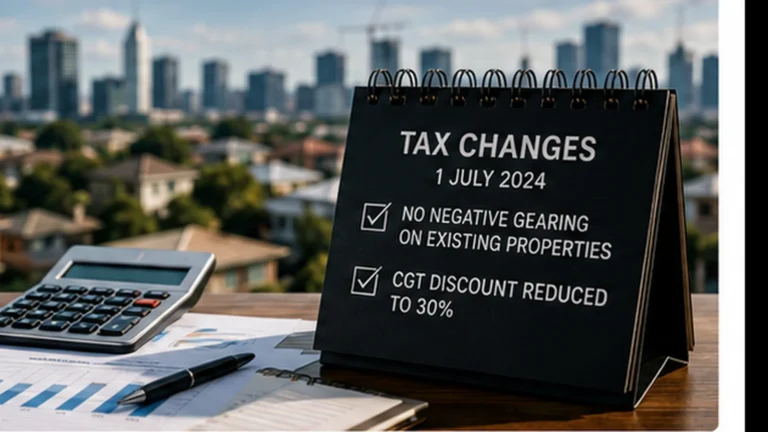
From 1 July 2027, the federal government intends to limit negative gearing for residential property investments to new builds. Existing arrangements are set to remain unchanged for properties held before Budget night, while new builds will keep access to the concession.
The policy logic is clear enough: direct investor tax support away from established homes and towards new supply.
But the practical result depends on behaviour.
If investors shift into new housing quickly, the policy could support new projects and improve supply over time. If investors pause, wait for clarity or decide the numbers no longer stack up, the near-term effect could be weaker demand for projects that need buyers before they can proceed.
That is the trade-off.
Australian Property Review has looked at this broader issue in Property Industry Confidence Has Turned Negative, Here’s Why It Matters, where the key point was that policy design and market confidence do not always move at the same speed.
The government may want capital to flow into new homes. The market still has to decide whether the risk-adjusted return is worth it.
The apartment problem is the pressure point
The 20.7 per cent quarterly fall in new private sector “other residential” commencements is the number to watch.
That category includes apartments and attached dwellings. It matters because higher-density housing is usually where supply can be added closer to jobs, transport and services.
It is also where feasibility can be fragile.
A project can look viable when rates are lower, build costs are stable and buyers are confident. Change those assumptions and the margin can disappear.
Developers then have three options:
Delay the project.
Redesign or reduce the scope.
Walk away.
None of those options adds homes quickly.
For investors, this is where the headline debate about tax can become too narrow. Negative gearing is only one variable. Yield, strata costs, vacancy risk, settlement timing, build quality, resale demand and interest rates still matter.
A tax setting can improve the after-tax position of a new build, but it cannot rescue a weak deal on its own.
For a deeper investor angle, read Australian Property Review’s Negative Gearing Changes Open Investor Risk.
Renters feel the shortage first
When supply falls behind, renters usually feel it before anyone else.
That does not mean every suburb sees the same rent increase. Local vacancy, wages, household formation and new stock all matter. But at a national level, weak construction makes the rental market less forgiving.
The second-order effect is simple.
If fewer new homes are started today, fewer homes are completed later. If population and household demand keep growing during that lag, rental competition remains tight.
This is why the Housing Accord is not just a builder story. It is a renter story, a first-home buyer story and an investor risk story.
A renter may not care whether a project failed because of financing, planning, labour or tax uncertainty. The practical result is the same: fewer choices and less bargaining power.
Australian Property Review has covered that pressure in Negative Gearing Changes Risk a Rental Market Squeeze.
What changed and what didn’t
What changed is the construction momentum.
The March quarter showed a clear fall in new dwelling starts, especially in higher-density housing. That makes the Housing Accord’s delivery task harder.
What did not change is the underlying need.
Australia still needs more homes. Renters still need more choice. Buyers still need more affordable entry points. Investors still need deals that work on cashflow, not just tax treatment.
The key issue is not whether Australia needs the 1.2 million-home target. It is whether the system can physically deliver it.
That system includes planning approvals, infrastructure, builders, materials, skilled labour, finance, pre-sales, investor demand and buyer confidence.
One weak link can slow the whole chain.
What could derail the catch-up
There are four risks to watch over the next 6 to 12 months.
First, interest rates. Higher borrowing costs reduce what buyers can pay and make development finance harder to absorb.
Second, construction costs. If labour, materials and insurance keep rising faster than selling prices, more projects will fail feasibility tests.
Third, investor hesitation. If tax reform creates uncertainty before it creates new-build demand, projects that rely on investor pre-sales may struggle.
Fourth, planning and infrastructure delays. Even strong demand cannot produce homes quickly if sites are not serviced, zoned and approved.
The base case is that supply improves slowly, but not fast enough to remove pressure from rents and prices in the near term.
The upside case is that rate cuts, planning reform and clearer tax rules bring buyers and developers back into the pipeline.
The downside case is that commencements stay weak while demand remains firm, leaving renters and first-home buyers competing in an even tighter market.
The practical take
If you are a buyer, renter or investor, do not treat the Housing Accord as a guarantee of easier conditions.
Treat it as a supply test.
For buyers, watch new listings, local completions and borrowing capacity, not just national targets.
For renters, assume tight conditions remain possible unless your local area has a visible lift in completed stock.
For investors, pressure-test every deal before tax. A simple rule of thumb: if the property only works because of the tax treatment, the margin is probably too thin.
Start here: check the construction pipeline in the suburb or region you are watching before making a decision based on national headlines.
If you want the weekly signal, subscribe to the free Australian Property Review newsletter: newsletter.apreview.com.au
General info, not financial advice.