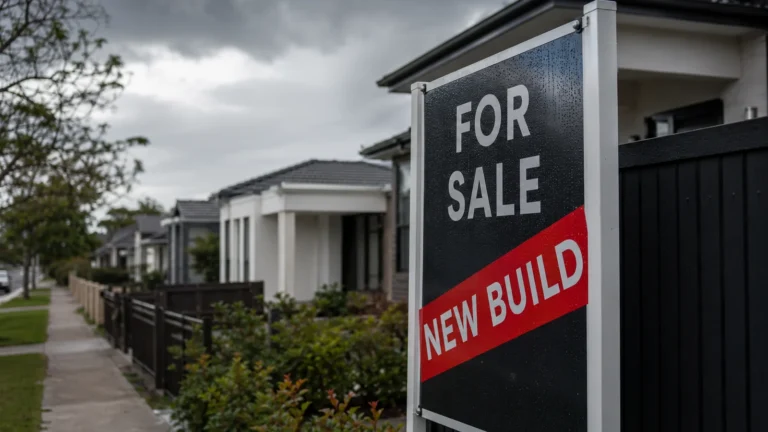
Labor’s negative gearing changes were sold as a fairness reform. The political target is clear: reduce investor competition for established homes and give first-home buyers a better chance.
That is the clean version.
The harder question is what happens in the property market before extra housing supply actually arrives.
The federal government has announced reforms that limit negative gearing benefits for residential property to new builds from 1 July 2027, while changes to the capital gains tax discount are also part of the broader tax package. Existing investors are expected to be protected through grandfathering, which means many current arrangements continue for assets already held. (Australian Parliament House)
That matters because the housing market does not move neatly from one policy setting to another. It adjusts through prices, rents, borrowing power, confidence and behaviour.
For property investors, the new front is not just tax. It is uncertainty.
The policy aim is simple. The market response is not
The government’s argument is that investor tax benefits should do more to add housing supply, rather than help investors compete for homes that already exist.
In plain English, negative gearing lets an investor offset rental losses against taxable income. If that benefit is restricted for established homes but retained for new builds, investors have a stronger reason to look at new apartments, townhouses and house-and-land packages.
That could help developers secure buyers for new projects. It could also shift investor demand away from older houses and units that first-home buyers are trying to buy.
So far, that is the best-case version.
Here’s the catch. New homes are not built instantly.
A first-home buyer can inspect an established home this weekend and settle in weeks. A new apartment project can take years to approve, fund, build and complete. In between, the market has to absorb a change in investor behaviour before the supply response is fully visible.
Australian Property Review has already examined this timing problem in Negative gearing changes put housing supply on notice, where the central risk is confidence before projects even start.
What changed and what did not
What changed is the incentive structure.
New investors looking at established residential property face a different after-tax calculation. The tax system is being used to encourage capital into new housing rather than existing stock.
What did not change is the basic maths of property investment.
A property still needs rent, resale demand, manageable costs, finance approval and a margin of safety. A tax benefit can improve the after-tax outcome, but it does not rescue a weak asset.
That is where some investors may get caught.
If a new apartment only works because of the tax treatment, the risk may be doing more work than the return. Body corporate costs, settlement valuations, vacancy risk and local oversupply still matter.
A simple rule of thumb: if the deal fails before tax, do not let the tax rule do all the heavy lifting.
Quick take:
Negative gearing changes may redirect investor demand into new housing. That can support supply over time, but investors still need to pressure-test yield, vacancy, settlement risk and resale demand before buying.
First-home buyers may not get instant relief
The reform is aimed partly at helping younger Australians into home ownership. Treasury and the government have argued the changes should improve access for first-home buyers, with the Prime Minister defending the policy on the basis that home ownership has become too hard for younger Australians.
But affordability is not controlled by tax settings alone.
First-home buyers still face deposit hurdles, serviceability tests, income limits, interest rates and competition from other buyers. Even if some investors retreat from established homes, that does not automatically make a suburb affordable.
The outcome may split by market.
In some established-home markets, weaker investor demand could reduce heat at auction or slow price growth. In lower-priced new apartment markets, the opposite may happen. Investors who still want tax support could move into the same stock that first-home buyers use as an entry point.
Australian Property Review has already covered this issue in Negative gearing shake-up sends investors into new apartments. The key risk is crowding in the affordable new-build segment.
Now, the part most people miss: policy can reduce competition in one lane and increase it in another.
The supply target is still the hard part
The government’s housing ambition sits around the National Housing Accord target of 1.2 million new homes over five years. Australian Property Review has previously reported that the National Housing Supply and Affordability Council forecast points to a material shortfall against that target, with projected completions well below the 1.2 million goal. (Australian Property Review)
That is the core tension.
Tax reform may change where investors look. It does not automatically solve planning delays, infrastructure bottlenecks, construction costs, labour shortages or development finance.
A housing target is not a completed dwelling. A zoning change is not a finished apartment. A budget measure is not a tenant with keys.
This is why the negative gearing changes should be seen as part of the housing system, not a stand-alone fix.
For more on the delivery bottleneck, read Australian Property Review’s analysis of Australia’s housing shortfall and house price outlook and Housing infrastructure crisis threatens home targets.
Investors face a confidence test
Markets dislike uncertainty because uncertainty makes buyers pause.
That does not mean investors will disappear. Many will keep buying. Some will pivot to new builds. Some will hold existing properties longer because grandfathered tax treatment may become more valuable. Others may reduce exposure if the numbers no longer stack up.
The second-order effect is important.
If existing landlords hold rather than sell, listings could tighten in some areas. If new investors avoid established rentals, some suburbs may see fewer rental properties added. If capital floods into selected new-build projects, prices in that segment may rise before the promised supply benefit arrives.
None of these outcomes is guaranteed. They are the pressure points to watch.
The base case is a split market:
- established investor stock faces more caution
- new-build projects get more attention
- first-home buyers get some relief in certain areas, but not all
- renters remain exposed if supply takes too long
- developers still need projects to be financially viable
That is not a clean win or loss. It is a trade-off.
The rent risk sits in the timing
The government wants investment to support new supply. That logic has merit.
But rental markets operate in the present tense.
A renter does not live in a forecast. They live in available stock. If investor demand for established homes weakens faster than new rental supply is completed, vacancy pressure could stay tight in some suburbs.
That is why investors and renters should watch vacancy rates, not just national policy headlines.
Vacancy risk means the risk that a property sits empty or that rental competition shifts against the landlord. In today’s market, the greater concern in many areas is the opposite: too few available rentals. But if too many similar new apartments complete in one pocket at the same time, local vacancy risk can still rise.
Both things can be true.
Australia can have a national housing shortage and still have local oversupply in a specific apartment precinct.
What would change the outlook
Three things would make the policy look stronger.
First, faster new supply. If approvals, infrastructure and construction delivery improve, the investor shift into new builds could help add homes rather than just reshuffle demand.
Second, stable credit conditions. If rates and serviceability settings become less restrictive, more buyers and developers can make projects work.
Third, clear implementation. Investors can adapt to tough rules. They struggle more with rules that feel unsettled or politically vulnerable.
Three things would make the risk worse.
A deeper pullback in investor lending would reduce demand for rental stock. Construction delays would push the supply benefit further out. Another round of policy changes would increase the chance that investors sit on their hands.
The practical take
If you are an investor, do not start with the tax rule. Start with the asset.
Pressure-test the rent, vacancy rate, body corporate costs, local supply pipeline, resale demand and settlement risk. Then run the numbers again without optimistic capital growth.
If you are a first-home buyer, do not assume the policy makes every market easier. Watch where investors are being redirected. In some new-build segments, competition may rise rather than fall.
Start here: before signing a contract, compare the property’s pre-tax cashflow with its after-tax outcome. If the investment case only works after the deduction, the buffer may be too thin.
Want the weekly signal without the property spin? Subscribe to the free Australian Property Review newsletter.
General info, not financial advice.