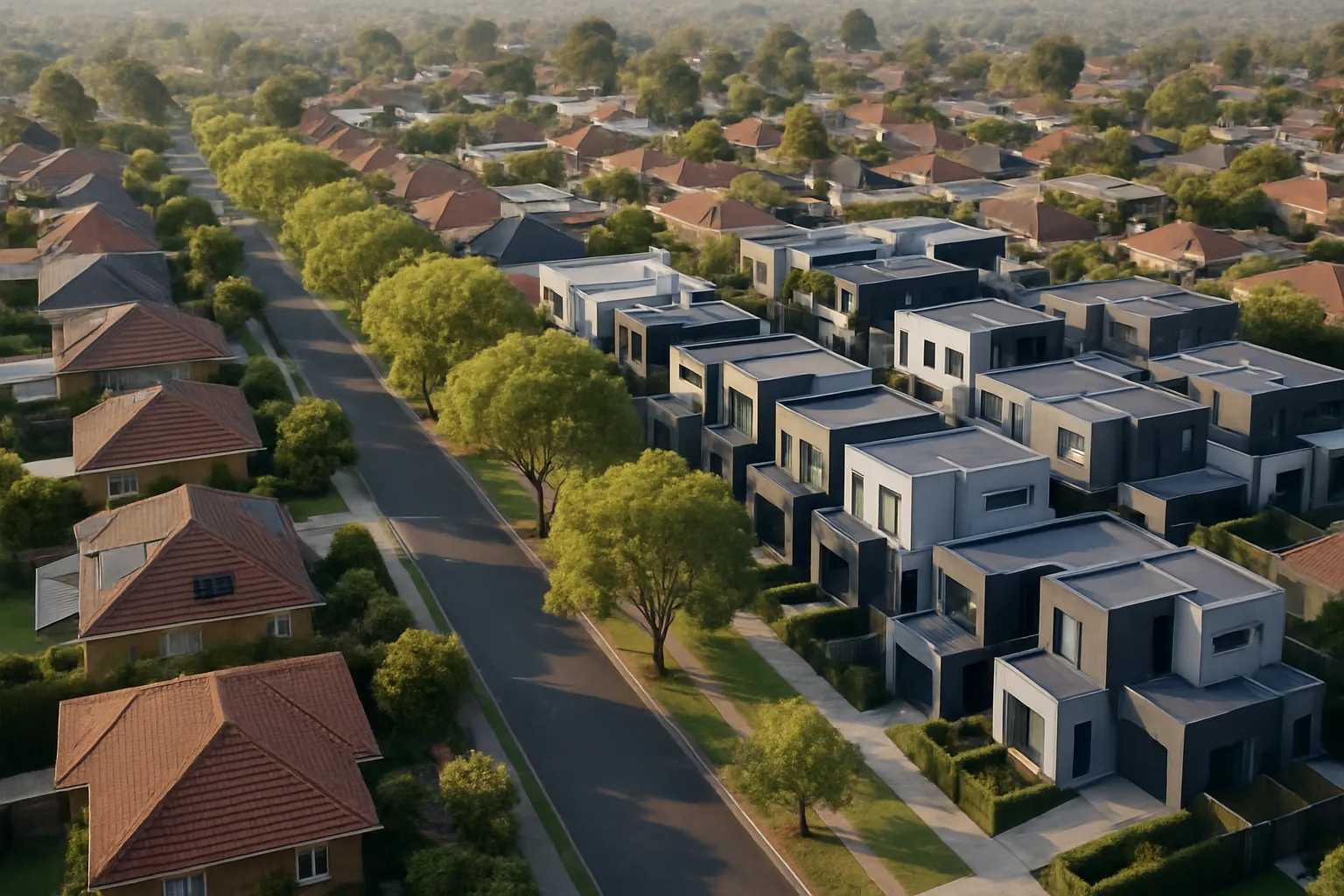
A four-bedroom townhouse in Mount Waverley’s secondary school zone is expected to sell for $1.25 million to $1.35 million, roughly $400,000 below what a comparable detached house would cost in the same catchment. The gap exists because buyers sacrifice land and backyard space but gain a renovated interior they’d otherwise spend $150,000 to $250,000 creating themselves, at a time when construction costs make extensions prohibitive.
The property at 46 Gordon Road has street frontage, its own driveway, and no active owners corporation, features that blur the line between townhouse and house. It underwent a three-year transformation by its owner, who reconfigured the ground floor, updated kitchens and bathrooms with stone benchtops and Italian porcelain, and retained the Tudor-style exterior while modernising the interior. The owner initially planned to stay long term but is now selling, with auction scheduled for mid-August.
Why the $400k discount exists
Melbourne school zone property savings of this scale hinge on three factors working simultaneously. First, detached houses in high-demand school catchments, Mount Waverley Secondary College, in this case, command a premium that pushes median prices well above $1.6 million. Second, construction costs for extensions or full renovations have climbed to the point where buyers prefer paying for completed work rather than managing trades. Third, buyers willing to accept a smaller allotment and less outdoor space can access the same school zone, proximity to transport, and internal footprint at a material discount.
The townhouse delivers four bedrooms, two bathrooms, and a ground-floor room suitable as a study or bedroom, comparable internal space to many older detached houses in the area. The difference is the land: townhouses typically sit on 250 to 350 square metres, while detached houses in the suburb average 600 to 800 square metres. For families prioritising school access and walkability over backyard size, the trade-off pencils.
The renovation premium buyers avoid
Replicating the Gordon Road renovation, stone benchtops, Ilve appliances, heated towel rails, anti-fog mirrors, floor-to-ceiling tiles, would cost $150,000 to $250,000 depending on scope and finishes, based on current Melbourne construction rates. Bathrooms represent the highest cost per square metre due to waterproofing, tiling, and trades coordination. Kitchens follow, particularly when buyers upgrade appliances and stone.
Buyers considering older detached houses in the same price range face a choice: purchase at $1.25 million and spend $200,000 on renovations, or buy a renovated townhouse at $1.3 million and move in. The second option eliminates construction risk, trade delays, and the need to live through a renovation. With fixed-rate construction loans harder to secure and builder insolvencies still elevated, the certainty of a completed fit-out carries weight.
Where this strategy doesn’t apply
The $400,000 saving only materialises in suburbs where school zone premiums are steep enough to create the gap. Mount Waverley Secondary College is one of Victoria’s most sought-after zones, which inflates detached house prices and makes the townhouse alternative viable. In suburbs with less competitive school catchments, or where townhouse and house prices converge, the discount shrinks or disappears.
Buyers also need to accept the land constraint. A 300-square-metre allotment limits outdoor entertaining, vegetable gardens, and future extension options. Families with young children or those who value outdoor space may find the trade-off unworkable regardless of the dollar saving. The internal footprint is larger, but the external flexibility is gone.
Strata and owners corporation dynamics matter, even when inactive. While 46 Gordon Road has no active owners corporation and separate insurances, other townhouses in similar zones operate under body corporate structures that impose fees, restrict renovations, and require consensus for exterior changes. Buyers need to verify governance arrangements before assuming a townhouse offers the same autonomy as a house.
School zone premiums: how long they hold
Melbourne’s school zone premiums are sticky because supply in catchment areas is fixed and demand is driven by families with school-age children who can’t wait for market timing. Mount Waverley Secondary College’s reputation has been entrenched for decades, which sustains the premium even during broader market corrections. However, two risks could erode the $400,000 gap over the next 12 to 24 months.
First, if detached house prices in the suburb fall faster than townhouse prices, possible if investor demand softens or borrowing capacity tightens further, the relative discount narrows. Second, if construction costs decline due to reduced material prices or increased builder competition, the renovation premium buyers avoid by purchasing a completed townhouse shrinks, making the detached-house-plus-renovation path more attractive again.
State government policy on school zoning also introduces uncertainty. Rezoning decisions, new school builds, or changes to catchment boundaries can shift demand and premiums within 12 months. Buyers banking on a school zone’s stability need to monitor Department of Education announcements and enrolment trends.
Comparable suburbs where the math works
Beyond Mount Waverley, the same dynamic plays out in Glen Waverley (Glen Waverley Secondary College zone), Balwyn (Balwyn High School), and Bentleigh East (McKinnon Secondary College). In each case, detached house medians exceed $1.5 million, construction costs remain elevated, and renovated townhouses in the same catchments trade $300,000 to $500,000 below comparable houses.
The strategy works best in middle-ring suburbs with established school reputations, higher land values, and sufficient townhouse stock to provide options. Inner-city suburbs like Kew and Hawthorn have school zone premiums but fewer townhouses, which limits supply and narrows the discount. Outer suburbs like Cranbourne or Pakenham have lower land values, so the detached-house-versus-townhouse gap is smaller in dollar terms even if percentage discounts are similar.
Callout: In plain English
You’re paying $400,000 less than a house in the same school zone, but you’re giving up land, outdoor space, and future extension options. The internal footprint is comparable, the renovation is done, and you avoid construction risk. It works if school access and walkability matter more than backyard size, and if you’re confident the school zone premium won’t erode before you need to sell.
If you’re deciding now
Start by calculating the true cost of the detached alternative: purchase price plus realistic renovation budget (get three quotes, not one), plus holding costs during construction, plus the risk buffer for delays or cost overruns. Compare that total to the renovated townhouse price. If the gap is $300,000 or more, the townhouse likely delivers better value unless land size is non-negotiable.
Verify the school zone boundaries with the Department of Education, don’t rely on agent claims or outdated maps. Confirm the property’s title, owners corporation status, and any restrictions on future modifications. If the townhouse has an active body corporate, request financial statements and meeting minutes for the past two years to assess levy stability and governance.
Model your exit scenario. If you plan to hold for five to seven years, will the school zone premium still exist? If enrolments decline or a new school opens nearby, your resale pool shrinks. If you’re buying primarily for school access and plan to move once children finish secondary school, the shorter hold period reduces long-term zoning risk.
For a deeper look at when renovation budgets justify the effort versus buying completed work, see Renovation strategy in Newtown: when the numbers work and when they don’t. If you’re concerned about holding through a correction, Negative equity risk: who’s exposed and what it takes to tip breaks down the thresholds.
Subscribe to the weekly Australian Property Review newsletter for school zone updates, renovation cost tracking, and suburb-level signals that shift the math on decisions like this.
General info, not financial advice.