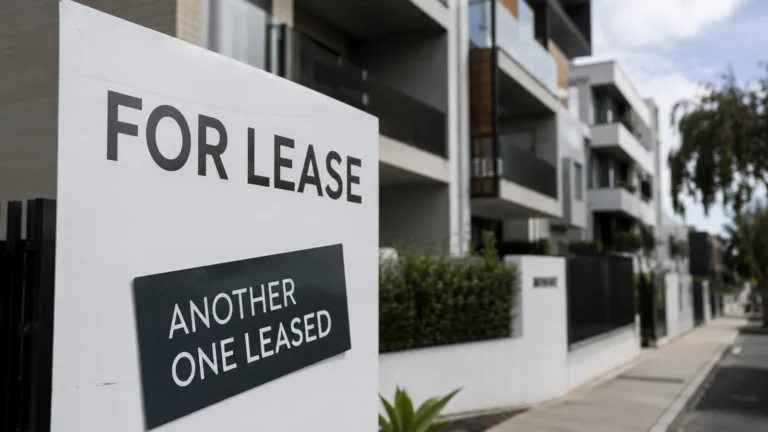
A Sydney tenant paying $700 weekly for a one-bedroom apartment near the beach now pays $800. The jump came after the May federal budget overhauled negative gearing and capital gains tax settings to steer investors toward new builds instead of existing stock. The question: is this one tenant’s experience an early signal of the rental-supply squeeze economists predicted, or an outlier in a market already under pressure?
The policy mechanics are straightforward. Investors who previously claimed tax deductions on losses from existing rental properties can no longer do so under the new rules. Capital gains tax concessions were also trimmed for sales of established homes. The intent was to redirect capital toward new construction and ease competition for owner-occupiers. The trade-off, flagged by critics during the budget debate, was fewer investor landlords buying existing stock to rent out, which meant less rental supply at a time when tenant demand was already rising.
What the citywide numbers show
PropTrack data covering the June quarter, one additional month since the reforms took effect, recorded Sydney house rents climbing 6.3 per cent, or roughly $50 weekly, to a record $850. Unit rents rose 4 per cent, adding $30 weekly on average. Quarterly increases of this magnitude are not unprecedented in Sydney’s rental market, but the timing and the concentration of rises in previously affordable suburbs point to tightening supply rather than seasonal drift.
Some tenants across the city reported rent hikes exceeding $150 weekly over the same three-month window, often translating to double-digit percentage increases. The common thread in the data: fewer new rental listings coming to market while tenant demand held steady or grew, driven by migration inflows and household formation that outpaced new dwelling completions.
The supply equation and what drives it
Investor activity influences rental supply in two ways. First, investors who buy existing homes and rent them out add immediately to the available rental stock. Second, investors who buy new builds also add supply, but with a construction lag. The budget changes were designed to shift the mix toward the second category. The risk, now playing out in real time, is that the first category contracts faster than the second can scale up.
Early signals from lending data and auction clearance rates suggest investor participation in the established-home market has pulled back since May. New-build sales have not yet risen enough to offset that withdrawal. Construction timelines for apartments typically run 18 to 24 months, so even if investor appetite for new stock picks up in the next two quarters, the rental supply benefit will not materialise until 2027 at the earliest.
The maintenance and quality angle
The tenant whose story prompted this analysis also reported discovering mould in the apartment shortly after moving in. The landlord’s agent advised her to clean more frequently, buy a dehumidifier and run a fan. She now cleans walls weekly and washes all clothing fortnightly to manage the issue, spending her own money on mould-prevention products.
This detail matters beyond one tenant’s frustration. Rental stock quality and landlord responsiveness to maintenance requests are separate policy debates, but they intersect with the supply question in a predictable way: when vacancy rates are low and rent growth is steep, tenants have less leverage to demand repairs or negotiate terms. A landlord who knows another tenant will take the property if the current one leaves has less incentive to address non-urgent maintenance. Tight supply amplifies existing quality problems.
Scenario planning: how this could play out
Base case: investor activity in established homes stays subdued for the next 12 months. New-build investor purchases rise modestly but construction delays mean rental supply grows slowly. Rents continue climbing at 4 to 7 per cent annually in Sydney, with sharper spikes in suburbs where affordability previously attracted high tenant demand. Vacancy rates stay below 2 per cent.
Upside (for tenants): construction productivity improves, planning approvals accelerate, and a higher share of new apartment projects reach completion by late 2026. Rental supply growth catches up to demand growth by mid-2027, and rent increases moderate to 2 to 3 per cent annually.
Downside: migration stays elevated, construction costs and financing challenges delay new projects further, and more investors exit the rental market entirely rather than shifting to new builds. Rental supply contracts in real terms. Rents rise 8 to 12 per cent annually through 2026, and affordability stress pushes more households into share arrangements or further from employment centres.
Key numbers
Sydney house rents: $850/week (June quarter), up 6.3% or $50/week. Unit rents: up 4% or $30/week. Reported individual increases: $100 to $150+/week in some cases. Vacancy rate (last available): sub-2%. Construction lag for new apartments: 18-24 months from sale to completion.
Risks worth tracking
The policy assumes new-build investor appetite will rise enough to replace the lost established-home supply. That assumption rests on: developers bringing enough projects to market at price points investors find viable; banks lending to investors for off-the-plan purchases at similar rates to established-home loans; and construction finishing on schedule without further insolvencies or material shortages.
Any one of those could stall. Developer margins are already under pressure from higher building costs and slower pre-sales. Lender appetite for construction-linked loans tightened after recent builder collapses. If the new-build pipeline does not scale as forecast, the rental supply gap widens further.
The second risk is tenant mobility. If rent growth in Sydney consistently outpaces wage growth, which it has over the past 18 months, more renters will either move to regional areas with lower rents or increase household density by taking on additional housemates. Both responses reduce per-capita housing costs but also reduce overall quality of life and economic participation. The policy debate tends to focus on supply numbers; the lived experience is stress, trade-offs and delayed decisions.
The practical adjustment
If you are renting in Sydney or another capital city where similar dynamics are emerging, start by pressure-testing your rent-to-income ratio now, not when the next lease renewal notice arrives. The 30 per cent guideline (rent as a share of gross household income) is a rough benchmark; anything above 35 per cent limits your ability to save or absorb other cost increases. Run a 30-day cashflow test to see where the margin actually sits.
If you are an investor weighing whether to hold an existing rental or sell, model the after-tax return under the new rules against your alternative uses for the capital. The loss of negative gearing does not make every established rental unviable, but it does change the return profile. Compare your net rental yield (after all costs, including the lost tax benefit) to what you could earn in other asset classes with similar risk. If the gap is wide, selling may be the rational move, but recognise that decision adds to the supply contraction.
If you are tracking the market as a prospective buyer (renter or owner-occupier), watch new-build approvals and construction commencement data from the Australian Bureau of Statistics monthly. Those numbers, with an 18-month lead time, will tell you whether the supply response is real or wishful thinking. Also track investor lending volumes (available via Australian Prudential Regulation Authority updates) to see whether the shift to new builds is actually happening or whether investors are exiting altogether.
For a broader take on how household budgets are adjusting to cost pressures across rent, groceries and utilities, see the cost crunch analysis.
What happens if this continues
If rental supply does not catch up to demand over the next 12 to 18 months, the affordability question escalates from a financial stress issue to a structural economic one. Workers priced out of rental markets near employment centres either move further out (raising commute costs and time) or leave the city entirely. That reduces labour supply in the sectors that depend on it, hospitality, retail, healthcare, education, and creates its own wage and inflation pressures.
The political response, if rent growth stays in the high single digits annually, will likely involve further intervention: rent caps, expanded social housing funding, or a reversal of parts of the budget changes. Each carries trade-offs. Rent caps reduce landlord returns and can further discourage investment. Social housing takes years to deliver at scale. Reversing the negative gearing changes puts the policy back where it started, with investors competing against first-home buyers for established stock.
There is no perfect answer. The current settings assume the market will self-correct through new supply. The early data suggests that correction is not happening fast enough to prevent rental pain in the interim.
One clear next step
If your rent has jumped or you expect it will at the next renewal, calculate your maximum sustainable rent now, before the lease notice forces the decision. Take your monthly after-tax income, multiply by 0.30, divide by 4.33 to get the weekly figure. That is the upper limit before other financial goals (saving, debt repayment, cashflow buffer) start getting squeezed out. If your current or expected rent sits above that line, you have three months to either negotiate, find a cheaper property, or adjust your income. Waiting until the lease expires leaves you negotiating from a weaker position in a tight market.
Subscribe to the weekly analysis to track how this plays out across the capital cities and whether the new-build supply response materialises as forecast.
General info, not financial advice.