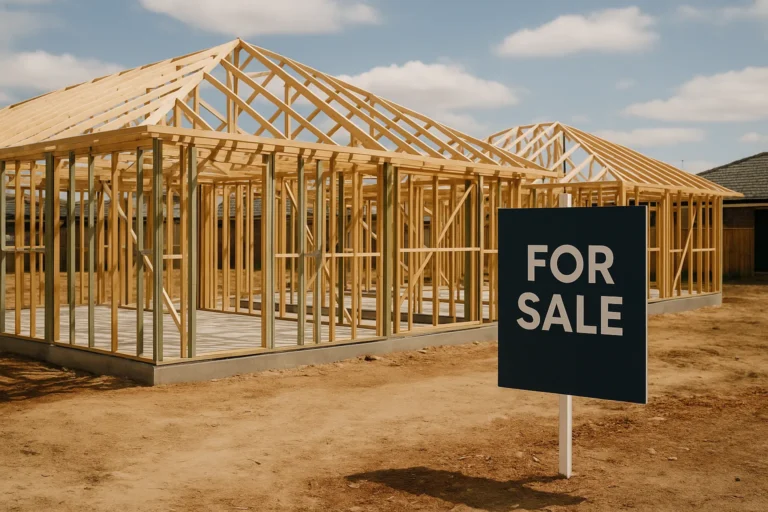
A proposal to strip mandatory energy efficiency standards from new homes has reignited the oldest tension in housing: upfront cost versus lifetime running expense. Industry submissions claim recent construction-code changes added between $3,600 and $33,000 to each build. Government modelling says the current seven-star energy rating lifted capital costs by less than 1%. The gap matters because it determines whether relaxing the rules delivers cheaper homes or just shifts the bill from builder to buyer, compounding over decades.
The policy would cut the National Construction Code from more than 2,000 pages to 80, making energy and accessibility measures optional rather than mandatory. The pitch is that buyers should choose their own trade-offs. The counter-argument is that buyers who skip energy features today will pay for it every billing cycle for the next 20 to 30 years, and resale value will suffer as efficient stock becomes the baseline.
What the numbers show
The current seven-star standard requires new homes to maintain comfortable temperatures with less heating and cooling energy than older builds. Government analysis found the capital-cost increase was under 1% of total construction spend. Separate research by the Reserve Bank and CSIRO found construction costs stayed flat or declined after previous energy-rating lifts, suggesting builders absorbed the changes through design and material efficiencies rather than passing them on in full.
Industry groups dispute this, pointing to cumulative code changes over seven years. Their $3,600 to $33,000 range reflects varied home sizes, climate zones and baseline specifications. The wide spread suggests inconsistent measurement: a $33,000 claim likely bundles accessibility, fire safety and other non-energy updates alongside insulation and glazing upgrades.
What is not disputed: running costs. Homes built to lower energy standards use more power for heating and cooling. In western Sydney or outer Melbourne, where summer peaks hit 40°C and winter lows drop near zero, a poorly insulated home can add $1,000 to $2,000 per year in energy bills compared to a seven-star equivalent. Over a 20-year ownership period, that compounds to $20,000 to $40,000 in today’s dollars, before factoring in real energy-price increases.
Key numbers
- Current seven-star standard lifted build costs by less than 1%, per government analysis
- Industry groups claim recent code changes added $3,600 to $33,000 per home
- Poorly insulated homes in climate-extreme areas can cost $1,000–$2,000 extra per year in energy bills
- Over 20 years, that gap totals $20,000–$40,000 in additional running costs
- RBA and CSIRO found construction costs flat or down after previous energy-rating increases
Who carries the cost under optional standards
If energy measures become optional, volume builders will likely offer two tiers: a base model without upgraded insulation or double glazing, and a premium version with energy features at extra cost. Buyers stretching to enter the market will default to the cheaper option. First-home buyers using maximum borrowing capacity have no headroom to add $10,000 for better windows when that same $10,000 buys more floor area or a better location.
The risk concentrates on renters and lower-income owner-occupiers. A landlord building an investment property has no incentive to pay for energy efficiency when tenants pay the electricity bill. A buyer who skips insulation to meet settlement saves today but faces higher bills every quarter. If energy prices stay elevated or climb further, the lifetime cost of that decision multiples.
Resale becomes the second-order effect. As newer stock is built to seven-star or higher, older or code-exempt homes become the bottom tier. Buyers comparing a 2027-built home with no energy features against a 2025-built seven-star equivalent will factor running costs into their bid. The price gap widens over time as energy costs compound and climate-conscious buyers preference efficient stock.
The two-tier market scenario
Optional standards create a split: newer builds with energy features hold value, while budget builds and rentals cluster at the low end. This is not hypothetical. Markets with weak energy regulation already show the pattern: older, poorly insulated homes in climate-extreme areas sit longer on the market and sell at discounts once buyers model the true cost of ownership.
The political framing is that regulation blocks affordability. The economic framing is that removing minimum standards transfers cost from builders to buyers, and from upfront capital to lifetime expense. Builders save on materials and labour today. Buyers pay higher bills for 20 years and face a resale penalty when efficient homes set the benchmark.
For investors, the equation tilts further: build cheap, collect rent, let tenants absorb energy costs. Returns look better on paper because capital outlay is lower, but tenant churn may increase if bills become unmanageable in poorly insulated stock. Vacancy risk climbs in markets with better-quality rental alternatives.
Trade-offs and what remains unknown
The strongest case for optional standards is that buyers should decide their own trade-offs based on climate, budget and how long they plan to stay. A retiree downsizing to a mild-climate area may not need the same insulation as a young family in a temperature-extreme zone. The weakest case is that information asymmetry and time-horizon mismatch mean most buyers will under-invest in features that pay off over decades, not months.
What would change the calculus: if energy prices fall sharply and stay low, the lifetime-cost penalty shrinks. If construction-code compliance genuinely adds $30,000 per home and removing it brings that saving straight through to buyers, the upfront relief may justify higher bills later. Neither assumption is the base case. Energy prices have trended up, and builder margins absorb part of any regulatory saving rather than passing it on in full.
State-by-state codes could allow regional tailoring, but the argument that a national code ignores climate variation misreads how it works. The existing code already incorporates eight climate zones with different performance requirements. A home in Tasmania does not face the same insulation spec as one in Darwin. What a national framework provides is consistency in testing, compliance and material standards, which lowers industry costs and makes cross-border projects simpler.
Practical implications for buyers and investors
If optional standards proceed, buyers face a new decision at contract stage: pay more now for energy features, or accept higher running costs later. The rational choice depends on ownership horizon, climate zone and financing headroom. A buyer planning to hold for 15-plus years in a temperature-extreme area should model the energy saving and factor it into their build budget. A buyer stretching maximum serviceability to get into the market may have no choice but to skip upgrades and wear the bill.
Investors building new stock need to weigh tenant appeal and holding costs. Skipping energy features lowers upfront spend but may increase vacancy or tenant complaints if bills become unmanageable. Markets with strong rental demand and low vacancy can absorb lower-quality stock. Softer markets cannot.
For existing owners, the policy creates a relative advantage if their home already meets or exceeds seven-star equivalency. As new builds without energy standards enter the market, well-insulated existing stock holds value better. The gap will show first in climate-extreme suburbs where energy costs are highest.
Anyone making a build or buy decision in the next 12 months should pressure-test the energy-cost assumption. Get a bill estimate for your climate zone under different insulation scenarios, model it over your expected ownership period, and compare that to the upfront cost of upgrades. The trade-off is not abstract: it is a number you can calculate, and it compounds every year you hold the property. For more on how policy shifts affect investment decisions, see Property Tax Changes: 5 Wealth Moves Investors Must Check.
If you want the policy breakdown and market-impact analysis each week, subscribe to the newsletter.
General info, not financial advice.