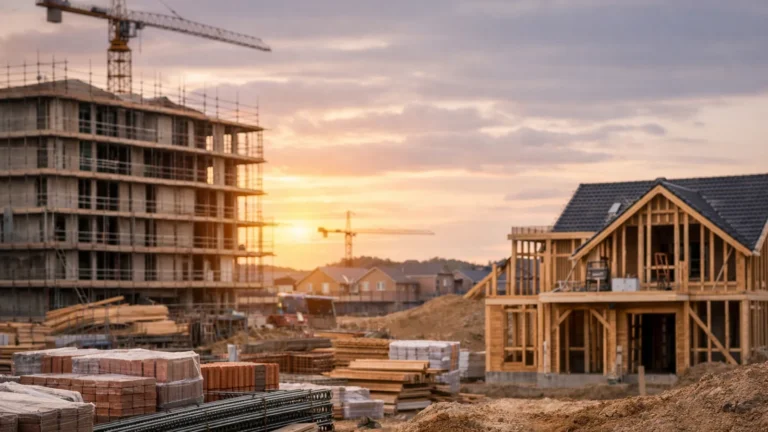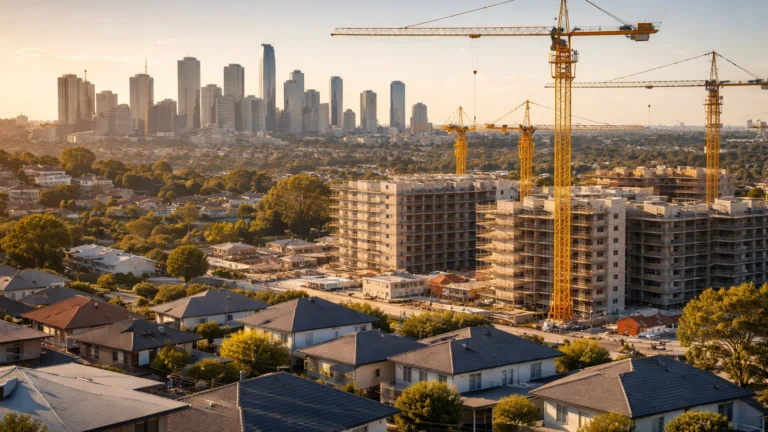
The federal government’s 1.2 million home target is running more than 100,000 approvals behind schedule halfway through year two, with cumulative approvals sitting at 393,426 since the National Housing Accord began. The accord’s arithmetic requires 240,000 completions a year, which means at least 250,000 approvals annually given the gap between approval and construction. By this point, the nation needed 500,000 approvals to stay on track. It has 78 per cent of that figure.
The numbers arrived via ABS data for the year to June 2025, which showed approvals rose 8.4 per cent year on year to 204,649. That lift is welcome but does not close the structural gap. To hit 1.2 million homes by mid-2028, the pipeline now requires approvals running well above 300,000 for the next three years, a 47 per cent jump from the current run rate.
Why the pipeline is slowing
Construction costs rose 5.8 per cent in the year to June, fourteen times the 0.4 per cent increase in the prior twelve months. That compression narrows feasibility for projects already operating on tight margins. Higher borrowing costs compound the pressure, particularly for smaller builders and apartment developers reliant on debt financing.
Labour constraints add a second bottleneck. Major infrastructure commitments across states, including hospital builds and Olympic projects, are pulling trades away from residential construction. With unemployment still low and rental vacancy tight, underlying housing demand remains strong, but the supply side cannot keep pace.
The May budget introduced changes to self-managed super fund borrowing rules, removing the ability for SMSFs to leverage into property, including new builds. That policy shift directly reduces one source of demand for newly approved dwellings, most of which would have entered the rental market. Industry groups have labelled it an own goal when measured against the 1.2 million home objective.
The approval-to-completion lag
Not every approval converts to a build. Feasibility shifts between approval and construction start as rates, costs and sales absorption change. Projects that stacked up commercially twelve months ago may no longer clear the return threshold today, particularly for medium-density and apartment developments where presales are harder to secure.
The current trajectory suggests the nation will finish 305,000 completions short of the accord target, requiring a 49 per cent increase in housing completions from this point forward. That level of acceleration has no recent precedent in the Australian market.
Callout: The catch
Even if approvals jump to 300,000 next year, the time lag between approval and completion means the supply impact will not hit the market until 2027 at the earliest. Short-term rental tightness will persist regardless of policy settings today.
The interest rate trade-off
Some analysts have suggested a rate rise could paradoxically help by cooling build cost inflation. The mechanism: higher rates would price out marginal buyers, reducing builder order books and forcing greater competition on price. The risk is that cooling demand widens the supply gap the policy is meant to close, creating a second-order problem down the track.
The base case is that rates hold steady or ease modestly through 2026, keeping enough buyer demand in the system to support the approval pipeline without overheating build costs. The downside scenario is rates stay higher for longer, feasibility tightens further, and approvals fall below 200,000 again.
Structural constraints beyond policy
Planning bottlenecks remain entrenched in most jurisdictions. Zoning reforms have moved forward in New South Wales and Victoria, but the time from lodgement to shovel-ready approval still averages 18 to 24 months for medium-density projects. Land release schedules in growth corridors are misaligned with infrastructure delivery, leaving approved lots without roads, water or public transport connections.
Regulatory complexity adds cost and delay at every stage. The Productivity Commission’s interim report released recently confirmed what developers see daily: when projects become harder, slower and more expensive to deliver, fewer homes get built. The commission identified workforce shortages, infrastructure constraints and tax settings as compounding factors.
What this means for housing supply medium term
The shortfall reshapes the supply-demand fundamentals for the next three years. Rental markets will stay tight, particularly in capital cities with strong migration and low vacancy. Prices for existing stock will hold firmer than they would have if the pipeline had stayed on track, because the supply buffer will not arrive when originally modelled.
For investors, the dynamics favour markets with visible land supply and infrastructure commitments over those reliant solely on infill density. New South Wales and Queensland have clearer medium-term pipelines than Victoria, where planning delays are compressing approvals despite strong underlying demand.
For first-home buyers, the calculus is whether to build or buy established. Build costs are rising faster than established prices in most markets right now, and completion times are stretching as trades capacity tightens. Buying an existing dwelling avoids construction risk and delivery lag but means paying for scarcity in a market where new supply is not arriving fast enough to ease pressure.
What could shift the trajectory
A material easing in rates or build costs could bring stalled projects back into feasibility, lifting approvals above 250,000 within twelve months. Major planning reforms that compress approval times from 18 months to nine months would accelerate the pipeline, though that level of change has not occurred in any state to date.
The alternative is that costs stay elevated, rates hold higher, and the pipeline continues undershooting the target. That scenario extends rental tightness and price pressure through 2027, with policy interventions arriving too late to change the medium-term supply curve.
What to watch over the next six months
Monthly approval data will show whether the recent lift to 204,649 holds or reverses. A fall below 190,000 in any quarter signals the pipeline is contracting again. State budget announcements in the second half of 2025 will clarify infrastructure spending and planning reform timelines, both of which directly affect feasibility.
SMSF lending data will confirm how much demand the May budget changes removed from the new-build market. If the drop is larger than expected, rental supply tightens further and yields stay elevated longer.
Build cost indices from the major estimators will show whether the 5.8 per cent annual increase moderates or accelerates. If costs keep rising above five per cent annually, the feasibility squeeze gets worse before it improves.
For investors and developers tracking this, the practical question is not whether the target will be missed but by how much, and what that means for pricing and returns in the markets where you operate. If approvals do not clear 250,000 within twelve months, the shortfall becomes structural, not cyclical.
If you want the weekly read on policy shifts and supply fundamentals, subscribe to Australian Property Review’s newsletter.
Related coverage: CGT changes housing supply tax reform | Budget tax shock property trusts investors
General info, not financial advice.