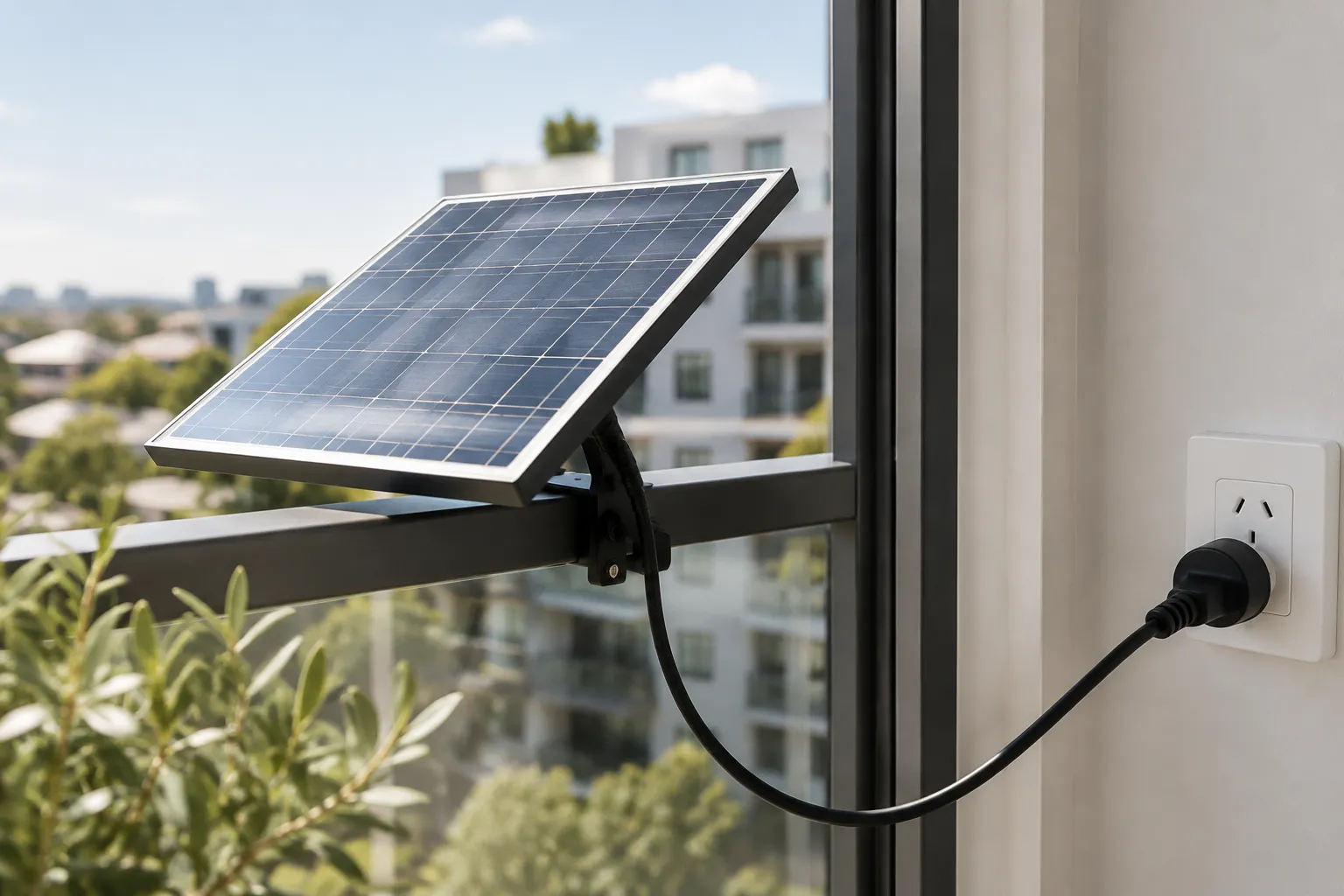
Australia’s energy ministers confirmed they’ll legalise plug-in solar and battery systems that renters install themselves without touching property wiring or asking landlord permission. The technology exists overseas, 800-watt panels that plug into a standard socket, cost $650 to $1,300, and move house when the tenant does. Target rollout is mid-2027, conditional on product standards and network registration rules that ministers will hand to regulators this year.
For landlords holding rental stock, this introduces a variable that hasn’t existed before: tenant-controlled infrastructure that draws power through circuits the landlord owns but doesn’t monitor or approve. The systems don’t require an electrician and won’t be listed on a property condition report because they’re chattel, not fixtures. A tenant plugs one in, it feeds energy back through the socket to offset their fridge and TV load, and when they leave it goes with them.
The immediate question isn’t whether this cuts tenant power bills, it will, by a few hundred dollars a year at 800 watts in a high-use household. The question is how it redistributes operating risk and appeal between landlord and tenant when energy infrastructure stops being the landlord’s capital decision and becomes the tenant’s portable accessory.
Who carries circuit risk when the landlord never sees the panel
Plug-in solar is capped at 800 watts to prevent overloading a standard 10-amp circuit, but that assumes the circuit isn’t already loaded near capacity and that the tenant registers the system with the network as required. A landlord won’t know a panel is installed unless they see it on a balcony during an inspection. If a tenant plugs one into an older circuit that wasn’t designed for reverse power flow, or into a board that’s running multiple high-draw appliances on the same line, the safety cutoff in the inverter is supposed to disconnect instantly when unplugged, but the regulatory framework ministers are building assumes compliance that hasn’t been enforced yet.
The product standard and registration cap will exist by 2027; the enforcement mechanism that ensures every $800 panel bought online actually meets the standard is the gap. Landlords won’t be liable for a tenant’s plug-in device any more than they’re liable for a tenant’s toaster, but if a panel trips a circuit repeatedly or causes a safety callout, the landlord pays the electrician to diagnose it and the tenant may not disclose what they’ve installed until the sparky finds it.
The catch
A tenant can install and remove a plug-in solar panel without the landlord knowing, which means the landlord can’t pre-emptively assess whether the property’s electrical infrastructure, especially in older builds with original wiring or shared circuits, will handle intermittent reverse power flow safely, and won’t know a problem exists until a fault call occurs.
How portable energy systems change tenant selection calculus
A rental property with north-facing balcony space or a usable courtyard becomes incrementally more attractive to cost-conscious tenants if plug-in solar is legal and portable. That’s a marginal competitive advantage in vacancy-tight markets, a tenant choosing between two comparable units may pick the one where they can install their own panel and cut $200-300 off quarterly power bills. For landlords, it’s appeal without capital outlay, but it also means tenants who install panels will stay longer if the next property lacks balcony access or has poor solar orientation, which could compress turnover and reduce rent-setting flexibility in softer markets.
The flipside: properties with no outdoor balcony or courtyard access, common in older low-rise apartments and terrace conversions, lose relative appeal as plug-in solar scales up. A landlord can’t install a balcony to capture that demand, so the building’s existing form factor becomes a fixed constraint that didn’t matter for tenant selection until energy autonomy became portable.
What the $650-$1,300 price point means for upgrade competition
A landlord considering whether to install a full rooftop solar system (typically $4,000-$8,000 for a rental property) now competes against a tenant spending $800 on a plug-in unit that delivers 10-15% of the output but costs nothing to the landlord and moves with the tenant. The landlord’s rooftop system is still the better financial return over a long hold if they’re paying the electricity bill in a lease structure that includes utilities, but that’s rare in Australian residential rentals. Most leases make the tenant responsible for power, which means the landlord’s rooftop solar investment only adds appeal, it doesn’t recoup cost through lower bills they’re not paying.
Plug-in solar shifts that equation further: a tenant who can install their own portable panel has less reason to select a property because the landlord installed solar, and a landlord has less incentive to install a fixed system because the competitive advantage it offers in tenant selection just narrowed. The loser in that scenario is full-system uptake in rental stock, which matters for grid-level renewable penetration but doesn’t change the landlord’s investment return unless future regulation makes energy efficiency a mandatory rental standard or a ratings disclosure requirement.
Scenarios that change the payoff
Base case: plug-in solar becomes legal mid-2027, adoption is gradual, product standards hold, and landlords see no measurable change in operating costs or tenant behavior beyond marginally longer tenancies in solar-suitable properties and slightly shorter marketing periods for units with balcony access.
Upside for landlords: the product standard is strict, enforcement is effective, and plug-in systems reduce tenant complaints about energy costs without adding landlord liability. Properties with good solar aspect become measurably easier to lease, and landlords avoid capital outlay on rooftop systems they wouldn’t recoup anyway.
Downside: cheap imported panels flood the market before the product standard is enforced, non-compliant units cause safety incidents or repeated nuisance tripping, and landlords face electrician callouts and tenant disputes over who’s responsible when a circuit fails. Media coverage links plug-in solar to rental property electrical faults, strata schemes pre-emptively ban balcony installations, and the rollout stalls in apartments where two-thirds of renters actually live.
Practical implications for landlords holding rental stock
If you’re holding units with balconies or courtyards in markets where tenant retention matters, this change marginally improves your competitive position without requiring action. If you’re holding older walk-ups or conversions with no outdoor space, the relative gap widens but not enough to justify retrofit unless you’re already renovating.
The decision point is whether to disclose in lease terms that tenants may install plug-in solar systems and must register them with the network, or wait until the regulatory framework is final and enforcement mechanisms are clear. Early disclosure signals you’re tenant-friendly on energy costs; delayed disclosure avoids setting a precedent before the safety standards are proven in practice.
Landlords considering rooftop solar to add property appeal should pressure-test the return now: if plug-in solar delivers 10-15% of your proposed system’s output at 15% of the capital cost and the tenant controls it, the premium a full system commands in rent may not cover the payback period unless you’re in a market where energy-efficient properties command a documented rent premium and you’re holding long enough to recoup.
Subscribe to the newsletter for the next regulatory update and what it means for rental stock positioning.
General info, not financial advice.