Large-scale greenfield land transactions in Sydney’s outer rings aren’t rare, but they’re usually quiet. When one surfaces with a $700 million asking price during a softening housing market, the underlying assumptions deserve scrutiny.
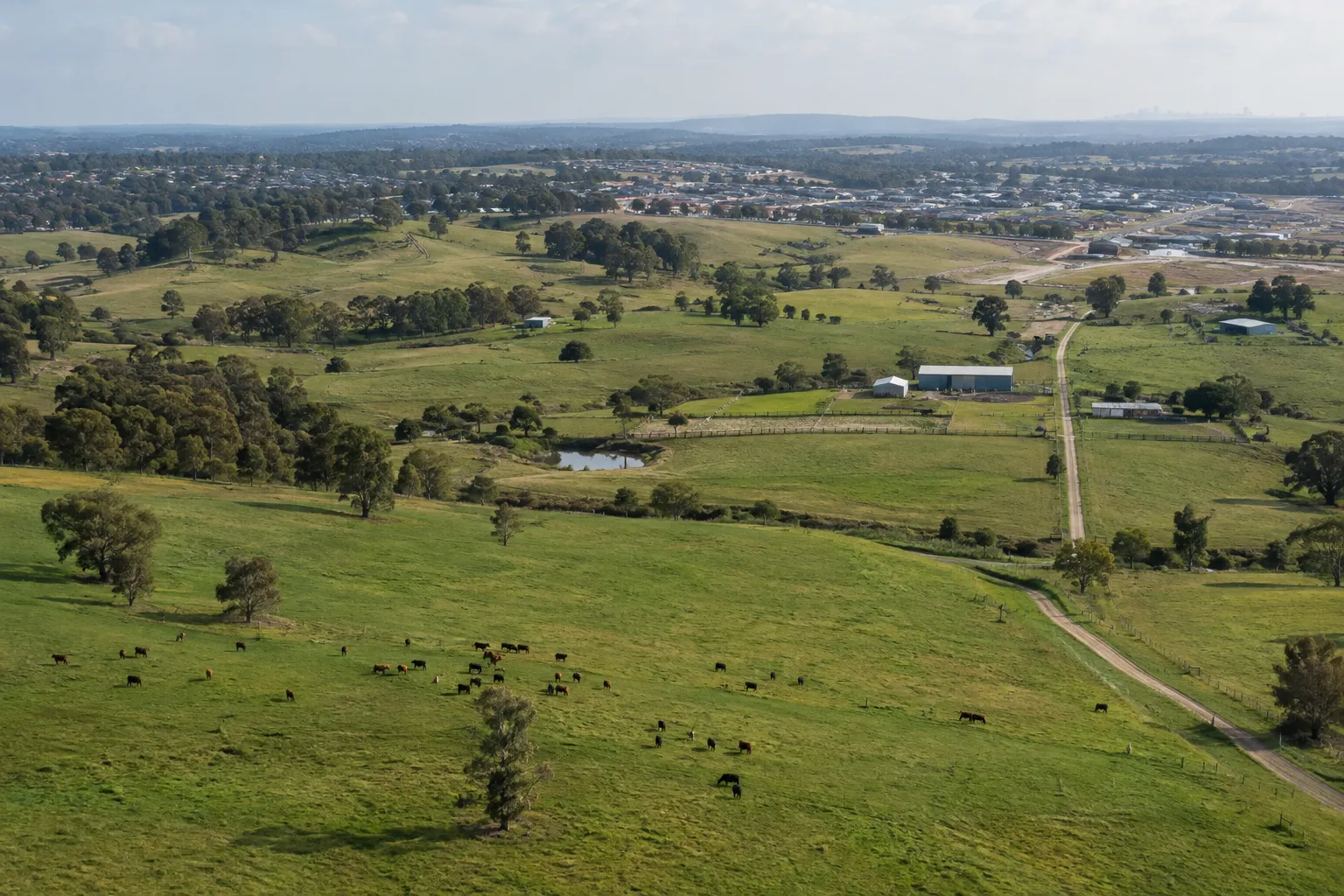
The property in question is a working cattle farm positioned for eventual residential subdivision. The price implies a per-hectare cost that only makes economic sense if three conditions align within a narrow window: government infrastructure gets funded and delivered on schedule, planning approvals move faster than the historical average, and buyer demand in outer suburbs stays strong enough to absorb multi-stage lot releases over several years.
Any one of those assumptions breaking changes the return profile significantly.
What the price tag assumes about infrastructure
A $700 million outlay for undeveloped land on the urban fringe carries an implicit bet on state and local government infrastructure commitments. Roads, water, sewer, power, none of it exists at subdivision-ready capacity on a working farm.
The developer’s financial model needs certainty on two things: what gets built, and when. If a planned arterial road or rail extension gets deferred by 18 months, the entire staging schedule shifts. Lot releases that were meant to hit peak-price windows end up competing in a different market cycle.
Historically, major infrastructure projects in growth corridors run 12 to 24 months behind initial timelines. A developer paying top dollar today is pricing in on-time delivery, or accepting that delays compress margins.
There’s a second layer: who pays. Developer contributions for trunk infrastructure can run to tens of millions on projects this scale. If those cost-sharing agreements aren’t locked in before settlement, the effective land cost rises.
The approval gauntlet and its hidden timeline costs
Planning approval timelines for large greenfield sites in NSW vary widely. A straightforward rezoning with council and state government alignment might take 18 to 24 months. Add environmental offsets, traffic studies, heritage assessments, or community opposition, and it stretches to three or four years.
Every month of delay has a carry cost. Interest on $700 million of acquisition debt at current commercial rates is roughly $3.5 million per month. If approvals take 36 months instead of 24, that’s an extra $42 million before a single lot goes to market.
The base-case return model assumes streamlined approvals. The risk case is that one referral agency, environmental, transport, water, objects or requests material changes to the masterplan, triggering a redesign and re-exhibition cycle.
Developers who’ve done multiple stages in the same growth corridor have relationship capital and process knowledge. A new entrant or offshore buyer faces a steeper learning curve, which usually translates to longer timelines.
Demand risk over a five-to-seven-year selldown
Large land subdivisions don’t sell in one hit. A realistic absorption rate for outer-Sydney greenfield lots is 80 to 120 per year, depending on location and competing supply. That means a project of this scale runs for five to seven years from first release to final settlement.
The developer is betting that demand in 2029, 2030, and 2031 looks roughly like demand today, or better. That’s a long bet in a market where interest rates, migration settings, and construction costs are all moving variables.
If the housing market softens further, lot prices compress. If construction costs stay elevated, the gap between land price and finished-home affordability widens, and fewer buyers can close the loop. If migration slows or first-home buyer incentives get wound back, absorption slows and the selldown stretches.
Every extra year of holding unsold inventory adds financing cost and opportunity cost. The model works if demand holds and prices drift up with wage growth. It gets uncomfortable if demand stalls and the developer is forced to discount to maintain cashflow.
Risks to watch
- Infrastructure funding announcements deferred or rescoped in state budgets
- Planning approval timelines extending beyond 24 months due to referral agency pushback
- Competing greenfield supply from adjacent precincts hitting the market simultaneously
- Interest rates staying higher for longer, compressing buyer borrowing capacity
- Migration settings tightening, reducing underlying household formation in outer growth areas
Who’s buying at this price point
A $700 million acquisition isn’t first-home buyer territory. It’s institutional capital or large private developers with balance-sheet capacity to carry land through approvals and staged development.
The likely buyer profile: someone who already has projects in adjacent corridors, can leverage existing contractor and consultant relationships to compress timelines, and has access to patient capital that doesn’t force distressed selling if market conditions soften mid-project.
Alternatively, it’s a fund or offshore buyer making a long-term allocation to Australian residential land, willing to accept lower initial returns in exchange for inflation-linked upside over a decade.
Either way, the acquisition only makes sense with a multi-year hold and a confident view on Sydney’s medium-term population growth trajectory.
Scenarios that shift the payoff
Base case: infrastructure on time, approvals in 24 months, steady absorption at target prices. The developer achieves mid-teens returns over seven years.
Upside: state government accelerates infrastructure, migration stays strong, competing supply gets delayed. Absorption accelerates, lot prices rise, the project pays back faster and the internal rate of return climbs.
Downside: infrastructure gets deferred, approvals stretch to 36 months, the housing market softens, absorption slows. The project still completes but returns compress to single digits and the developer’s capital is tied up longer than planned.
The downside scenario doesn’t require a crash. It just requires the three big assumptions, infrastructure, approvals, demand, to miss by 12 to 18 months each. That’s well within historical experience for large NSW greenfield projects.
What this signals about fringe land values
If this transaction settles near the asking price, it sets a benchmark for similar holdings in Sydney’s growth corridors. Neighbouring landholders will reference it in their own valuations. Councils and state agencies will factor it into developer contribution negotiations.
If it doesn’t transact, or if the eventual sale price is materially lower, that’s a signal too: either the infrastructure assumptions don’t stack up, or buyer appetite for long-dated development risk has softened.
Either outcome tells you something about where institutional capital thinks Sydney’s housing market is heading over the next five years.
For comparison, consider how co-housing redevelopment in inner Melbourne achieves density uplift on existing urban sites, a different risk profile, shorter timelines, but constrained by strata and neighbour coordination rather than infrastructure delivery.
The practical question
If you’re tracking Sydney’s housing supply pipeline, the question isn’t whether this site eventually gets developed, it almost certainly will. The question is: at what price, over what timeline, and with what returns.
Those answers matter because they determine how much new supply hits the market, when, and whether the next wave of similar projects gets funded or shelved.
For now, the $700 million price tag is a hypothesis. The market will test it.
Stay across major land transactions and what they mean for supply with the Australian Property Review newsletter.
General info, not financial advice.