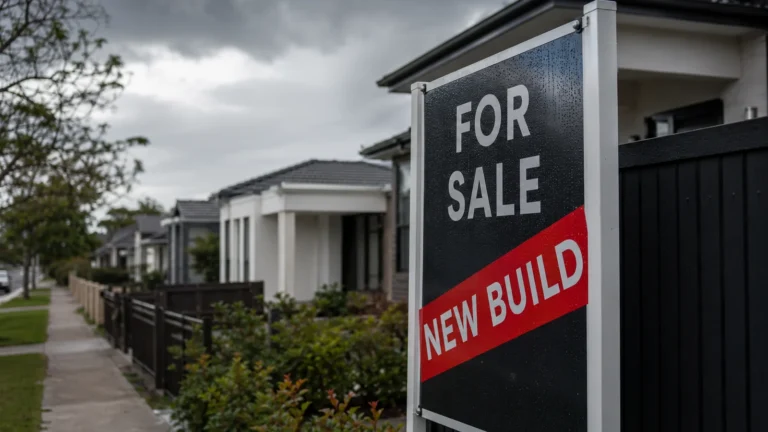
Labor’s housing tax changes are being sold as a way to direct investor money towards new construction and give more first-home buyers a chance to purchase established properties.
The policy may achieve part of that goal.
But evidence presented during parliamentary scrutiny has exposed a harder truth: improving the distribution of home ownership is not the same as increasing the total number of homes.
Susan Lloyd-Hurwitz, chair of the National Housing Supply and Affordability Council, has supported the broad equity case for the reforms while acknowledging the expected supply cost.
That distinction matters because Australia is not choosing between a fair housing market and an unfair one in isolation. It is making the change during a shortage of homes, tight rental conditions and weak construction feasibility.
The argument is no longer simply about whether property investors receive too much tax support.
It is about whether reducing that support can change who owns housing without making the shortage worse.
The government is pulling two different levers
The housing package changes the tax treatment of both property losses and capital gains.
From 1 July 2027, negative gearing for residential property is expected to be limited to qualifying new builds. Investors purchasing established homes after the relevant commencement arrangements would no longer be able to offset those property losses against salary or unrelated income in the same way.
The existing 50 per cent capital gains tax discount would also be replaced by an inflation-indexed system for affected assets. Rather than automatically discounting half the nominal gain, the investor’s cost base would be adjusted for inflation.
A proposed minimum 30 per cent tax rate on certain capital gains adds another layer.
These measures affect different parts of an investment.
Negative gearing affects annual cashflow while the property is held. Capital gains tax affects the after-tax return when the asset is sold.
Put them together and the government changes both the cost of holding an established investment property and the potential reward at the end.
That is why the behavioural response could be larger than any single tax measure suggests.
In plain English
The policy is designed to make established homes less attractive to investors and new homes relatively more attractive. That may help some owner-occupiers compete, but it does not guarantee investors will redirect their money into construction.
Redistribution is not the same as supply
The clearest challenge to the government’s sales pitch has come from within the housing policy establishment.
Lloyd-Hurwitz told the parliamentary inquiry that accepting some reduction in supply could be justified by the broader benefit of reducing intergenerational inequality and excessive investor demand.
Treasury secretary Jenny Wilkinson had previously drawn a similar distinction, describing the tax measures as being more closely connected to changing the distribution of housing ownership than lifting overall supply.
That does not mean the policy has no housing benefit.
A rental property sold by an investor does not disappear. It may be bought by a first-home buyer who previously rented, changing the tenure of the dwelling from rental to owner-occupied.
The number of homes remains the same, but ownership becomes more widely distributed.
The problem is that the number of rental homes can still fall during that transition. Not every displaced tenant is in a financial position to purchase, and not every investor leaving the established market will buy a new apartment or fund a new development.
This is the second-order effect that matters.
A policy may help a marginal first-home buyer while placing more pressure on a renter who remains locked out of ownership.
The 35,000-home estimate needs context
Budget modelling indicates that the tax reforms, considered separately from other housing measures, could result in about 35,000 fewer homes being built over a decade.
That is roughly 3,500 homes a year.
Against Australia’s total housing stock, the figure may appear modest. Against the existing supply deficit and the difficulty of meeting national construction targets, it is not trivial.
The government argues that other measures, including infrastructure funding, planning reform and support for housing construction, can offset the reduction.
That is possible, but it relies on policies with different delivery risks.
Tax changes can alter investor decisions quickly. Planning reform, infrastructure construction and development approvals often take years to translate into completed homes.
The timing gap is the catch.
Investor demand could weaken before replacement supply arrives.
Australian Property Review has previously examined why negative gearing reform could produce a rental squeeze when investor behaviour changes faster than the construction pipeline.
We have also looked at the broader negative gearing tax trap facing Australia, including the risk of treating ownership reform and rental supply as if they were the same policy problem.
Why new-build investment may not absorb the money
The government’s theory is straightforward.
Remove part of the tax advantage from established homes, preserve stronger treatment for qualifying new housing, and investors should shift towards construction.
In practice, established and new properties are not interchangeable.
An investor choosing an established house in a proven suburb may care about land value, local demand, comparable sales and the ability to inspect the finished property.
A new apartment or house-and-land package introduces different risks:
- developer and builder failure
- construction delays
- valuation shortfalls
- high strata costs
- settlement risk
- oversupply in a specific precinct
- uncertain rental demand after completion
Tax settings influence decisions, but they do not erase those risks.
Some investors will move into new housing. Others may buy shares, commercial property or other assets. Some may pay down debt instead.
That is why the policy’s success depends on more than making established property less attractive. New projects must also be feasible, financeable and appealing on their own merits.
As Australian Property Review explained in its analysis of the Budget tax impact on young investors, a tax incentive cannot compensate indefinitely for weak yields, high construction costs or an inflated purchase price.
Economists back reform but question the 30 per cent floor
The debate is not split neatly between supporters and opponents.
Economists Saul Eslake and Michael Brennan have supported moving away from the flat 50 per cent CGT discount towards an inflation-indexed model. Indexation attempts to tax the real gain after inflation rather than taxing price growth that partly reflects a decline in money’s purchasing power.
Both have raised concerns about the proposed minimum 30 per cent rate.
That floor could weaken the logic of indexation by creating a separate minimum liability even where a taxpayer’s circumstances would otherwise produce a lower effective rate.
Critics also argue it could affect investment beyond housing, including business assets and entrepreneurial risk-taking.
Supporters may respond that without a floor, investors could structure or time disposals to reduce tax.
Both concerns are legitimate.
The issue is whether the minimum rate is tightly designed to prevent avoidance or whether it becomes a broad penalty on long-term investment.
Treasury modelling would help resolve part of that dispute. Business groups and economists have called for more of the underlying economic and productivity analysis to be released publicly.
Until that happens, claims from both sides should be treated as scenarios rather than settled outcomes.
Renters carry the near-term risk
The strongest argument for the reform is that fewer tax-advantaged investors competing for established properties may improve purchasing opportunities for owner-occupiers.
The strongest argument against it is timing.
Australia’s rental market cannot easily absorb a sharp reduction in private investor participation while new housing remains slow and expensive to deliver.
Landlords cannot simply raise rents by any amount they choose. Rents are ultimately constrained by tenant incomes, local vacancy rates and competing properties.
But where vacancy is already low, even a modest contraction in available rental stock can intensify competition.
The likely effects would not be uniform.
Markets with strong apartment construction and higher vacancies may adjust with limited disruption. Areas dominated by detached housing, small landlords and weak development pipelines could face greater pressure.
This is why national claims about rents rising or falling miss the practical point. The impact will differ by location, dwelling type and the speed at which investors respond.
What property investors should do now
The legislation and transitional rules matter more than the political slogans.
Existing holdings may receive different treatment from future purchases. New builds may retain tax advantages unavailable to established homes. The minimum CGT rate could also affect sale timing and the relative appeal of different ownership structures.
Investors should not make a rushed purchase or sale decision based only on the headline.
Start by pressure-testing three figures:
- Cashflow without the full negative gearing benefit.
- The after-tax return under both CGT methods where a choice may apply.
- The property’s performance if rent growth or capital growth is weaker than expected.
A property that only works because of a tax deduction is already carrying a narrow margin for error.
The same applies to new housing. Preferential tax treatment does not automatically make an overpriced or poorly located project a sound investment.
Australian Property Review has examined how the broader CGT changes could affect housing supply and why investors should separate tax benefits from the underlying quality of an asset.
The real test comes after investor behaviour changes
The government can reasonably argue that the current system favours asset owners and encourages investors to compete for established housing.
Its critics can reasonably argue that reducing investor demand during a rental shortage creates risks for tenants and construction.
Both can be true.
The base case is that the reforms modestly shift ownership towards first-home buyers, reduce investment in established homes and redirect some, but not all, investor capital into new supply.
The upside case is that strong planning and infrastructure reform makes new projects viable enough to replace the lost investment quickly.
The downside case is that investors retreat, construction remains constrained and renters carry the adjustment through tighter choice and higher effective housing costs.
The deciding factor will not be the tax announcement itself.
It will be whether governments can make new housing easier and cheaper to build before private capital finds somewhere else to go.
Start here: review any planned property purchase using the proposed post-2027 tax settings, not the rules investors have relied on in the past.
Get independent property analysis without the sales pitch. Subscribe to the free Australian Property Review newsletter.
General info, not financial advice.