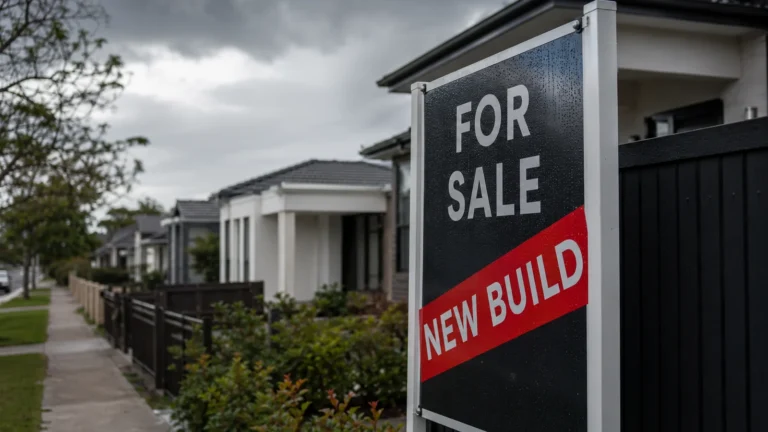
Price forecasts now predict drops up to 15% through 2026 and 2027. The RBA Governor flagged tolerating a 20% fall without systemic financial risk. Auction volumes are shrinking, clearance rates sliding past normal winter patterns. Yet every percentage point down still leaves the same problem: not enough homes.
The policy response has targeted demand levers, interest rates, tax settings, rental regulations, while construction approvals remain stuck below replacement levels. ABS building approval data shows new dwelling approvals running 30% behind the pace needed to match population growth and household formation over the past three years. NHFIC supply pipeline estimates put the cumulative shortfall above 200,000 dwellings nationally, concentrated in Sydney, Melbourne and Brisbane.
The mechanics nobody’s solving
Prices falling doesn’t add supply. It changes who can access existing stock and at what cost, but the total number of homes stays static unless construction catches up. Right now it’s not catching up.
Approvals for detached houses have dropped in every mainland capital except Perth over the past 18 months. Unit approvals lifted briefly in late 2025 but remain 40% below the 2017-2019 average. Builders cite three constraints: land release timelines stretching 24-36 months in growth corridors, construction finance pulling back as lenders tighten serviceability, and local planning rules that fragment medium-density projects into drawn-out approval fights.
None of those constraints ease when prices drop. Land holding costs stay high, construction loans still require the same equity buffers, councils still process the same DA queues. Price falls redistribute affordability within the existing stock, they don’t unlock the coordination needed between state planning, local zoning and federal housing finance to actually build more.
The catch
A 15% price drop takes median Sydney back to mid-2024 levels. Median Melbourne falls to early 2024. Both cities had structural supply deficits then, too. The price level changes; the shortfall doesn’t.
What rental policy does and doesn’t do
NSW’s portable bond scheme launches in three council areas this winter. Tenants pay $25 per transfer, the state intermediates disputes, and landlords wait longer for bond claims while NCAT backlogs grow. The scheme targets tenant mobility friction but does nothing for the 330,000 renters moving annually who can’t find a property to move into in the first place.
Rental reforms across the eastern states over the past two years, pet clauses, minimum standards, fixed-term limits, address tenant security and habitability. They don’t address the vacancy rate sitting at 1.2% in Sydney and 1.4% in Melbourne, both well below the 3% threshold that historically kept rent growth in check. Investor lending has dropped 8.6% year-on-year as negative gearing reform cleared early adopters and speculative buyers from the market, but new rental supply hasn’t replaced them. Build-to-rent projects contribute fewer than 5,000 completions nationally in 2026, a rounding error against the deficit.
Policy aimed at tenant outcomes without coordinating supply delivers better conditions for the tenants who secure a lease and longer search times for those who don’t. That trade-off sharpens when vacancy stays this tight.
Who carries the cost when supply lags demand
Prices falling 10-15% don’t rebalance the market if the shortfall stays above 200,000 dwellings. They shift who absorbs the cost. Recent buyers in the past 18 months face equity erosion and serviceability pressure as rates stay elevated. Mortgage stress watchlists are growing as borrowers who stretched at the peak hit payment buffers. Renters face longer search windows and fiercer competition for the limited stock turning over. Developers pull back as feasibility tightens, construction finance dries up further, and the pipeline shrinks instead of expands.
Vendor confidence collapsing, auction volumes down, days on market extending, slows transaction activity but doesn’t reduce housing need. Households still form, migration still runs above 200,000 net annually, existing stock still ages and requires replacement. The gap between what’s needed and what’s being built widens with every quarter approvals stay suppressed.
The planning-finance-tax coordination gap
Closing a 200,000-dwelling deficit requires three systems moving together. State planning needs to zone and release land at scale in transit corridors, not drip-feed greenfield parcels that take three years to service. Local councils need to pre-approve medium-density typologies (duplexes, townhouses, low-rise units) in established suburbs instead of requiring bespoke DAs for every site. Federal housing finance settings need to make construction loans and build-to-rent debt viable again as interest rates normalise, instead of leaving the sector starved while owner-occupier lending dominates.
Rental policy, price falls and demand-side tweaks don’t coordinate those three. They adjust who gets access to the stock that exists and under what terms. The actual shortfall persists until construction approvals lift sustainably above 180,000 per year for multiple consecutive years, and completions follow 12-18 months later.
Base case and what breaks it
Base case: prices fall 10-12% by mid-2027, transactions stay subdued, construction approvals bump along current levels, and the deficit compounds to 250,000+ dwellings by 2028. Rental vacancy stays below 2%, rent growth runs ahead of wages, and investor participation limps along as negative gearing reform reduces forward returns.
Upside: a coordinated package, commonwealth-backed construction finance, state planning reform accelerating medium-density approvals, local government fast-tracking pre-approved typologies, lifts approvals 20% within 12 months and starts chipping into the backlog by late 2027.
Downside: further serviceability tightening or a migration slowdown reduces household formation expectations, builders cancel marginal projects, and approvals fall another 15%, widening the gap to 300,000+ dwellings and locking rental vacancy below 1.5% structurally.
What it means for the next 12 months
Price falls and rental policy changes dominate headlines but neither addresses the core constraint. If you’re deciding whether to buy, the affordability improvement from a 10-15% drop matters only if your serviceability holds and you’re not relying on near-term capital growth. If you’re renting, mobility schemes and tenant protections improve your experience in a lease but don’t shorten the search or ease competition. If you’re an investor, the supply deficit supports long-term rental demand, but near-term returns compress as lending falls and tax settings shift.
The practical signal: watch construction approvals and planning reform announcements, not price forecasts or rental rule changes. The deficit closes when new supply accelerates, not when existing stock reprices.
For weekly analysis on what’s actually shifting supply and demand, subscribe to the Australian Property Review newsletter.
General info, not financial advice.