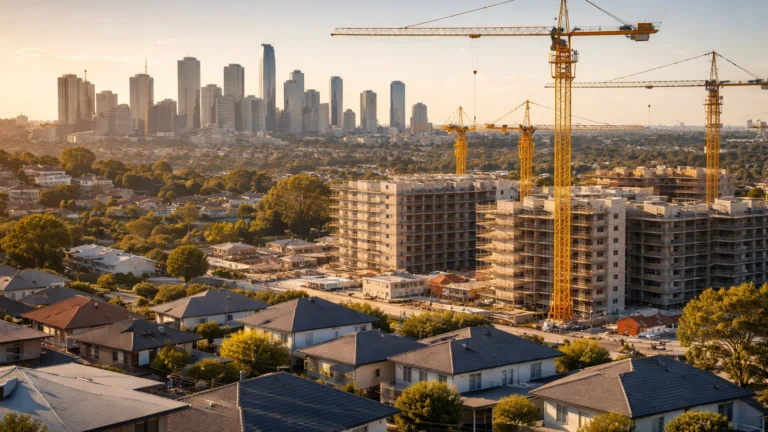
Australia chases a 1.2 million home construction target while simultaneously raising the cost and complexity of investing in that exact housing stock. The contradiction shows up in capital flows: foreign residential property approvals peaked at $72.4 billion in 2015–16, with 88 per cent directed toward new dwellings, vacant land or redevelopment the following year. Today those approvals have dropped to negligible levels, and domestic investors increasingly face the same policy treatment that pushed international capital elsewhere.
The policy mechanic is straightforward. Development projects need pre-sales before banks provide construction finance. Remove a segment of buyers and feasibility calculations shift. When foreign purchasers were restricted to new stock, their capital directly funded supply addition. Policy changes since the mid-2010s progressively raised barriers: higher foreign-buyer taxes, tighter lending rules for non-residents, vacancy charges, reduced investment migration pathways. Chinese capital controls compounded the decline.
Where the money went instead
Capital is not emotional. High-net-worth families allocate based on legal certainty, political stability, and whether rule changes arrive every electoral cycle. Countries competing for internationally mobile wealth use residency and investment programs as deliberate attraction tools. The UAE and United States actively market these structures. Australia moved in the opposite direction during the same period its housing shortage intensified.
Domestic investors now navigate stacking costs: stamp duty, land tax, finance expenses, rental regulation, planning delays, capital gains tax, and most critically, rule-change risk. The latest federal tax reforms redirect negative gearing incentives toward new housing from July 2027. The principle has merit if government subsidies flow to supply addition rather than established stock turnover. But Treasury modelling cited by the Grattan Institute estimates around 35,000 fewer homes built over the next decade as a result, even though Grattan argues other supply measures offset that reduction.
The cashflow squeeze on small landlords
Most Australian rental supply comes from individual investors holding one or two properties, not institutional portfolios. A nurse, teacher or tradesperson with an investment property provides accommodation the private rental market depends on. Policy that treats all investors as large-scale speculators misreads the actual ownership structure. When investment returns compress and regulatory uncertainty increases, the marginal decision shifts from holding to selling, or from buying new development stock to avoiding the sector entirely.
Developers require purchaser commitments before construction finance approves. Remove investor appetite for off-the-plan apartments and project feasibility narrows. Rental vacancy rates remain near record lows while policy settings reduce the capital willing to fund new supply. The system is interconnected: first-home buyers, renters, investors, developers and lenders do not operate independently. Changing one variable moves all the others.
What stalls projects before they start
Uncertainty costs more than individual tax increases. An investor committing capital for twenty years prices in the probability rules will change mid-cycle. Each policy announcement that reshapes investment returns raises the hurdle rate required before capital commits. Development feasibility modelling already operates on thin margins in high-cost Australian cities. Add rule-change risk and projects that were borderline viable become unviable.
The policy contradiction is clear: government rhetoric emphasises supply urgency while tax and regulatory settings actively reduce private capital flows into development and rental housing. Foreign investment restrictions were the initial target. Domestic investors now face similar treatment. The result is predictable: capital compares jurisdictions and asks whether Australia still wants it.
The catch
- Foreign residential approvals: $72.4bn peak (2015–16) vs negligible today
- New dwelling share of approvals: 88% at peak, aimed directly at supply addition
- Treasury estimate: 35,000 fewer homes over next decade from latest tax changes
- Rental vacancy: near record lows while policy reduces investor participation
- Capital mobility: high-net-worth allocation follows certainty, not sentiment
The UAE comparison
Australian investors see Dubai and US property investment opportunities marketed directly through social media. The question that follows is whether their money would be more welcome elsewhere. This is not abstract capital flight theory. It is a nurse in Sydney weighing whether to buy an off-the-plan apartment in Australia or allocate the same funds offshore where tax treatment is clearer and rule changes less frequent. That comparison would have seemed absurd a decade ago. Today it is a rational calculation.
Luxury apartment demand softens as major developer posts loss shows how reduced investor appetite flows through to development feasibility. Chinese capital exit: $900m office tower sale tests CBD appetite tracks the same dynamic in commercial property as international capital reallocates.
The policy reset required
Australia cannot choose between housing supply and private investment. The investment funds the construction. A coherent policy framework would encourage foreign capital when it creates genuinely additional housing, give domestic investors durable incentives to add new stock, reward long-term rental supply provision, reduce planning delays, and create tax settings that improve development feasibility rather than compress it.
Most importantly, stop rewriting the rules every electoral cycle. Capital demands predictability. The first signal a country is losing investment is not sudden offshore flows. It is doubt. And doubt is now measurable in the gap between construction targets and the capital willing to fund them.
Start here: if you are weighing a new development investment, pressure-test the cashflow assuming tax settings change again in three years, because they probably will. If the numbers only work under current rules, the project is mispriced. Subscribe to Australian Property Review for weekly analysis of policy settings and capital flows that drive housing supply.
General info, not financial advice.