Australia’s economy grew 0.4 per cent in the June quarter and 2.1 per cent through the year, according to the ABS, a result that looks steady on paper but tells a different story when you strip out population growth and look at what households are actually doing with their money.
GDP per capita stayed flat over the quarter and rose just 0.7 per cent year-on-year, meaning living standards are barely moving even as the aggregate economy ticks forward. Household consumption lifted 0.4 per cent, but spending stayed muted across most categories, with fuel, domestic travel and international trips all pulling back as Middle East conflict pushed petrol prices higher and discretionary budgets stayed tight.
The one bright spot: vehicle purchases jumped 10.3 per cent, driven by a continued shift toward electric vehicles. The ABS attributes that to households making a longer-term play on running costs rather than a surge in consumer confidence, people are buying to cut ongoing expenses, not because they feel flush.
The policy bind
The RBA now faces a choice with no clean answer. Weak household spending and flat per-capita growth argue against another rate rise, push borrowing costs higher and you risk tipping cautious households into outright retrenchment, with knock-on effects for retail, services and construction demand. But inflation hasn’t surrendered, and a pause risks letting price pressures entrench, particularly if wages keep climbing (compensation of employees rose 1.5 per cent in the quarter, driven by competition for skilled labour and bonuses).
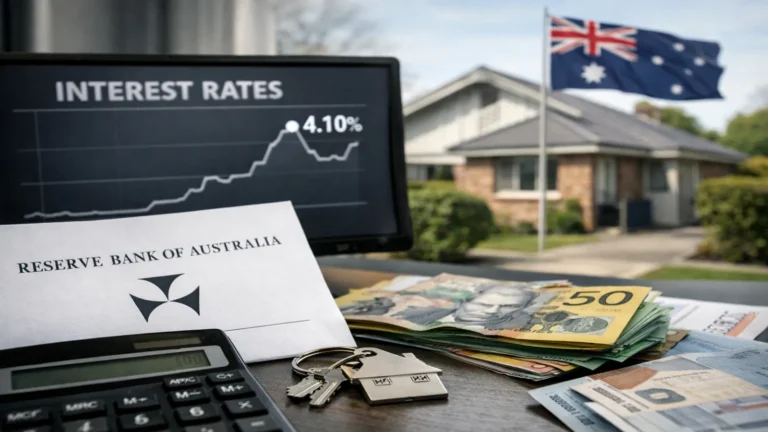
Three of the four major banks, NAB, CBA and ANZ, now forecast one more hike to 4.6 per cent before year-end. Westpac remains the outlier, calling no change through 2026. That split matters for anyone choosing between fixed and variable rates in the next three months.
For mortgage holders, another hike would push standard variable rates past 6.8 per cent at most lenders, lifting repayments on a $600,000 loan by roughly $180 a month compared to the current 4.35 per cent cash rate. Serviceability buffers, already tight for many borrowers approved in the past 18 months, would compress further, and refinance options narrow when rates climb and equity hasn’t kept pace.
A hold, meanwhile, gives borrowers breathing room but leaves open the risk that inflation stays elevated for longer, forcing the RBA to hike later and harder, or to hold rates higher for an extended period, delaying any prospect of relief.
What the spending mix tells us
The composition of June quarter growth offers clues about where household caution is biting hardest. Discretionary categories, fuel, travel, hospitality, stayed weak. The electric vehicle surge looks more like strategic cost-cutting than confidence. And the household savings ratio edged up from 6.4 per cent to 6.5 per cent, suggesting people are still building a modest buffer rather than deploying cash.
That buffer is thin by historical standards, well below the pandemic-era peak, but it’s enough to keep default rates low for now. The question is how long it lasts if rates rise again or if unemployment ticks up from the current 4.2 per cent.
Business investment also softened, falling 0.5 per cent for the quarter as spending on machinery and equipment pulled back after a strong March. That was partly driven by a slowdown in data centre fit-outs, though investment in that category remains elevated overall. Annual business investment is still up 10.4 per cent, supported by purchases of planes and industrial transport equipment, but the quarterly dip underscores that even firms are choosing projects carefully.
Trade-offs and timing
If the RBA hikes in the next few months, the immediate impact hits variable-rate borrowers and anyone refinancing or buying in the near term. Construction finance also tightens, builder closures are already at decade highs, and another rate rise would push marginal projects further underwater, worsening the supply constraint that’s kept dwelling completions below demand.
If the RBA holds, inflation stays the central risk. Wage growth at 1.5 per cent per quarter annualises to around 6 per cent, well above the 2-3 per cent target band. Services inflation, which makes up the bulk of the CPI basket, remains sticky, and a pause now could mean higher rates later if price pressures don’t ease on their own.
There’s no scenario where both risks disappear. Either the RBA prioritises inflation control and accepts weaker demand, or it prioritises household resilience and accepts slower progress on prices.
Key numbers
- GDP growth: 0.4% (June quarter), 2.1% (year-on-year)
- GDP per capita: flat (quarter), +0.7% (year)
- Household consumption: +0.4% (quarter)
- Compensation of employees: +1.5% (quarter)
- Household savings ratio: 6.5%, up from 6.4%
- Business investment: -0.5% (quarter), +10.4% (year)
What to watch in the next four months
The RBA’s next decision lands on 29 September. Between now and then, watch monthly CPI (due mid-September), labour force data (monthly releases through August and September), and any further deterioration in retail trade or consumer sentiment surveys. If unemployment rises or retail sales fall for two consecutive months, the case for a pause strengthens. If wage growth holds or accelerates and services inflation stays elevated, another hike becomes more likely.
For borrowers making decisions now, the split in bank forecasts tells you the outcome is genuinely uncertain. If you’re refinancing or buying in the next six months and your serviceability buffer is already tight, model repayments at 4.6 per cent, and if that pushes you close to the edge, either wait or factor in a longer timeline before rates fall.
For investors, weaker per-capita growth and cautious household spending point to subdued rental demand growth in discretionary locations (coastal, lifestyle markets) while essential worker hubs near employment centres hold up better. Construction finance conditions also matter, if builder exits accelerate, supply constraints tighten further and put upward pressure on rents and prices in undersupplied markets, though that’s a medium-term dynamic, not an immediate one.
Start here: model your repayments and equity position at 4.6 per cent, check your fixed-rate options if you’re inside 12 months of expiry, and if you’re considering a purchase, pressure-test the decision against both a hike and a longer hold at current rates. Subscribe to the Australian Property Review newsletter for weekly analysis on rates, policy and market signals.
General info, not financial advice.