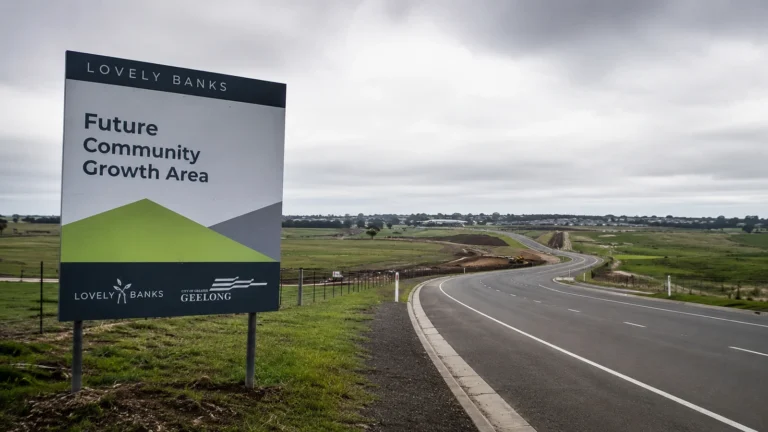
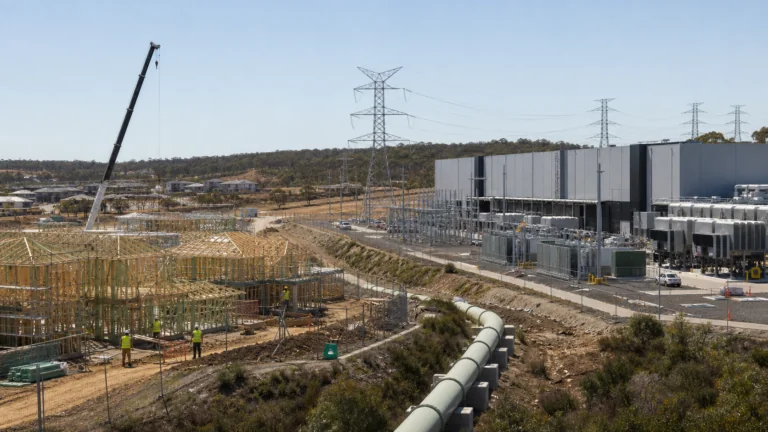
Australia’s server-farm construction pipeline has grown from less than half a gigawatt in 2015 to 16.2 gigawatts now planned or underway. That’s thirteen times current capacity, concentrated almost entirely in NSW and Victoria, and it’s rewiring the economics of industrial property in metro zones where big sites are already scarce.
The immediate effect: developers building AI server infrastructure are outbidding warehouse operators for large land parcels, paying premiums that traditional logistics tenants can’t match. A recent capital-markets analysis projects warehouse rents in Melbourne’s west could rise 132 per cent above current prime rates by 2028 if the buildout continues at forecast pace. Sydney’s outer central-west corridor faces an 88 per cent uplift under the same scenario.
Why server farms pay double for dirt
A one-megawatt facility uses as much electricity as 360 mid-sized warehouses. That power demand, and the grid connection, cooling infrastructure and fibre backhaul it requires, means operators need larger lots close to substations and metro fibre nodes. Over the past twelve months, average land values for two-to-five-hectare sites in Sydney’s outer central-west precinct rose 9.6 per cent year-on-year; Melbourne’s west saw 16.5 per cent growth in the same period.
Smaller parcels, the one-hectare and sub-hectare lots that suit standard logistics sheds, appreciated far more slowly: 2.5 per cent in Sydney, 0.8 per cent for 2,000-square-metre Melbourne sites. The divergence signals a structural split: if you own or lease large, well-serviced industrial land in metro corridors, you’re in a different market now.
The construction labour squeeze
Server-farm builds are electrician-heavy, commissioning and fitout require large crews of qualified sparkies and communications technicians for months. Australia’s construction workforce is already stretched across residential builds (which are running below the national housing target), the Brisbane Olympics pipeline, and major CBD and transport projects. Industry groups warn the $155 billion server-infrastructure queue will pull skilled trades away from housing and other sectors at exactly the wrong time.
The job-creation pitch, up to 400,000 positions, according to proponents, is front-loaded in the construction phase. Once a facility is commissioned, ongoing operational headcount is low. That leaves a boom-bust labour pattern: short-term demand spikes that bid up wages and delay competing projects, then a return to baseline once the racks are racked.
The catch
- Energy load: one megawatt equals 40 shopping centres or 440 office towers; total demand forecast to grow 25 per cent annually to 2030, pressure-testing a grid still 64 per cent fossil-fuelled
- Water: cooling systems draw significant volumes in markets where residential and agricultural users already compete
- Community opposition: 83 per cent of survey respondents say they wouldn’t want to live near a server farm; only 16 per cent see local benefit
Who wins and who waits
Owners of large industrial landholdings in metro precincts with substations nearby are seeing valuations repriced upward. Logistics operators hunting for big-box warehouse sites face higher entry costs and longer search timelines as suitable parcels get locked up by server-farm developers.
For residential developers, the labour-competition risk is real but hard to quantify. If electricians and communications trades flow toward higher-margin server projects, housing timelines stretch and costs rise, adding another constraint to a supply pipeline already stalling under policy and cost pressures.
The downstream effect on commercial office markets is indirect but worth tracking: if industrial rents climb sharply, occupiers reassess logistics footprints and supply-chain costs, which feeds into business-location decisions and, eventually, office-market demand patterns in outer precincts.
What could stall the pipeline
Grid-connection delays are the most likely bottleneck. Energy networks weren’t designed for the load profile server farms bring, and upgrades take years. Water-access constraints in drought-prone regions could slow approvals or force operators toward air-cooled designs that cost more upfront.
Community and council opposition is rising. If local governments start rejecting applications or imposing costly mitigation requirements, the buildout slows and developers shift to regional or offshore markets where infrastructure and approvals move faster.
Base case and variants
Base case: the pipeline delivers half the forecast capacity by 2030; warehouse rents in core metro industrial precincts rise 40-60 per cent above current levels; construction-labour costs stay elevated but don’t break project economics.
Upside (for landowners): full buildout proceeds; rents approach the 130 per cent premium scenario; industrial land in metro corridors becomes as tightly held as inner-city commercial sites.
Downside: grid and water constraints force half the pipeline offshore or into long delays; rent growth moderates to 15-25 per cent; the labour crunch eases as projects stall.
The practical take
If you hold or lease industrial land in metro precincts near substations, request a desktop valuation now and track whether developers are circling. If you’re planning a warehouse build or expansion in NSW or Victoria, lock in land and construction crews early, waiting six months could mean bidding against server-farm budgets.
For residential developers and trades contractors, model a scenario where electrician availability drops 20 per cent over the next eighteen months and see what that does to your project timeline.
Subscribe to the newsletter for weekly updates on infrastructure, land values and construction-market shifts.
General info, not financial advice.