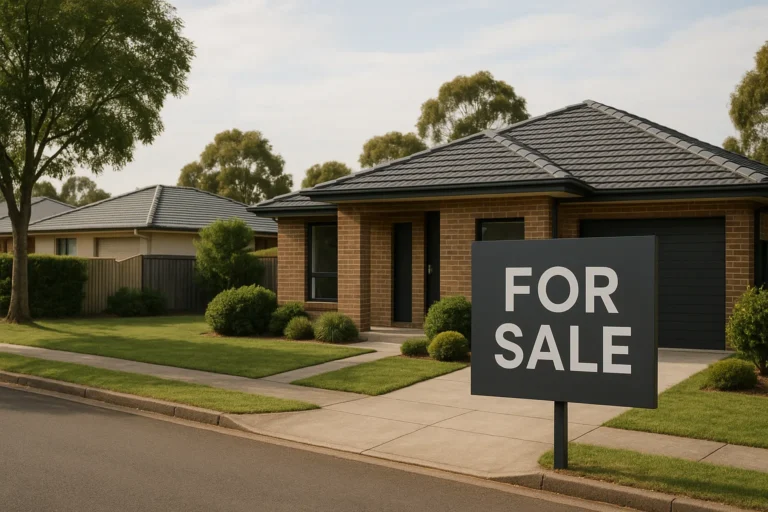
A three-bedroom brick house in Wetherill Park sold under the hammer for $1.2925 million on 1 August, roughly $50,000 above the two most recent comparable sales in the street. Four bidders competed in front of 70 people. National auction clearance that same week sat at 45.1 per cent across 1,090 scheduled auctions, according to PropTrack. The gap between this result and the broader market raises the question: what separates properties that still draw competitive bidding from those that pass in?
What drove the result
The property had been held by one owner for 40 years, was well-maintained, and sat on land large enough for a secondary dwelling. The campaign attracted 30 to 35 inspections over four weeks, 22 contract requests, and eight registered bidders on auction day. Bidding opened at $1.05 million and moved quickly to $1.22 million before slowing into a three-way contest that pushed the price to $1.2925 million. The successful buyer was a local resident planning to knock down and rebuild; underbidders were a mix of first-home buyers and investors.
Two comparable sales in the same suburb three weeks earlier settled at $1.243 million and $1.22 million. The agent had expected a ceiling around $1.24 million. The final price represented a 4 per cent premium over recent comparables in a market where prices are broadly falling. Wetherill Park’s median house price rose 5.9 per cent over the year to July, reaching $1.44 million, but that annual figure masks recent weakness: the agent noted that at the market peak six months earlier, the same property would likely have sold for at least $50,000 more.
The two-speed dynamic at suburb level
Inspection volumes in the area have fallen from 30 to 60 groups per campaign at the peak to 10 to 25 now. This campaign’s 30 inspections sat above the current average. The agent reported three auctions in the preceding week, all sold, two breaking street records. The common thread: original-condition homes on usable land in established pockets where buyers see future optionality, either through renovation, knock-down-rebuild, or a granny flat.
Investor numbers dropped sharply after federal budget changes to negative gearing and capital gains tax rules took effect, but serious buyers with longer hold periods are still transacting. Of the eight registered bidders at this auction, three were owner-occupiers planning to live in the property, five were investors. That mix is higher than the broader market, where investor activity has pulled back more dramatically. The question is whether properties offering dual-use potential or future development upside are temporarily insulated or whether this is a narrow window before broader credit tightening flows through.
Callout: The practical take
You’re seeing a split: homes that offer flexibility (land size, zoning, renovation scope) or sit in tightly-held streets with low turnover are still drawing multiple bidders, even as clearance rates suggest two in every three auctions either pass in or are withdrawn. Properties without those features are taking longer to sell and achieving lower prices relative to peak comparables. If you’re buying, focus on what gives a property a competitive edge in a thinner market. If you’re selling, understand that presentation, realistic pricing and a clear story about future use are now table stakes, not optional extras.
Risks to watch over the next six months
Interest rates remain the primary variable. The Reserve Bank’s recent hikes are still working through household budgets, and serviceability buffers mean fewer buyers qualify at current prices. Migration settings, which have supported demand in outer suburbs, could shift if labour market conditions weaken. The granny flat strategy, which underpinned part of the investor interest in this sale, faces tighter scrutiny under new tax settings. If construction costs stay elevated or council approval timelines blow out, the development optionality that justified premium prices may not deliver the expected return.
The agent expects further price declines in the short term, even while pointing to recent strength in premium stock. That view reflects the reality that liquidity is concentrating in a narrower band of properties. If credit conditions tighten further or unemployment rises, even well-located homes with future upside could see bidder numbers fall. The successful buyer in this case was a local with long-term plans; if that buyer profile disappears, so does the premium.
What this means for decision-makers now
If you’re an owner-occupier planning to hold for five to ten years and you find a property that ticks eight or nine of your boxes in a corrected market, history suggests you’re unlikely to lose over that timeframe. If you’re an investor, the calculus is harder: the tax changes reduce the cashflow benefit of holding negatively geared property, and the granny flat play requires capital, time and council approval with no guarantee of rental yield uplift that justifies the outlay. Properties that drew four bidders six months ago are now drawing one or two, and those that drew one or two are passing in. The difference between a competitive result and a pass-in often comes down to land size, street appeal, and whether buyers can see a clear path to adding value.
Start by pressure-testing your assumptions. If you’re relying on future development potential, model the cost, timeline and net yield. If you’re buying for capital growth, compare recent sales in the same street, not suburb-wide medians. And if you’re selling, understand that motivated buyers today expect vendors to meet the market, not the market six months ago. Buyer paralysis is real in this environment, but properties with clear value propositions are still transacting.
Subscribe to Australian Property Review for weekly analysis of what’s moving and what’s stalling in the property market.
General info, not financial advice.