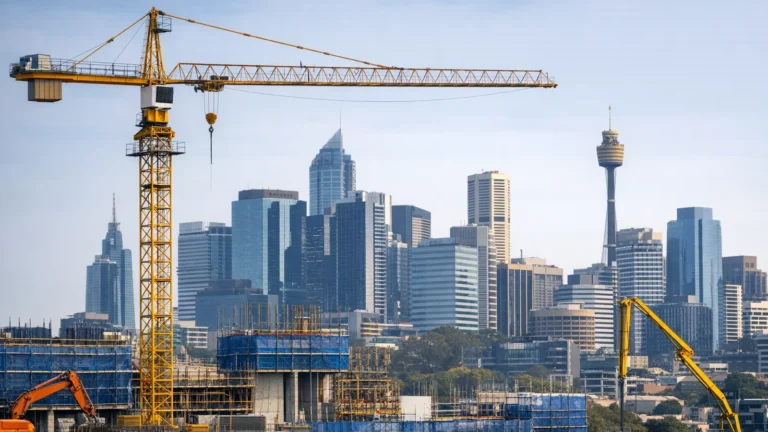
The construction sector is contracting at the exact moment national housing targets demand acceleration. Building approvals hit 17,000 dwellings in July 2026, well below the 25,000 monthly run rate needed to meet existing supply commitments. Industry representatives now project the shortfall will exceed 200,000 dwellings when updated forecasts land next month, with the gap widening rather than closing.
The supply slowdown comes despite repeated government pledges to prioritise dwelling delivery. Builders are pulling back on new projects, not ramping up. That contradiction demands a closer look at what’s actually constraining supply, and whether the industry’s preferred policy solutions address the core problem or simply shift costs elsewhere.
The margin squeeze claim
Construction costs have risen approximately 50 per cent over the past five years, according to sector data. That figure includes materials, labour and compliance costs. The argument from industry groups is straightforward: buyers aren’t willing to pay what it now costs to deliver a dwelling, so projects stall before they start.
Recent federal budget measures, changes to capital gains tax treatment, negative gearing rules and self-managed super fund borrowing restrictions for residential property, are cited as immediate demand dampeners. The claim is that these policy shifts reduced investor appetite just as the sector needed sustained inflows to hit supply targets.
The question is whether those cost pressures are genuinely unsolvable under current settings, or whether they reflect deeper productivity and business model issues within the construction sector itself.
The catch
Cost inflation hit the construction industry harder than many other sectors over the same period, but margin compression isn’t unique to builders. The gap between revenue and cost growth is a problem across discretionary spending categories. What makes construction different is the policy lever being requested: tax concessions and regulatory relief that effectively subsidise the input side without addressing output efficiency.
What the insolvency pattern reveals
Builder insolvencies create cascading losses through subcontractor networks and supplier chains. When a major project collapses, the damage spreads well beyond the headcount at the failed firm. Subcontractors are left holding unpaid invoices, suppliers lose forward orders, and labour moves out of the sector or sits idle.
Those insolvencies aren’t random. They cluster around business models that relied on thin margins amplified by volume, financed with optimistic completion timelines and cost assumptions. When materials or labour blow out mid-project, there’s no buffer. The structure fails.
If the core issue is systemic margin pressure, insolvencies should correlate with cost spikes across the board. If it’s business model fragility, they’ll cluster around firms that took on riskier contract structures or over-leveraged during the previous cycle.
The data leans toward the latter. Not every builder is failing, and not every project is stalling. The ones that are tend to share similar risk profiles: fixed-price contracts signed before the inflation surge, high leverage, exposure to multi-unit projects with long delivery windows.
The policy demand vs the structural fix
The industry’s preferred policy response, restoring investor tax settings, easing SMSF borrowing restrictions, accelerating planning approvals, would increase demand-side activity and potentially support higher dwelling prices. That might stabilise revenue for builders in the short term, but it doesn’t address cost-side productivity.
Australia’s construction sector has lagged global peers on labour productivity growth for over a decade. Prefabrication adoption is low, digital workflows are patchy, and subcontractor coordination remains manual and fragmented. Those aren’t tax policy problems. They’re operational and structural.
Governments have committed to supply targets without funding the infrastructure or planning reform needed to unlock land at scale. Builders are being asked to deliver volume under conditions that penalise efficiency and reward lowest-bid contracting. The result is a sector stuck between unmet targets and unsustainable margins.
Risks to monitor over the next quarter
If building approvals stay below 20,000 per month through the September quarter, the national shortfall will lock in at a level that can’t be closed without a step-change in delivery capacity or a major demand shock that lowers the target itself. Neither scenario is constructive for existing owners, renters or prospective buyers.
Interest rate movements will matter more than tax settings in the near term. If the RBA holds or cuts, serviceability improves and buyer appetite may stabilise even without policy intervention. If rates rise or hold higher for longer, demand-side measures won’t be enough to sustain activity.
Watch for announced project cancellations from mid-tier builders over the next 90 days. That’s the clearest real-time signal of whether margin pressure is worsening or stabilising.
What this means if you’re deciding now
If you’re timing an off-the-plan purchase, the risk isn’t just completion delays, it’s whether the project proceeds at all. Ask for completion insurance, verify the builder’s balance sheet if you can, and assume a 12-month buffer on any quoted timeline.
For investors weighing new construction vs established stock, the tax changes narrow the relative advantage of new builds unless you’re capturing depreciation benefits that outweigh the higher purchase price and delivery risk.
If you’re waiting for supply to catch up and ease price pressure, the data says that’s not happening in the current policy and cost environment. The shortfall is growing, not shrinking.
Negative gearing tax reform: industry demands second consultation over supply risks covers the broader policy debate around investor incentives and housing supply.
What would change the trajectory
A genuine supply response requires three things that aren’t currently in place: land release at scale with funded infrastructure, planning systems that don’t penalise density, and construction productivity gains that allow builders to operate profitably at lower revenue per dwelling.
Tax settings can influence demand, but they don’t build houses. Without addressing the cost and efficiency side, restoring investor concessions just inflates input prices and shifts the affordability problem without solving it.
The next federal budget will clarify whether government sees this as a tax policy issue or a structural productivity problem. The difference matters.
Start here: if you’re making a building-related decision in the next six months, treat supply optimism as a political talking point, not a market forecast. Plan for the gap to widen, not close.
Subscribe to the weekly signal for property data and policy updates that cut through the lobbying noise.
General info, not financial advice.