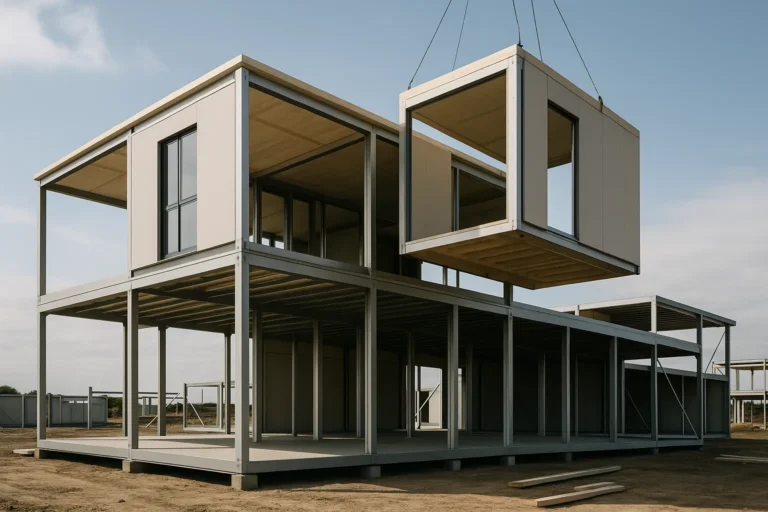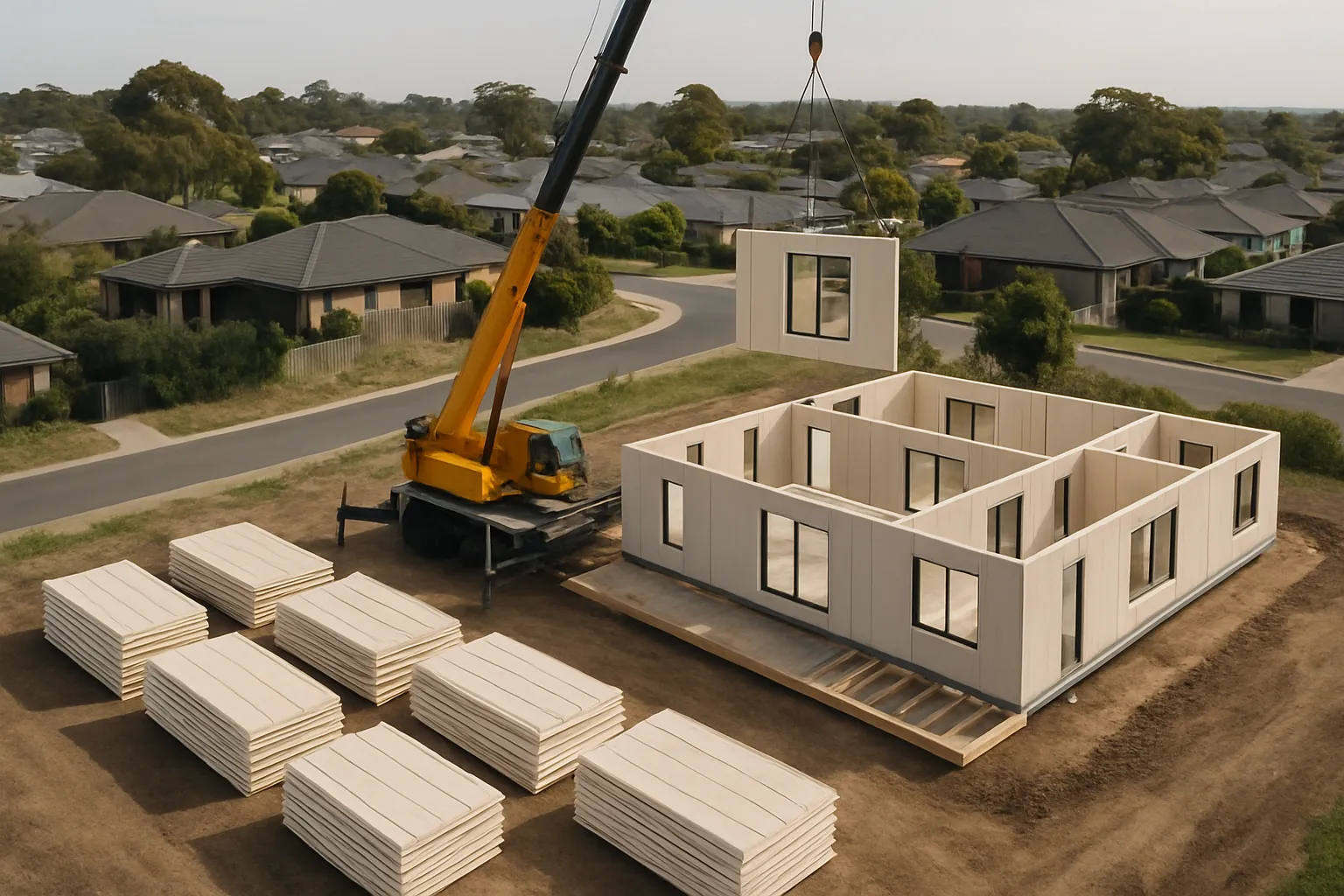
A US developer is building three-storey townhouses from flat-pack components that arrive by truck and click together on site, claiming construction costs 30–50 per cent below conventional builds. The company has raised close to $10 million and plans a factory capable of producing 1,200 homes a year.
The pitch is factory efficiency applied to housing: pre-wired wall panels, floors, stairs and roof sections manufactured under one roof, shipped in containers, assembled like modular furniture. Venture capital has backed the model, and the founders bring aerospace engineering and software backgrounds to a sector not known for either.
What the cost saving actually covers
The 30–50 per cent figure refers to the physical structure, walls, floors, wiring, insulation. It does not include land acquisition, which in Australian capital cities now accounts for 50–70 per cent of total project cost depending on location. Planning approval timelines, site preparation, connection fees and holding costs also sit outside the modular manufacturing process.
In metro Sydney or Melbourne, a $200,000 saving on the build still leaves a $600,000–$900,000 land component untouched. The arithmetic works better in growth corridors or regional centres where land is cheaper and zoning less contested, but that is also where demand and resale liquidity are weaker.
The Australian capacity and regulatory gap
Australia does not have an equivalent manufacturing base at this scale. Modular builders exist, several operate in the apartment and retirement-living segments, but none have announced plans for a 200,000-square-foot factory targeting 1,000-plus detached or attached dwellings per year.
Building codes differ by state. A pre-approved modular design certified in one jurisdiction may need fresh engineering sign-off in another, fragmenting the economies of scale that make factory construction viable. Labour agreements, transport logistics for oversized loads, and local council resistance to non-traditional builds add friction the US model does not always face.
venture capital that funds software or aerospace rarely flows to Australian construction. The sector’s track record of builder insolvencies, fixed-price contract blowouts and thin margins makes institutional investors cautious. Without that capital to build the factory, hire the engineers and cover the two-year ramp before revenue starts, the concept remains theoretical.
Who this helps if it scales, and who it doesn’t
First-home buyers chasing land-and-build packages in outer suburbs could see lower total costs if modular construction shaves $100,000–$150,000 off the build and shortens the timeline from 12 months to six. Faster delivery reduces holding costs and interest-rate exposure during construction.
Investors targeting new-build tax incentives may find modular an easier path to a compliant property, especially if councils pre-approve certain designs. But the same zoning constraints that limit traditional townhouse development, setbacks, heritage overlays, neighbour objections, will still apply. A factory-built townhouse on a site that cannot get DA approval delivers zero units.
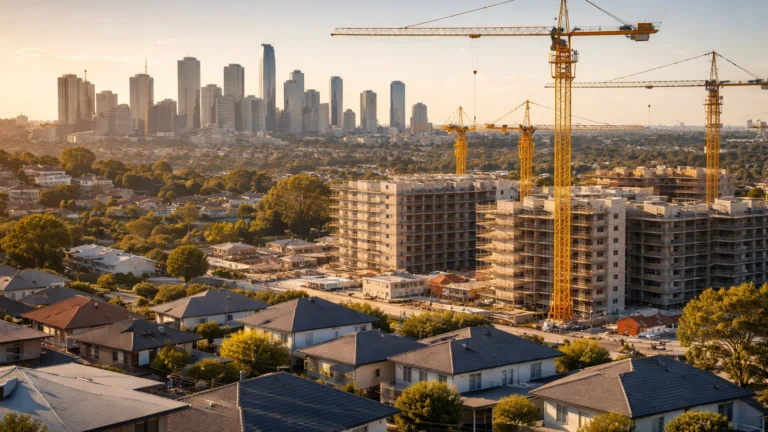
Upgraders and downsizers in established suburbs gain nothing unless their local council rezones for medium density and modular builders secure sites at scale. The US company’s model targets urban infill; Australia’s urban infill is locked behind planning processes that can run 18–36 months even when the land is available.
Trade-offs: speed versus customisation and resale perception
Modular construction trades speed and cost for design flexibility. Floor plans are standardised to maximise factory throughput. Buyers wanting custom layouts, higher-end finishes or site-specific architecture pay extra or go elsewhere, narrowing the addressable market to price-sensitive, time-sensitive purchasers.
Resale perception is an unknown. Australian buyers have historically paid a premium for brick veneer and prefer established construction methods. Whether a modular townhouse sells for the same price per square metre as a conventional build five years later depends on build quality, maintenance and market education. If resale values lag by even 5 per cent, the upfront saving evaporates on exit.
In plain English
Modular construction can cut the cost of putting up walls, floors and a roof by 30–50 per cent in a controlled factory environment. It cannot cut the cost of land, planning approvals, or the holding period while you wait for council sign-off. In Australian metro markets, land is the bigger cost line, and planning is the longer delay.
What would need to change for this to matter at scale
Three things unlock modular as a supply lever: state governments pre-approving a library of modular designs that councils must accept without re-engineering; land supply in locations people want to live, zoned for the density modular builders need to hit their unit economics; and patient capital willing to fund the factory before the first sale settles.
Without those, modular remains a niche play for greenfield estates and off-metro projects where land is cheap and council appetite for experimentation is higher. That may still deliver a few hundred units per year, but it will not move the national supply needle.
Scenarios: base case and the optimistic tail
Base case: Australian modular builders continue operating at 200–400 units per year, mostly in retirement living, student accommodation and outer-suburban land estates. Cost savings stay in the 15–25 per cent range once local compliance, transport and site-specific variations are priced in. Institutional capital remains scarce.
Optimistic tail: a state government partners with a modular manufacturer to pre-approve designs and fast-track sites on surplus public land. First projects deliver in 12–18 months, proving the model. Private capital follows, and annual output reaches 1,500–2,000 units within five years. Even then, it is 2–3 per cent of national housing starts, not a step-change.
The practical next step
If you are buying off-the-plan or considering a land-and-build contract, ask whether the builder uses any modular or prefab components and what that does to the construction timeline and fixed-price risk. Shorter builds mean less interest-rate exposure during construction, which for a $500,000 loan at 6.5 per cent is worth $16,000 per six months saved.
For investors, track which councils are approving modular projects and whether resale comparables are emerging. If you are in a regional or growth-corridor market where land is under $200,000 and council is open to medium-density infill, modular may be the faster path to a rentable asset. In metro markets where land is $600,000-plus and DA timelines run two years, the modular saving is a rounding error.
Subscribe to the newsletter for weekly analysis on what is actually moving housing supply and where the next cost pressure points sit.
General info, not financial advice.