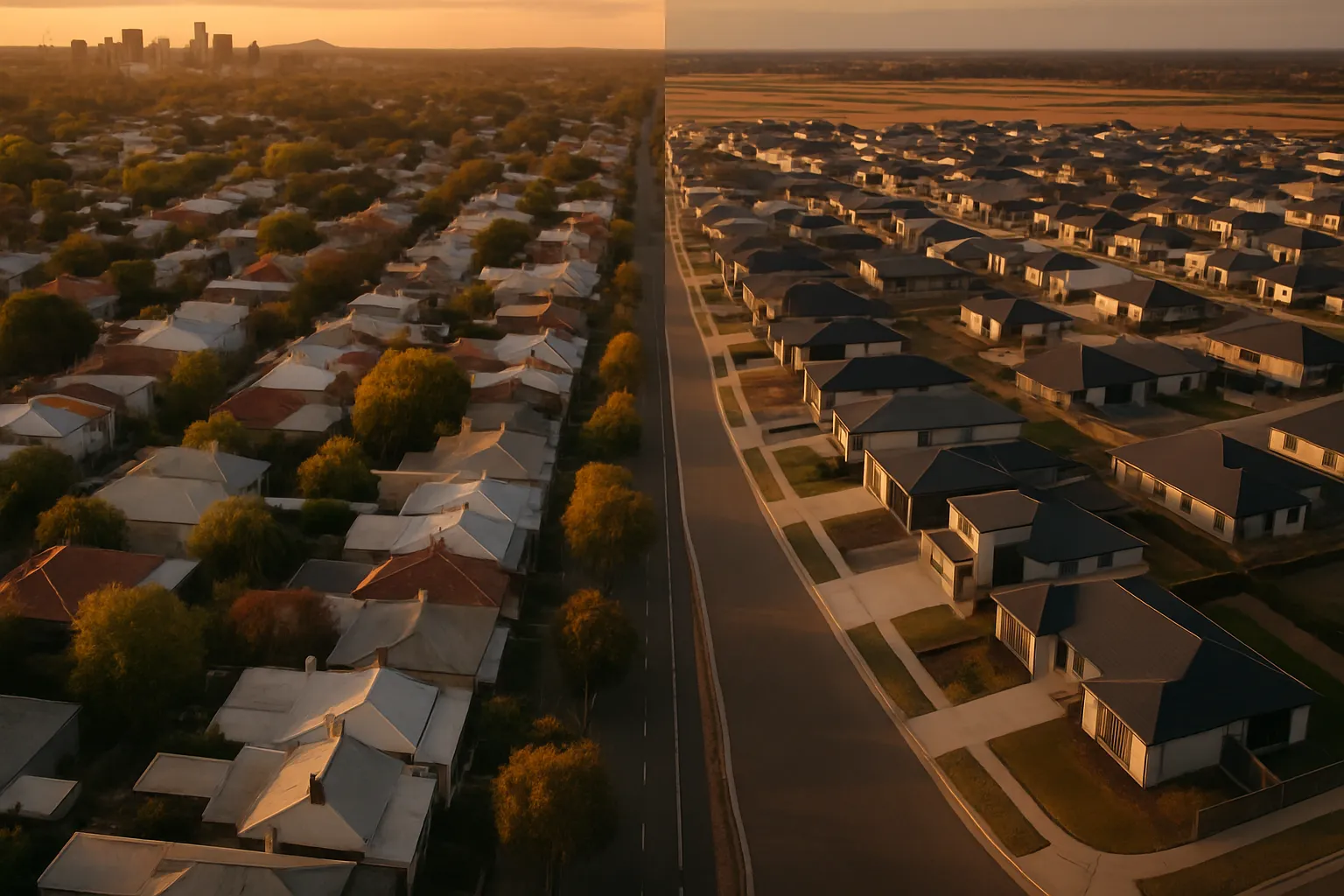
Sydney dwelling values are already 5% below peak. Melbourne is following the same path. Brisbane and Adelaide turned negative in the past two months. The question now is not whether prices are falling, it is how far they can fall before years of accumulated gains disappear.
The answer depends entirely on which city you are in. Markets that recorded the strongest growth during the post-pandemic boom have built the deepest buffers. Markets where values stagnated now have almost no room to absorb further declines without erasing five years of capital growth.
The city-by-city buffer breakdown
Melbourne peaked at $840,000 in November 2025 after five years of minimal growth. A 10% decline from that peak would return dwelling values to pre-pandemic levels. Beyond that threshold, buyers who entered the market in 2020 would see their equity vanish.
Sydney is already more than 5% below its peak, but the buffer remains deeper than Melbourne’s. Even a 20% downturn would only take median values back to around May 2021, still inside the pandemic boom window.
Perth recorded one of the strongest growth cycles of any capital. A 20% decline from peak would still leave median dwelling values around April 2025 levels. The city gained so much during the past three years that it can absorb a severe correction and remain ahead of where it stood twelve months ago.
Brisbane entered a downturn only two months ago, but the buffer is substantial. A 20% fall would return values to roughly August 2024. Adelaide holds a similar position: even a 20% correction would only wind the clock back to April 2024.
Key numbers
- Melbourne: 10% decline returns values to pre-Covid levels
- Sydney: 20% fall takes values back to May 2021
- Perth: 20% drop leaves values at April 2025 levels
- Brisbane: 20% correction returns market to August 2024
- Adelaide: 20% decline winds back to April 2024
What this means for buyers at different entry points
Anyone who bought in Melbourne since late 2020 is now closer to negative equity risk than buyers in Perth, Brisbane or Adelaide who entered at similar points in their respective cycles. The divergence is not about national trends, it is about how much growth each city banked before the downturn began.
Buyers who entered Perth in 2023 or Brisbane in 2022 have substantial equity cushions even if prices fall another 10% to 15%. Melbourne buyers from the same period have almost none.
This creates a split market for refinancing, upgrading and portfolio expansion. Borrowers in high-buffer cities can still access equity for deposits on additional properties or negotiate better rates. Borrowers in low-buffer cities are locked into their current lender’s terms unless they can inject fresh cash to meet loan-to-value ratio thresholds.
The negative equity picture so far
Despite the headlines, widespread negative equity has not materialised. Fewer than 0.2% of first-home buyers who used the expanded 5% deposit scheme since October last year have fallen into negative equity, 87 households out of roughly 48,000.
Almost half of those first-home buyer households are in regions where current equity sits at 5% or less, but that does not mean they are underwater. Provided borrowers continue to meet repayments, the immediate financial risk remains low.
Regional markets are holding better equity positions than capital city submarkets. Queensland Outback recorded 14.2% equity for first-home buyers, followed by Western Australia Outback at 12.7% and South Australia Outback at 12.2%.
Sydney’s Eastern Suburbs sit at just 0.8% equity, Melbourne’s Inner East at 1.9%, and the Mornington Peninsula at 2%. This partly reflects the fact that first-home buyers target more affordable properties, including in regional areas that have since experienced stronger price growth.
The catch for leveraged owners and investors
Owner-occupiers who do not need to sell can ride out the downturn without forced action. Upsizing or downsizing within the same falling market means taking less for the current property but paying less for the next one.
The pressure lands on highly leveraged borrowers who need to refinance, access equity or sell. If the property has lost 10% in value and the loan-to-value ratio has climbed above 80%, refinancing becomes difficult without a cash injection. If a sale is forced during a downturn, the borrower absorbs the capital loss and may still owe the lender if the sale price does not cover the outstanding loan balance.
Investors face a different calculation. Falling values reduce the equity available to fund the next purchase. Weaker rents or prolonged vacancies compound the cashflow pressure. Investors who bought in low-buffer cities like Melbourne with thin deposits are now facing serviceability reviews from lenders who revalue the security property downward. For more on how settlement failures are rising as some buyers walk away, see this analysis of buyers betting on further 20% drops.
Investors in high-buffer cities have more room to wait. Even if cashflow is tight, the equity cushion provides breathing space to refinance or negotiate with the lender without being forced into a distressed sale.
Who else takes the hit
State and federal governments collect significant revenue from property transactions. Stamp duty, land tax, capital gains tax and GST all flow from property activity. Falling prices reduce transaction volumes as buyers delay purchases, waiting for the market to settle. Lower sale prices mean lower stamp duty collections. Weaker capital growth means lower future capital gains tax receipts.
If the downturn extends into 2026, state budgets that rely heavily on stamp duty, particularly New South Wales and Victoria, will need to find revenue elsewhere or cut spending. Federal revenue from capital gains tax will lag by 12 to 18 months as investors who sold in 2025 lodge tax returns in mid-2026.
Superannuation contributions tied to property, including the downsizer contribution, may also shift if property returns weaken relative to other asset classes. Homeowners aged 55 and over can contribute up to $300,000 from the sale of their home into superannuation. If property values fall and prospective downsizers hold off selling, that flow of contributions slows.
What could reverse the decline
A sustained fall in mortgage rates would bring buyers back into the market quickly. Mortgage rates in Australia have already begun to shift as lenders retreat from previous floor levels, but serviceability tests still assume rates will rise by at least 3 percentage points from the loan rate. If the Reserve Bank of Australia cuts the cash rate by 50 basis points or more over the next six months, serviceability loosens and buyer demand recovers.
A reversal or softening of negative gearing and capital gains tax reforms would stabilise investor sentiment. If the federal government walks back the proposed changes or phases them in more gradually, investors who paused acquisition plans may re-enter the market.
Supply constraints could also floor prices. If construction completions remain well below demand, and workforce shortages persist, then even weak buyer demand may be enough to prevent a prolonged downturn.
What to do with this
If you bought in Melbourne since 2020, calculate how far your equity cushion extends before you hit negative equity. Use the current median value for your suburb, subtract 10%, and compare that to your outstanding loan balance. If the gap is thin, prioritise paying down principal over discretionary spending or offset-funded lifestyle purchases.
If you bought in Perth, Brisbane or Adelaide during the boom, you have more room. A 15% to 20% decline still leaves most buyers with positive equity. Use that buffer to negotiate better loan terms now, rather than waiting until the downturn deepens and lenders tighten criteria further.
If you are planning to buy, focus on cities where the buffer is thinnest. Melbourne and Sydney are closer to their pre-pandemic baselines than Perth or Brisbane, which means the downside risk from this point is smaller. Waiting for a 20% fall in Perth may mean waiting years, waiting for a 10% fall in Melbourne may mean waiting months.
Subscribe to the newsletter for weekly updates on how far each city has fallen and what the next threshold looks like.
General info, not financial advice.