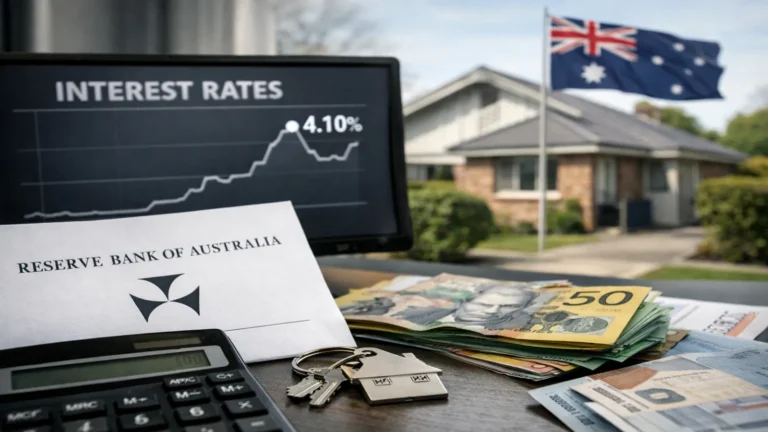
The Reserve Bank held the cash rate at 4.35% in August and did not discuss a reduction. That is the clearest signal yet that relief for mortgage holders will not arrive in 2026.
The August meeting minutes, released Tuesday, show the board watching several inflation risks that could still prompt a rate increase. The Middle East conflict remains a potential trigger for fuel and food price jumps. Domestic data centre construction, driven by the AI investment wave, is straining labour and materials markets.
The deputy governor spoke the week before the meeting and put the risk plainly: if an investment boom pushes inflation higher and the target stays out of reach, rates will go up again.
What the board is watching
The RBA is tracking three pressure points. First, geopolitical instability that could lift energy and grocery costs. Second, the construction pipeline for AI infrastructure, which is pulling workers and materials out of residential and commercial projects. Third, the persistence of services inflation, where wage growth is flowing through to prices faster than productivity gains can absorb it.
The minutes confirm the board will raise rates again if those risks materialise. That language has appeared in every statement since May, but this is the first time the minutes spelled out the specific threats in detail.
The inflation picture heading into September
The July CPI reading lands Wednesday, the final data point before the September decision. June annual inflation came in at 3.8%, with the trimmed mean at 3.6%. Both figures sit above the 2–3% target band.
The RBA’s updated forecasts do not see inflation returning to 3% until mid-2027. Housing costs are the biggest contributor, with rents and new dwelling construction making up roughly 14.5% of the index. Rents are rising because vacancy rates remain tight despite a marginal uptick in some cities. New dwelling costs are rising because labour shortages and material price volatility have not eased.
National home prices have dropped for four straight months, which one major bank economist said could slow household spending and indirectly help the inflation task. That mechanism works through the wealth effect: falling property values reduce perceived household wealth, which dampens discretionary spending, which reduces demand pressure on goods and services prices. It is a slow feedback loop, not a quick fix.
Key numbers
- Cash rate: 4.35%, unchanged since November 2025
- June annual CPI: 3.8%, above the 2–3% target
- Trimmed mean inflation: 3.6%, also above target
- RBA forecast: inflation returns to 3% by mid-2027
- Housing costs as CPI share: 14.5% (rents + new dwellings)
Scenarios for the next six months
Base case: the cash rate stays at 4.35% through the rest of 2026. Inflation continues to drift lower but remains above 3% into early 2027. The first cut arrives in the second quarter of 2027, assuming no external shocks.
Upside risk: the Middle East conflict escalates, fuel costs spike, and services inflation accelerates. The board lifts rates by 25 basis points before the end of the year. This scenario becomes more likely if the July CPI reading comes in above 4%.
Downside case: inflation drops faster than forecast, possibly due to a sharp slowdown in consumer spending or a faster-than-expected correction in housing costs. The RBA signals a willingness to cut in early 2027. This scenario requires both headline and trimmed mean inflation to fall inside the target band for at least two consecutive quarters.
The trade-off for borrowers
If you are on a variable rate, the monthly cost is not changing soon. The four major banks all forecast the cash rate has peaked, but none expects a cut before 2027. That puts the earliest relief at least 12 months away.
If you are considering fixing, the current one-year fixed rates sit around 5.8–6.2%, roughly 150–180 basis points above the cash rate. That spread reflects the banks pricing in a hold until mid-2027. Fixing now locks in certainty but removes the chance of benefiting from an earlier-than-forecast cut.
Serviceability is tightening at the margins. Lenders are using a 9–9.5% assessment rate, meaning a borrower needs to prove they can service a mortgage at that level even though the actual rate is closer to 6.5–7%. If your borrowing capacity is already stretched, non-bank lenders with higher LVR caps may offer more room, though typically at a higher rate.
What could shift the timeline
Three variables could bring a rate cut forward or push it further out. First, the pace of wage growth. If wages rise faster than productivity, services inflation stays elevated and the RBA holds longer. Second, global energy prices. A sustained drop in oil could ease inflation pressure across transport, food and goods. Third, the construction labour market. If worker shortages ease and housing costs moderate, the inflation path steepens.
The July CPI reading will clarify which scenario is most likely. If headline inflation ticks up or trimmed mean stays flat, the base case shifts toward a longer hold.
Your move if you are carrying a mortgage
Check your current rate against the market. If you are on a loyalty rate above 7%, refinancing could save 50–80 basis points without waiting for the RBA to move. Run your serviceability at the lender’s assessment rate to see how much buffer you have left. If you are already at the limit, build a cash reserve rather than stretching for a larger loan or upgrade.
If you are holding investment property, review your cashflow assumptions. Rates are not falling this year, and rental vacancy rates are improving in some markets, which could cap rent growth. That combination tightens the yield equation.
Subscribe to the newsletter for the weekly read on rates, credit and what is actually moving the dial.
General info, not financial advice.