A proposed crane fee in one of Sydney’s fastest-growing council areas might sound like a niche planning change. It is not.
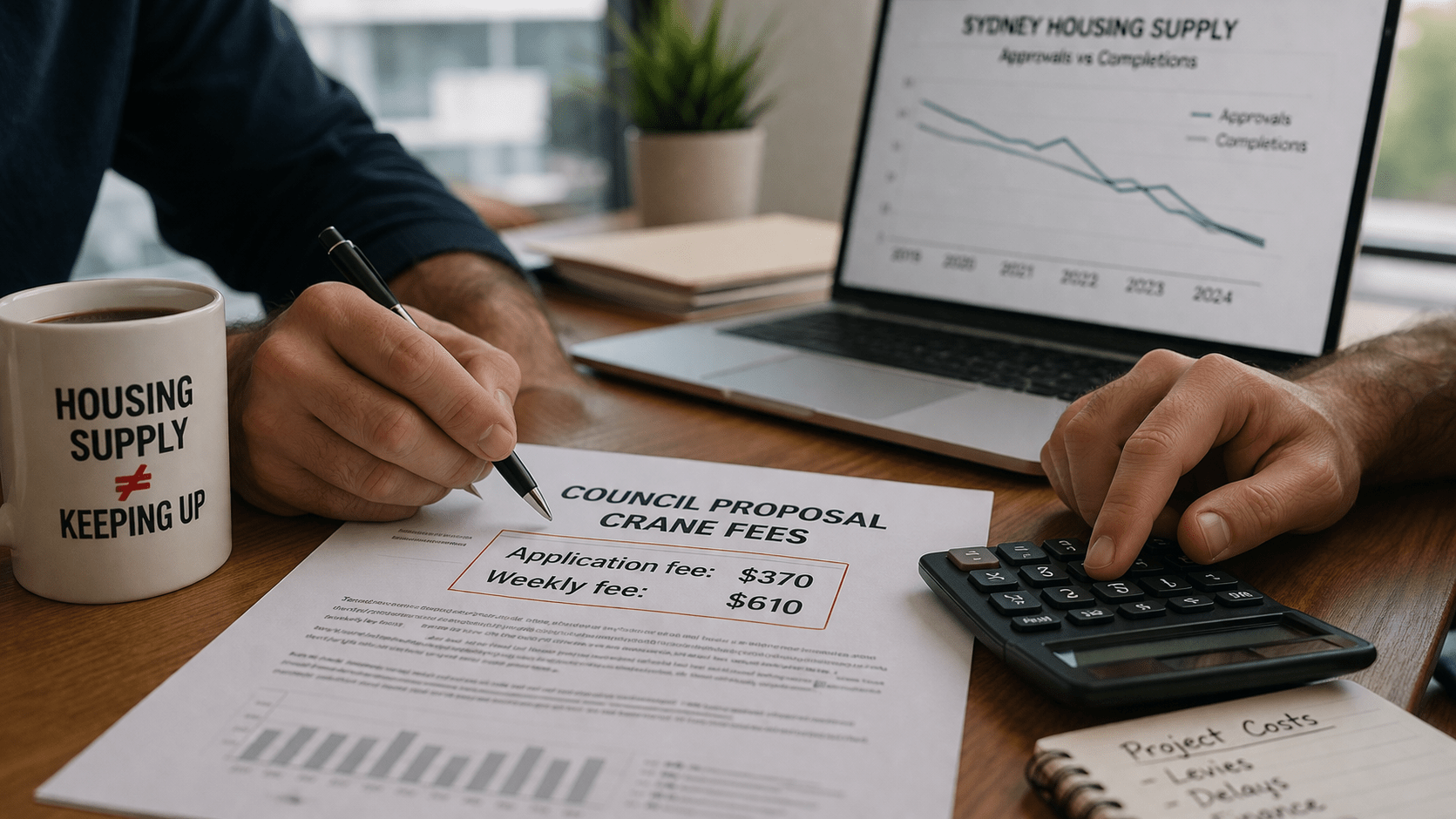
The Hills Shire Council is considering a new charging regime for developers using fixed tower cranes and mobile cranes when any part of the crane occupies, or swings over, public land or neighbouring private property. The draft proposal includes a $370 application fee and a $610 weekly charge.
On paper, the case is simple. The council says the policy is about public safety, liability and cost recovery. Developers say it is another layer of bureaucracy landing on an industry already struggling with higher finance costs, labour shortages, inflation and long approval timeframes.
Both claims can be true at once. But here’s the part most people miss: in a housing market already constrained by cost and delay, even modest new charges matter when they sit on top of everything else.
What changed and what didn’t
What changed is not crane safety law itself. The proposal does not create a new safety risk. It creates a new local fee and approval framework around activity that crosses beyond the strict boundary of a private site.
What did not change is the broader reality facing Sydney apartment projects. Feasibility is already under pressure. Builders and developers are still dealing with tight margins, patchy buyer confidence, higher debt costs and a planning system that rarely rewards speed.
That matters because small regulatory costs rarely arrive alone. One new fee might look manageable in isolation. A dozen “manageable” costs across planning, infrastructure, compliance, insurance and construction can be the difference between a project proceeding or stalling.
Why councils think this is reasonable
The council’s argument is not absurd. If a private development uses public space, or creates extra monitoring and inspection work, councils will say the broader community should not wear that cost.
That is a politically saleable position. Ratepayers are already sensitive to the idea that private development profits can be socialised while public inconvenience stays local. In that context, charging for oversight sounds fair.
There is also a legal and operational angle. Councils want a formal framework rather than handling crane-related risks case by case. From their perspective, a clear policy reduces ambiguity and gives staff a consistent process.
So what does that mean in plain English? The council is trying to move from ad hoc approvals to a standardised system where the developer, not the public, pays for the administration and supervision.
The catch is duplication
Developers are objecting because the proposal lands in an industry that is already heavily regulated.
Their concern is not just the dollar figure. It is the extra approval layer. Work health and safety rules already govern crane operations. State planning rules already shape how projects are assessed. Once councils add another process, the risk is no longer only cost. It is delay.
And delay is where these policies become more damaging than they first appear.
A weekly fee is visible. A three-week wait for processing, a revised application, another inspection window or a delayed site start is harder to quantify, but often more expensive. Interest keeps accruing. Trades need to be rescheduled. Presales can get riskier. Project timing slips.
That is why the industry pushback is stronger than the raw fee numbers might suggest.
This is not really a story about cranes. It is a story about the cost stack.
When councils add another fee or approval step, the effect is usually not dramatic on day one. But across a full apartment project, these extra layers can lift costs, slow delivery and reduce the number of projects that actually get built.
Why this matters beyond one council area
The Hills district sits at the centre of Sydney’s long-running housing expansion story. That makes this more than a local government footnote.
When fees rise in growth corridors, the second-order effects can spread wider than the policy itself. Developers rework project assumptions. Lenders examine viability more closely. Builders sharpen contingency allowances. Buyers eventually see the result through higher prices, fewer launches or smaller product.
Will a crane fee alone make a home unaffordable? No. That would overstate it.
But that is the wrong test.
The better test is whether Sydney’s housing system can afford yet another friction point. On that question, the answer looks less comfortable. Housing affordability is not usually broken by one big tax or one dramatic policy mistake. More often, it is eroded by a series of smaller decisions that each add cost, delay or uncertainty.
This proposal fits that pattern.
Who really pays
Councils can charge developers. Developers can invoice projects. But markets decide who carries the burden.
In a weak market, some of the hit comes out of developer margin because buyers will not absorb endless price increases. In a tighter market, more of the cost is pushed into sale prices, rents or both. In all cases, the pipeline becomes a little more fragile.
That is why the debate matters to more than just developers.
First-home buyers are affected when apartment projects become harder to launch. Downsizers are affected when medium-density supply gets more expensive. Investors are affected when new stock slows and replacement costs rise. Even existing owners are affected indirectly, because constrained new supply can keep upward pressure on established values.
The broad lesson is simple: policy costs do not stay where they are first imposed.
What could derail the council’s case
The council’s strongest defence is cost recovery. Its weakest point is proof.
If the draft policy is meant to improve safety, critics will ask whether the safety outcome is genuinely new or whether the council is charging for oversight that is already covered elsewhere. If it is mainly about administration, opponents will ask whether the fee level is proportionate and whether the process can be handled without holding projects up.
That is where this proposal will likely be tested. Not on whether safety matters. Everyone agrees it does. The real question is whether this framework adds meaningful protection or simply adds another checkpoint to an already congested system.
If the answer leans too heavily toward paperwork rather than public benefit, the criticism will stick.
What happens next
The draft policy will go on public exhibition, which means there is still room for change before anything is locked in.
That matters because consultation can reshape details such as fee levels, exemptions, processing standards and the treatment of different crane types or project settings. The final version may end up narrower than the current proposal.
Still, the direction is worth watching. Even if this specific policy is softened, the bigger trend remains the same: more localised charges and tighter operational controls around development activity.
For anyone watching Sydney’s supply pipeline, that is the real signal.
Bottom line
A crane fee can be defended as cost recovery. It can also be criticised as another small policy move that makes new housing harder to deliver.
Both things may be true. But in a city already struggling to build enough homes at a workable price, policymakers should be careful about treating every added cost as trivial. The cumulative effect is where the damage usually shows up.