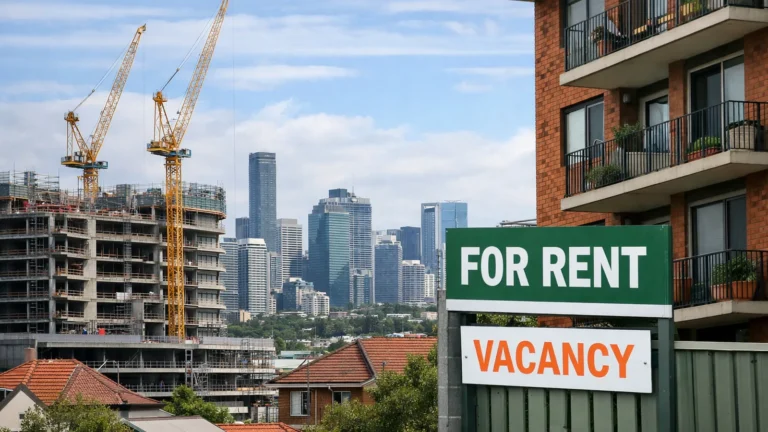
Australia’s housing approval numbers bounced hard in February. On the surface, that is the kind of data point policymakers want to see.
The Australian Bureau of Statistics said total dwelling approvals rose 29.7 per cent in seasonally adjusted terms to 19,022. The lift was driven mainly by private sector dwellings excluding houses, which jumped 101.2 per cent to 8,922. Private sector house approvals, by contrast, were basically flat, up just 0.2 per cent to 9,847.
That is the good news.
The less comfortable part is that one strong month does not mean Australia’s supply problem is suddenly on the mend. The February rebound looks heavily unit-led, and that matters because apartment approvals are usually the most volatile part of the series. A sharp bounce after earlier weakness can tell you activity has returned, but it does not automatically tell you the pipeline is healthy.
What improved, and what still hasn’t
The headline number improved. The breadth of that improvement is less convincing.
The ABS said apartment approvals rose 191.2 per cent in original terms to 5,398, while townhouse approvals rose 73.8 per cent to 2,981 after a weak January. Over the 12 months to February 2026, total dwellings approved reached 195,434, up 9.0 per cent from the previous year.
So yes, February was stronger.
But detached houses did not suddenly break higher. And the supply story Australia needs is not just “one month of better approvals”. It is a sustained lift in projects that actually move from approval to construction to completion. That is a much harder chain to fix.
Now, the part most people miss. Australia’s housing shortage is not just a demand problem. It is a delivery problem. A project can be approved on paper and still run into funding pressure, builder margin stress, labour shortages, planning friction or simple feasibility problems before enough homes reach the market. That is why a single monthly jump should be read carefully, not celebrated blindly.
Why apartments matter more than the headline suggests
If Australia is serious about improving affordability, apartments and townhouses are doing a lot of the heavy lifting.
Detached houses alone were never going to close the national housing gap. Higher-density housing is where scale comes from, especially in Sydney, Melbourne and other major urban corridors where land is constrained and demand is concentrated. That is why February’s rebound in non-house approvals is important. It tells you the part of the market that matters most for volume is still alive.
But it also tells you where the risk sits.
Apartments are capital-intensive, slower to deliver and more exposed to cost swings. When finance costs rise or construction inputs stay elevated, higher-density projects are often the first to become marginal. Australian Property Review has already covered that pressure in Why This Rate Rise Could Worsen Australia’s Rental Crisis and Labor housing target shortfall grows . The same logic applies here: approvals can bounce, but if feasibility stays fragile, supply can still disappoint later.
A rise in approvals is better than another fall.
It is not the same thing as saying Australia’s housing shortage is being solved.
The numbers say rebound. The cycle says caution.
There is another reason to stay disciplined with this data. Approval series can swing sharply from month to month, especially when large apartment projects enter or leave the count.
January 2026 was weak, with total approvals down 7.2 per cent and private sector dwellings excluding houses down 24.5 per cent. February then snapped back hard. That does not make either month irrelevant. It means the cleaner read is the broader trend: the pipeline is uneven, and the non-house segment is still doing most of the work.
This is where investors and homebuyers need to stay calm. A volatile monthly rebound is not the same as a durable construction upswing. If you are assessing the outlook for prices, rents or local supply risk, you need more than one data point. You need to watch whether approvals stay elevated, whether commencements follow through, and whether completions arrive where demand is actually strongest.
That is also why Australian Property Review’s earlier guide, How to Buy Your First Home in Australia, puts real weight on the local supply pipeline. Future stock matters. But so does the quality and durability of that stock flow.
What could derail the better story
The base case is not disaster. It is friction.
Several things could interrupt the February improvement over the next few months.
First, project economics are still tight. Even where demand exists, some developments do not stack up cleanly once finance, labour, insurance and materials are priced in. Australian Property Review’s coverage of cost pressure, including Builders seek relief as housing costs surge, keeps pointing to the same issue: approvals are only the front end of a much more fragile build process.
Second, policy changes can help, but they do not work overnight. Faster approvals and mid-rise planning reforms may improve the mechanics at the margin, as seen in Victoria fast-tracks six-storey apartments and limits objections. But faster paperwork does not automatically solve construction capacity or development feasibility.
Third, the national housing target still looks demanding. Even with February’s bounce, Australia needs a sustained and much less fragile pipeline if it wants to materially narrow the supply gap over time.
What this means if you are making a property decision now
For investors, this is a reminder not to read national approval data as a buy signal on its own. The useful question is local: is new supply building up in your target pocket, and is it the kind of supply that could cap rents or resale growth in two to four years?
For owner-occupiers, especially first-home buyers, the message is slightly different. A healthier approval pipeline can be good news if it leads to more choice and less pressure in specific corridors. But do not assume more approvals nationally means better affordability where you want to buy. That depends on suburb-level delivery, not just the headline number.
Rule of thumb: watch approvals for direction, but make decisions using local pipeline, vacancy, price point and borrowing capacity together.
Bottom line
February’s approval surge is better than another weak print. It suggests parts of the housing pipeline still have life, especially in apartments and townhouses.
But Australia’s housing problem was never going to be solved by one month of stronger numbers.
The real test is whether these approvals keep coming, whether projects remain financially viable, and whether enough homes actually get built in the places that need them most.