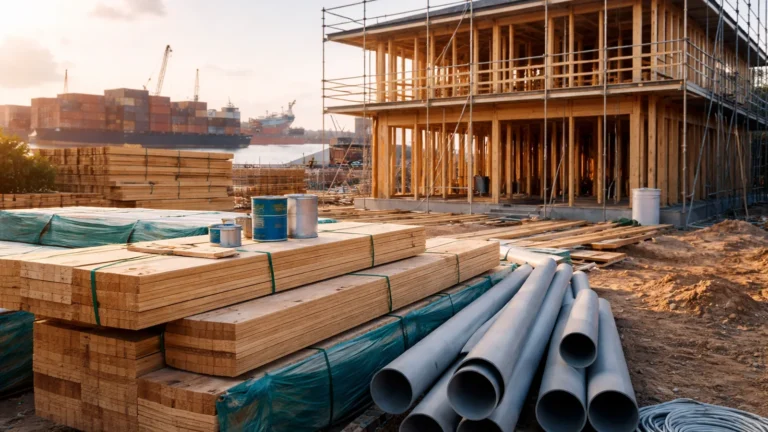
Meriton has reportedly stopped buying new development sites in Sydney and is putting more attention on Queensland, with planning delays and project economics at the centre of the shift. That matters because this is not just another developer complaint. When Australia’s biggest apartment builder says Sydney is no longer working, the signal is bigger than one company.
The easy version of this story is simple: developer leaves, Queensland wins, Sydney loses.
The real version is more useful.
Sydney already has a housing supply problem. Australian Bureau of Statistics data showed dwelling approvals jumped in February, but the broader pipeline still looks fragile, especially once you move from approvals to viable projects and then to homes actually getting built. Australian Property Review has already been tracking that weak link.
If a major apartment builder slows site acquisition in the country’s biggest housing market, the pressure does not show up all at once. It usually arrives later through fewer launches, tighter future supply, and a market that stays more expensive than policymakers hoped.
What changed and what didn’t
What changed is the tone and the capital allocation.
7NEWS reported that Meriton has stopped buying development sites in Sydney and is looking north to Queensland, blaming rising costs and long approval times for making projects harder to justify. Broader reporting around Harry Triguboff’s recent comments points to the same theme: slow planning, higher charges and weaker development economics in NSW.
What did not change is the underlying shortage.
Sydney did not suddenly become hard to build in this week. The approval system, holding costs, infrastructure charges, labour constraints and financing pressure have been building for years. That is why one developer’s decision should be read less as a dramatic break and more as a stress signal from a market already under strain.
Now, the part most people miss.
A pullback like this does not automatically mean Sydney apartment prices surge tomorrow. Demand still matters. Interest rates still matter. Buyer borrowing power still matters. Australian Property Review recently noted Sydney and Melbourne have already softened in quarterly value terms, which tells you finance conditions are still biting.
But supply decisions made now shape the market 2 to 5 years from now. That is the catch.
Why Queensland looks easier right now
Queensland is not magically cheap or risk-free. But it does look easier on a few fronts.
First, the growth story is stronger. Brisbane and the Gold Coast have benefited from migration, relative affordability and stronger recent price momentum than Sydney and Melbourne. Second, the development pitch is cleaner when approval pathways are faster and projects can move before costs drift higher again. Third, capital naturally goes where timing risk looks lower.
That does not mean every Queensland apartment project is suddenly a winner. Australian Property Review has already flagged that Queensland carries its own capacity risk, especially if residential work collides with Olympics-related demand, infrastructure work and a tight labour market. In other words, faster approvals help, but they do not remove the cost problem.
In plain English
If you are a developer, long approval delays are expensive.
Land has to be held. Debt has to be serviced. Consultants, legal work and compliance costs keep ticking over. Construction costs can move against you before a shovel even hits the ground. By the time approval lands, the project that looked viable on paper may no longer stack up.
That is why this matters beyond Meriton.
When enough projects stop stacking up, the city ends up with fewer apartments than it needs. That usually means higher rents, worse affordability and more political pressure for demand-side fixes that can end up inflating prices again if supply does not respond. Australian Property Review has made that point before in its coverage of supply risks, building cost pressure and first-home buyer policy effects. See also
- Dwelling approvals jumped, but Australia’s housing fix still looks shaky,
- Builders seek relief as housing costs surge, and
- \The 5% deposit trap pushing first-home prices even higher.
Why this is a policy problem, not just a developer gripe
It is easy to dismiss complaints from large developers as self-interest. Sometimes they are. Profit matters, and no developer builds out of charity.
But self-interest and policy signal are not opposites. They can be the same thing.
If the system is so slow and expensive that major private builders prefer to redirect capital elsewhere, the market is telling government something important. Not that every levy is wrong. Not that every planning objection is illegitimate. But that the total stack of delays, taxes, charges and uncertainty may be choking supply at exactly the moment Sydney says it needs more housing.
That is why this story should not be read as a personality piece about Harry Triguboff. The bigger question is whether Sydney can still attract enough large-scale apartment development to keep future supply from tightening further.
The real risk for buyers and renters
The first-order effect is fewer projects entering the pipeline.
The second-order effect is more important.
If large apartment developers retreat or slow down in Sydney, the pain tends to spread beyond the development sector. Renters face tighter vacancy risk. First-home buyers face fewer new-stock options. Upgraders face less choice in middle-ring apartment markets. Governments then face even more pressure to announce buyer assistance or planning reform, often after the supply damage is already underway.
I have seen this play out in different forms before: markets do not break because of one headline. They tighten because a dozen small decisions, delays and cost blows all push in the same direction.
What would change our mind
This is not a one-way call.
If NSW can materially shorten approval times, contain the cost stack and restore confidence that viable projects can move in a reasonable timeframe, capital can come back. Developers are not ideological. They go where the numbers work.
And if rates ease further, project feasibility may improve at the margin too. Lower funding pressure does not solve planning friction, but it can help reopen deals that currently look too thin. That is one reason it is worth keeping an eye on both the policy track and the credit track at the same time. For readers following that side of the market, Australian Property Review’s Rates & Credit coverage is also relevant, especially where serviceability and borrowing power keep shaping buyer demand.
Quick take
Sydney’s problem is not that one developer is unhappy.
Sydney’s problem is that a major apartment builder’s frustration fits the broader supply story too neatly.
When approvals are fragile, costs are high, and large projects take too long to move, housing shortages do not get solved by targets alone. They get worse quietly, then show up later in rents, prices and political blame.
Start here: watch the next six months for signs that NSW planning reform improves project timing, and whether other large developers start making the same call as Meriton.
Read more:
- Why build costs could jump for new homes in Australia and
- Sydney and Melbourne slip as housing split widens.
General info, not financial advice.