Most Australians are told a familiar story.
Work hard. Earn more. Stay disciplined. Things will sort themselves out.
That story sounds reasonable. It also breaks down faster than people expect.
A higher salary helps, but it does not automatically create wealth. Not when inflation keeps chewing through purchasing power. Not when lifestyle costs rise with income. Not when the whole plan still depends on one source of money landing in the account every fortnight.
That is the real trap.
For most households, the problem is not laziness or lack of ambition. It is structure. Too many people spend years trying to solve a long-term wealth problem with short-term earned income alone.
Here is the catch. A pay cheque is a foundation. It is not the finished system.
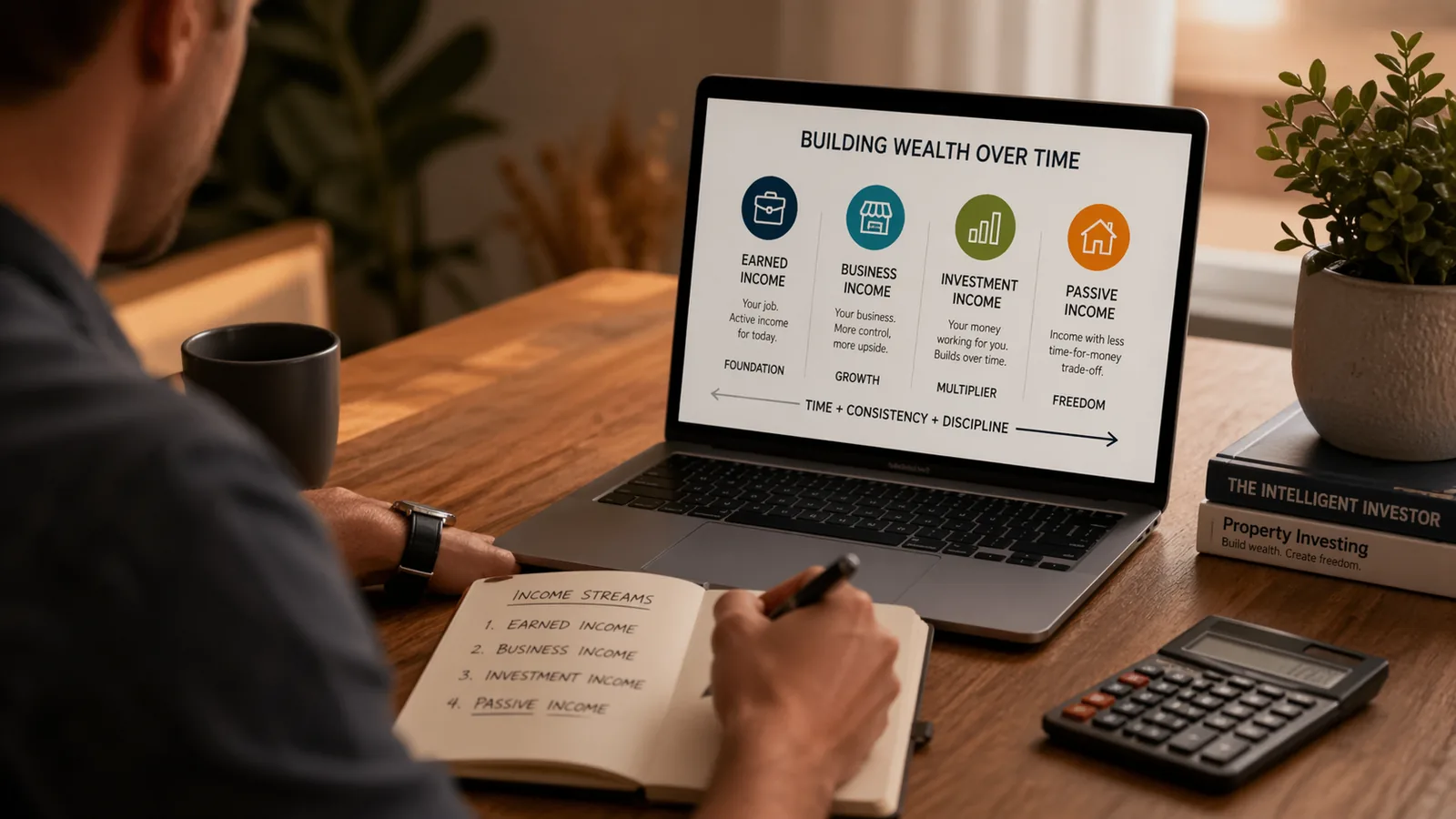
If you want genuine financial resilience, you usually need four layers working together over time: earned income, business income, investment income and passive income. You do not need all four at once. But if you stay stuck on the first one forever, the maths gets harder, not easier.
Why one income source stops working after a while
Earned income is where almost everyone starts.
You go to work, you get paid, and hopefully there is enough left over to save. There is nothing wrong with that. In fact, it teaches one of the most useful financial lessons early: money is tied to effort, and effort has a cost.
The problem is that earned income is usually capped.
Yes, you might get a raise. You might pick up overtime. You might change jobs and reset your base higher. But for most people, there is still a ceiling. Your upside is limited by time, your role, and what someone else is willing to pay.
That would be manageable if the rest of the system stood still. It does not.
Living costs move. House prices move. lender assessment rules move. Your tax bill often moves too. That is a big reason so many Australians feel like they are doing better on paper while feeling no more free in real life. Australian Property Review has already touched that pressure from the housing side in Why It Feels Like You Should Afford a Home, But Still Can’t.
The issue is not that earned income is bad. The issue is that earned income alone rarely compounds into freedom unless something else starts doing work in the background.
Some people should stay employees. Others should not.
This is where personal wiring matters more than finance gurus admit.
Some people value certainty. They sleep better knowing money lands regularly, even if growth is slower. Others want control badly enough that they will take volatility, longer hours and more stress in exchange for uncapped upside.
Neither camp is morally better. They are just different.
If you are in a salaried role, the smart move is not to romanticise entrepreneurship. It is to optimise what you have. That may mean negotiating better pay, moving into a higher-value role, lifting your skills, or changing industries. A stable income is powerful when you actually use it well.
If you are more commercially wired, business income can open a different lane. But this is the part social media makes look far easier than it is.
Running a business is not just doing the thing you are good at. It is sales, cash flow, bookkeeping, tax, compliance, pricing, follow-up, systems, and the emotional pressure of having no guaranteed income. Plenty of people are excellent at their trade and poor at running the machine around it.
That matters because revenue is not profit, and cash hitting the account is not automatically yours to spend.
The part new business owners learn the hard way
One of the quickest ways to go backwards is to confuse turnover with wealth.
A self-employed operator can have money coming in every week and still be under pressure. GST, tax, super, wages, software, insurance and supplier costs do not care whether your month felt productive. They still want to be paid.
Now, the part most people miss.
When someone leaves employment to work for themselves, they often focus on freedom and upside. Fair enough. But the first upgrade they actually need is not more ambition. It is better financial control.
That usually means clean bookkeeping from day one, a proper cash buffer, realistic forecasting, and a clear understanding of what the business must earn before the owner is truly getting ahead.
This is also why your household system matters as much as your business system. If personal spending is messy, business pressure leaks straight into family life. That is exactly why The three-bucket money hack that stops you going backwards is useful reading before anyone tries to scale income. The core point is simple: liquidity, growth and long-term capital should not all sit in one undisciplined pool.
Wealth usually starts changing at the third income stream
This is where the conversation gets more interesting.
The first two income types, earned income and business income, are both active. They depend heavily on your labour, your output, your hours, or your ability to win work.
Investment income is different.
This is the moment surplus capital starts producing something. It might be dividends, rent, distributions, option premium, interest, or another income stream from productive assets. It still needs oversight, and it is not always perfectly passive, but the important shift has happened. Your money is no longer sitting idle waiting for you to rescue the plan with more effort.
That shift matters more than many people realise.
A household that saves but never invests can look responsible for years while steadily losing ground in real terms. Cash has a role, especially for safety and flexibility. But too much cash for too long can quietly become its own risk. Australian Property Review made a similar point recently in The 72 Rule That Exposes How Fast Wealth Really Grows, especially around the damage inflation can do when money stays parked without a productive job.
That is why the move from saving to investing is so important. Not because every investment works. Not because risk disappears. Because over the long run, trying to build wealth without productive assets is usually just a slower form of stress.
In plain English
A strong wealth plan usually moves in this order:
- earn reliably
- protect cash flow
- build surplus capital
- put that capital to work
- keep reinvesting until the income becomes less dependent on you
That sounds basic. It is. But basic is not the same as easy.
Passive income is the endgame, not the starting point
Passive income gets thrown around too casually.
People talk about it as if it is a shortcut. Usually it is a result.
A paid-off property producing rent, a portfolio generating dependable distributions, a trust throwing off income, or a bond ladder funding part of retirement can all count. But those outcomes normally sit at the far end of years of earlier decisions.
That distinction matters because it changes what readers should do next.
If you are still stabilising your household budget, you do not need to obsess over “retirement income” content. You need cash flow discipline and a buffer.
If you are earning well but every spare dollar vanishes, your problem is not a lack of opportunities. It is leakage.
If you have built a decent buffer and are still hoarding too much cash, your issue may be fear dressed up as prudence.
If you already own assets but keep stripping income out of them to fund lifestyle upgrades, the machine may never get big enough to change your life.
This is where a lot of Australians get stuck. They start building an asset, then interrupt compounding before it has real force.
What this means for property readers
For Australian Property Review readers, the property angle is obvious but often misunderstood.
Property can sit in more than one part of this system. Early on, it may function as a growth asset with cash flow pressure attached. Later, as debt falls and rents rise, it can shift closer to passive income. The same asset can play a different role depending on timing, structure and how hard the loan is still working against you.
That is why lazy property advice is dangerous.
A house is not automatically a great investment because prices rose last cycle. A portfolio is not automatically resilient because it looks large. And more leverage is not automatically smart just because someone on a podcast made it sound confident.
The better question is whether the asset improves your overall financial machine.
Does it strengthen cash flow over time? Does it add flexibility? Does it create options later? Or does it leave you asset-rich, buffer-poor and one setback away from forced decisions?
Thinking about that trade-off should also see Invest or Pay Off the Mortgage? A Straight-Up Guide for Aussies and Should You Lock Your Mortgage Before Fixed Rates Climb Again? Both get at the same practical issue from different angles: the right move is not just about growth, it is about structure, flexibility and holding power.
What could derail the whole plan
There is no perfect formula here, but the failure points are surprisingly consistent.
One is lifestyle creep. Income rises, spending rises with it, and the surplus never appears.
Another is false confidence. People move into business or investing without enough buffer and find out too late that volatility feels different when repayments are due.
Another is delay. Plenty of households wait until they feel fully confident before investing. In practice, that often means waiting until assets are dearer, time is shorter, and the compounding runway is worse.
And then there is the biggest one of all: activity without direction.
Some people are financially busy for years. They refinance, budget, compare rates, watch markets, listen to podcasts and talk strategy constantly. But very little of that matters if the core machine is still missing the step where capital starts compounding.
The bottom line is less glamorous than people want
Building wealth is not usually about finding the cleverest idea in the room.
It is more often about graduating through the income layers in the right order.
Earned income gives you footing. Business income can lift upside if it suits your temperament. Investment income is where wealth starts becoming more than your labour. Passive income is what turns that long build into freedom.
Most people do not need to become entrepreneurs, full-time investors, or amateur economists. But they do need to stop treating one pay cheque as a complete plan.
If you are thinking, okay, but what should I do, start here.
Work out which of the four income streams you already have, which one is missing, and which move would most improve your position over the next 12 months. For some readers, that means lifting income. For others, it means getting serious about buffers. For others, it means finally moving from saving to disciplined investing.
Start here: identify the next income layer your household actually needs, then build the structure to support it before chasing anything flashy.
General info, not financial advice.
Read more
- The three-bucket money hack that stops you going backwards
- Invest or Pay Off the Mortgage? A Straight-Up Guide for Aussies
- Why It Feels Like You Should Afford a Home, But Still Can’t
- The 72 Rule That Exposes How Fast Wealth Really Grows