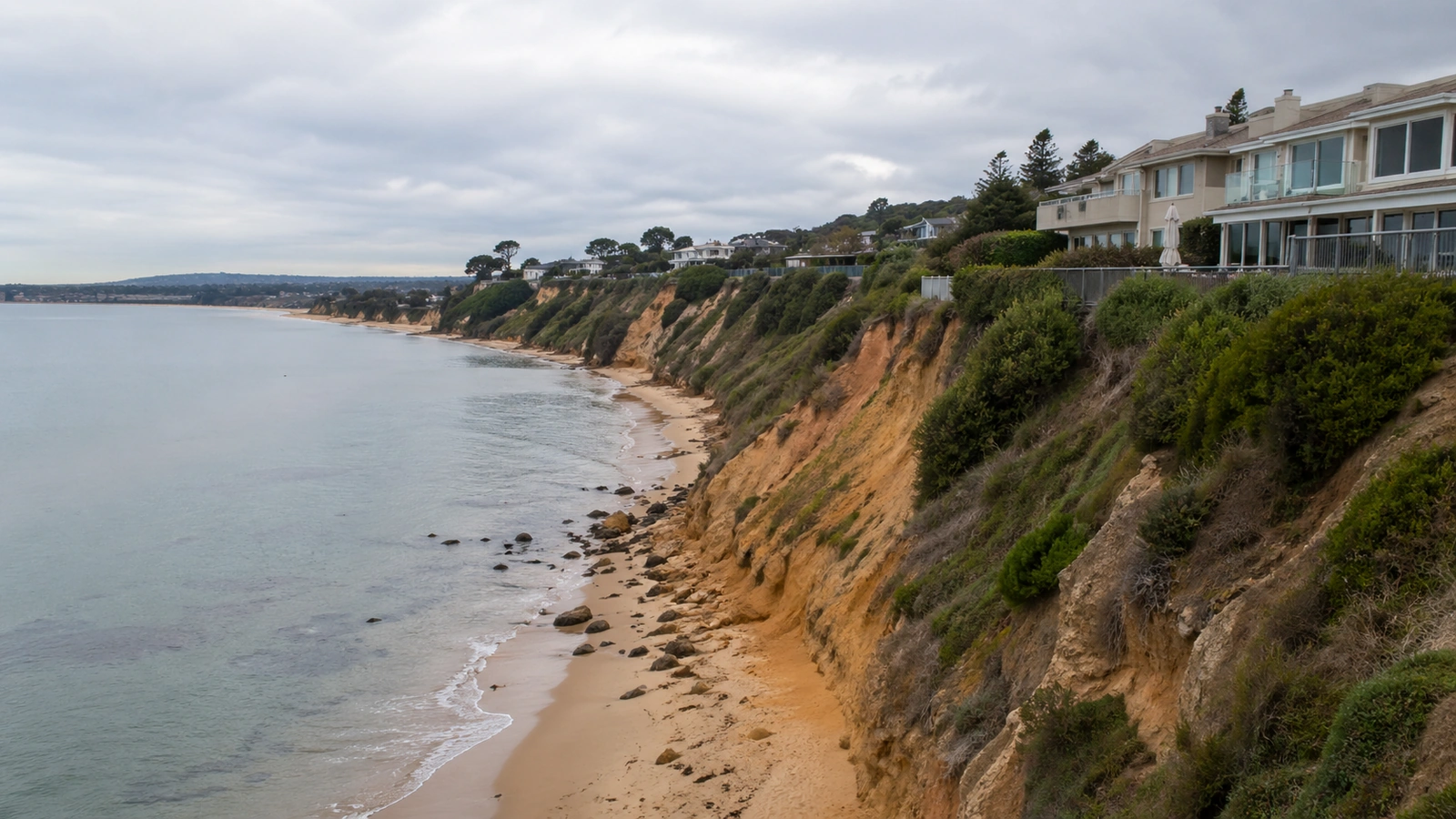
Victoria’s land tax squeeze is starting to show up where the market was once hardest to enter: prestige coastal property.
On the Mornington Peninsula, agents and buyers’ advocates are reporting more stock, slower turnover and larger discounts on some holiday homes and lifestyle holdings. The pressure is not coming from one factor. It is the mix of higher holding costs, weaker confidence, post-Covid price fatigue and owners reassessing whether a second property still makes financial sense.
That does not mean every beach house is suddenly cheap. It does mean the balance of power has shifted.
For buyers with cash, patience and a clear view of land tax exposure, this is the most interesting Victorian coastal market in years.
For owners, the message is less comfortable: the carrying cost of optional property has changed.
The tax bill is now part of the price
Victoria’s land tax system has become a bigger issue for property investors, second-home owners and some absentee owners.
The State Revenue Office’s current land tax tables show that Victorian land tax rises sharply as total taxable land value increases. For land holdings between $1.8 million and $3 million, the general land tax rate with the absentee owner surcharge is listed as $83,850 plus 5.65 per cent of the amount above $1.8 million.
The absentee owner surcharge is separate from ordinary land tax and applies to some owners who live outside Australia. The SRO says the surcharge rate is 4 per cent from the 2024 land tax year, up from 2 per cent between 2020 and 2023.
That distinction matters. Not every holiday home owner pays the absentee owner surcharge. But many non-principal-place-of-residence owners still face land tax, and in prestige markets the numbers can be large enough to change behaviour.
A $40,000, $60,000 or larger annual holding cost is not just an accounting line. It changes the question from “Do we love the property?” to “Do we love it enough to keep paying this every year?”
That is where discretionary property becomes vulnerable.
In plain English:
Land tax turns a second property from a lifestyle asset into an annual cashflow decision. If the property is not producing rent, not being used often, or no longer rising fast enough to justify the cost, some owners will sell.
Mornington Peninsula is feeling the adjustment
The Mornington Peninsula had one of the clearest Covid-era surges.
Melbourne lockdowns made space, lifestyle and coastal access more valuable. Buyers paid up for Portsea, Sorrento, Flinders, Merricks and other prestige pockets. Some bought with cheap debt. Some bought emotionally. Some assumed the work-from-anywhere shift would last longer than it did.
Now the market is different.
Recent reporting has pointed to rising listings, slower luxury sales and discounts across parts of the Peninsula, with agents describing buyers as active but more price-sensitive. Some rural and large-land holdings appear to be under heavier pressure than smaller, more liquid properties.
That pattern makes sense.
Large lifestyle blocks can be expensive to maintain, harder to rent efficiently and more exposed to land value-based taxes. If the buyer pool narrows at the same time, vendors have fewer ways to hold the line on price.
This is not just a Mornington Peninsula story. It is a warning about any market where the price was set during cheap money, but the holding cost is being paid in a higher-cost world.
Read more: Melbourne’s tax squeeze is real, but other cities may dodge the fallout
What changed and what didn’t
What changed is the cost of holding underused property.
A second home that once felt like a long-term store of wealth may now come with a tax bill, higher insurance, maintenance costs, council rates and, for some owners, refinancing pressure.
What did not change is the appeal of the Mornington Peninsula.
Portsea, Sorrento, Flinders and Merricks still have scarcity, amenity and emotional pull. Wealthy buyers still want coastal homes. Families still want legacy properties. Melbourne money still looks south when lifestyle becomes the priority.
The issue is price.
A great asset can still be a poor purchase at the wrong number. A beautiful holiday home can still become a forced sale if the owner’s cashflow no longer works.
This is why the current market is not simple.
Buyers may have more leverage, but they still need discipline. Sellers may be under pressure, but quality property will not automatically become distressed.
The part buyers should not miss
The discount is only useful if the long-term cost makes sense.
A buyer looking at a reduced $8 million or $10 million coastal property still needs to pressure-test the full annual ownership cost. That means land tax, vacancy risk, maintenance, insurance, debt cost and the opportunity cost of tying up capital.
The mistake is looking only at the discount from the previous asking price.
If a property was overpriced during the Covid boom, a 20 per cent reduction may only bring it closer to fair value. It may not be a bargain.
A better question is this: would the property still make sense if prices went sideways for five years?
That is the test many vendors are now facing.
It is also the test buyers should run before celebrating.
Second-order effects are starting to matter
When owners sell because holding costs rise, the impact can spread beyond luxury buyers.
More listings at the top end can reset local price expectations. Lower sale prices can influence valuations. Softer valuations can feed back into borrowing capacity, refinancing conversations and vendor confidence.
There is also a rental angle.
Some owners may try to rent the property before selling. Others may sell to owner-occupiers, reducing short-stay or holiday rental supply. The local effect depends on who buys and how the property is used.
For investors, the lesson is broader than one suburb.
Policy can change the return profile quickly. A property that looked safe under one tax setting can look much less attractive when annual costs rise and capital growth slows.
That is why tax should be part of the buying decision, not an afterthought after settlement.
Read more: Wage growth vs house prices in Australia
What could derail the buyer advantage?
Three things could change the mood.
First, interest rate cuts could bring confidence back into prestige markets. Lower borrowing costs do not help every luxury buyer, but they can improve sentiment across the market.
Second, vendors may withdraw rather than accept deep discounts. Prestige property markets often do not clear like ordinary suburban markets. If sellers do not need to sell, stock can sit or disappear.
Third, tax bills may fall if land valuations are marked down. That would not remove the pressure, but it could reduce the urgency for some owners.
Still, the base case is that Victoria’s second-home market remains more price-sensitive while holding costs stay high and confidence remains patchy.
This is especially true for properties with big land, limited income potential and owners who bought near the top.
The practical take
For buyers, this is a market to negotiate carefully, not emotionally.
Start with the annual holding cost, not the asking price. Ask your adviser to model land tax, debt, rates, insurance and maintenance under a base case and a downside case. Then compare that cost with how often the property will actually be used.
For sellers, the decision is more direct. If the property is no longer worth the annual cost, price it for the market you are in now, not the market of 2021.
The Mornington Peninsula has not lost its appeal. But the numbers have changed.
And in property, the numbers usually win eventually.
Read more: First-home buyer scheme may be pushing prices higher
General info, not financial advice.