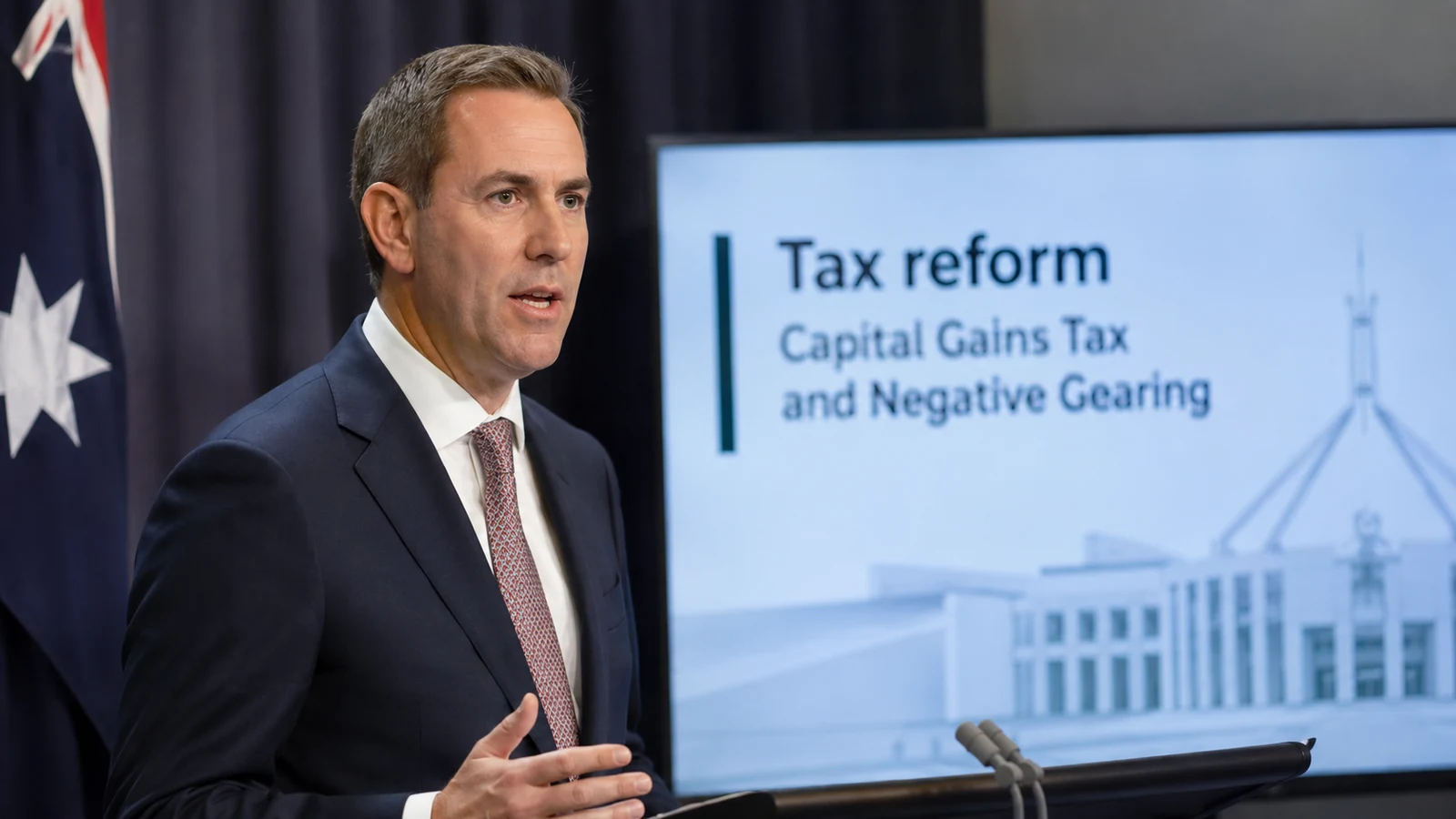
Labor’s attempt to redraw the tax rules for property investors has entered its harder phase: getting the numbers to pass it.
The Albanese government’s 2026–27 Budget proposes two major changes from 1 July 2027. The 50 per cent capital gains tax discount would be replaced with an inflation-linked method and a minimum 30 per cent tax on gains. Negative gearing would be limited to new builds, while established homes bought after Budget night would no longer allow rental losses to be deducted against salary or other non-property income.
Now the politics may reshape the policy.
The Australian Financial Review reports that Labor and the Greens have begun preliminary negotiations, with the Greens pressing for tougher changes to negative gearing and capital gains tax. No final agreement has been announced, and the legislation has not passed Parliament.
For property investors, that distinction matters. The Budget set out the government’s opening position. The Senate will determine how much of that position survives.
Labor has a policy, but not yet a deal
The government’s stated aim is straightforward: reduce tax support for investors competing over established homes and direct more investment into new housing supply.
Under the Budget proposal, properties held before Budget night retain their existing negative gearing treatment. Investors purchasing new builds would also retain access to negative gearing and, on sale, could choose between the current CGT discount and the new inflation-linked approach.
That protection for existing holdings is important. It was meant to reduce the risk of sudden selling, respect investment decisions already made and focus the behaviour change on future purchases.
But the government cannot pass disputed legislation through the Senate by itself.
The 48th Parliament’s published Senate composition gives Labor 30 seats, short of the 39 votes needed for a majority. The Greens hold 10 seats, making them one possible route for Labor if other crossbench support is not secured.
That is why a reform already significant for investors could become tougher before it becomes law.
Risks to watch
The Budget plan is not yet the final rulebook. Investors should track three moving pieces: whether existing assets remain protected, whether new-build concessions survive unchanged, and whether negotiations delay or reshape commencement arrangements.
Two tax settings are caught in the same bargaining fight
Negative gearing and capital gains tax are often discussed together, but they change different parts of an investment decision.
Negative gearing affects the years an investor holds a rental property. In plain English, where expenses exceed rent, the current rule can allow that loss to reduce other taxable income.
CGT affects the exit. Under today’s settings, eligible individuals and trusts generally discount a gain by 50 per cent after holding an asset for more than 12 months. The Budget proposal would instead adjust the asset’s cost base for inflation and apply a minimum 30 per cent tax rate on gains arising after 1 July 2027.
For an investor, one rule affects annual cashflow. The other affects what remains after selling.
This is why a tougher Senate deal would not be a small technical adjustment. If negative gearing is wound back more widely, holding costs could rise for a larger group. If CGT protection becomes less generous, investors may rethink whether and when to sell.
Australian Property Review previously examined why the Budget tax package changes more than one line on a tax return in The Budget Tax Shock Now Spreading Beyond Property. The key point remains: property behaviour changes when both the carrying cost and the exit reward are uncertain.
Grandfathering is the pressure point
Here’s the catch.
The most sensitive part of any negative gearing reform is not the headline ban or restriction. It is who gets protected from it.
The Budget proposal leaves existing arrangements unchanged for properties held before Budget night. That gives current owners a degree of certainty and narrows the immediate effect to later purchasing decisions.
A tougher outcome, if negotiated, could reduce that protection. For an owner who bought on the assumption that rental losses could offset salary income, a change applied more broadly would alter the holding-cost calculation after the purchase has already been made.
That does not automatically mean investors sell. Some may do the opposite.
An investor who faces weaker annual deductions and a less favourable tax outcome on a future gain may simply hold longer, postpone a sale or avoid a new purchase. That can reduce turnover rather than quickly release established homes to owner-occupiers.
It is one reason the housing result cannot be assumed from the political pitch alone.
Australian Property Review has covered the rental-market side of that risk in The Budget Tax Shock That Could Push Small Landlords Out. Shifting investment toward new supply may help over time, but established rental stock can be affected sooner than new homes can be delivered.
New builds may gain an edge, but supply still has to arrive
Under Labor’s proposal, new residential builds receive preferred treatment. Investors buying new homes keep access to negative gearing and gain more flexibility under the CGT settings.
That is a deliberate incentive. The government wants private capital funding extra dwellings rather than bidding for the same established homes as first-home buyers.
In theory, the logic is reasonable. More investment in new housing can support supply.
In practice, tax policy cannot by itself fix build costs, planning delays, skilled labor constraints, finance costs or weak feasibility in particular locations. An investor does not buy a new apartment or house-and-land package because the tax position sounds better on Budget night. They buy when the price, rent, completion risk and resale demand still stack up.
There is also a second-order effect. If investors and first-home buyers both become more concentrated in affordable new-build corridors, the government may shift competition rather than remove it.
That issue was explored in Australian Property Review’s analysis, Labor’s New-Build Tax Bet Could Backfire on Buyers.
Uncertainty changes behaviour before legislation does
The immediate issue for brokers, landlords and prospective investors is not only the final tax design. It is the period before anyone knows the final design.
A purchaser considering an established investment home now has to model at least three possible outcomes:
- Labor’s Budget proposal passes largely as announced.
- The Greens secure tougher treatment, particularly around protections for existing or future holdings.
- Negotiations stall, delaying the legislation or forcing a different parliamentary route.
None of those outcomes should be treated as certain.
But the uncertainty itself can affect decisions. A borrower may pause an offer. A broker may need to rerun servicing assumptions. An investor may choose a new build, keep cash available or decide the after-tax return is too difficult to forecast.
For markets, that matters because prices and rental supply move at the margin. Not every investor needs to step back. A smaller group delaying purchases in tightly supplied rental areas can still influence available stock and bargaining power.
What should property investors do now?
The practical next step is not to trade on a political headline. It is to pressure-test the property under less generous assumptions.
For an established investment property bought after Budget night, model the cashflow without relying on rental losses reducing wage income. For a long-term hold, ask your accountant how CGT indexation and a minimum tax rate could affect the sale outcome after 1 July 2027, if legislated.
For investors who already own property, do not assume grandfathering will either definitely remain or definitely disappear. At this stage, the Budget proposes protection, while media reports indicate it may become a negotiating issue.
That is the line to watch.
Labor has put property tax reform on the table. The Greens may now determine how far it travels, and which investors are left holding the cost of the compromise.