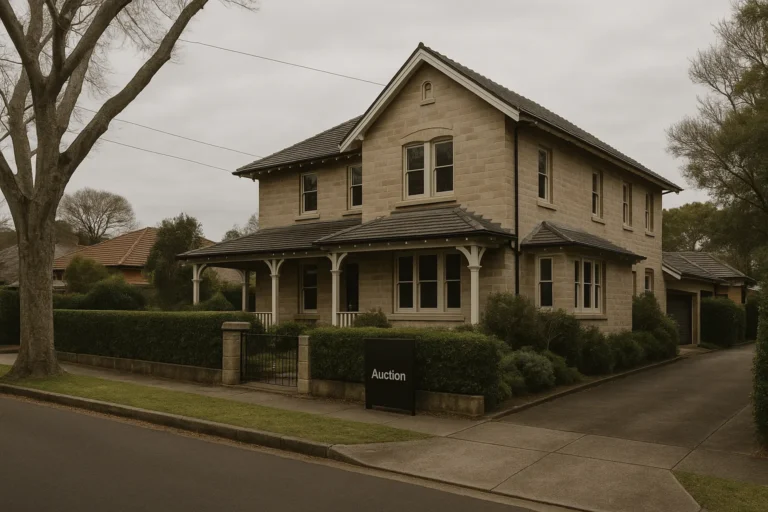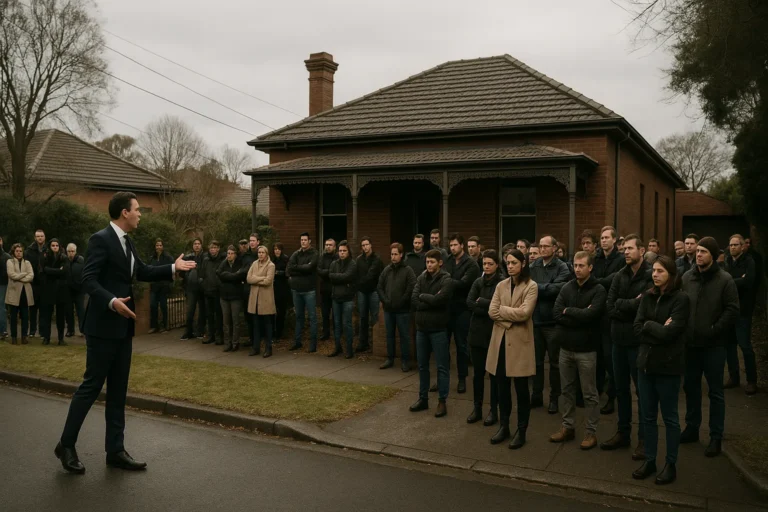
Auction listings across Australia have dropped 20% year-on-year even as total property listings climbed 22.8% over the same period. Vendors are pivoting to private treaty sales as clearance rates slide below 50%, down from around 70% in September last year. The shift is less about the auction format itself and more about what happens when buyer demand weakens and seller expectations lag behind.
Australia relies on auctions far more than most markets. In the four weeks to late June, roughly 30% of capital city sales went to auction, a figure that would be unthinkable in the US, where auctions are reserved for distressed assets, or the UK, where they account for around 3% of transactions. The model works when scarcity meets strong demand, creating competition that drives prices beyond listed ranges. When that dynamic breaks, the same format exposes vendor expectations that haven’t adjusted to current conditions.
Why the retreat is happening now
Clearance rates below 50% signal a mismatch between what sellers think properties are worth and what buyers are willing to pay. When one in five auctions ends without a sale, as recent data shows, the format stops being a price discovery tool and becomes a public failure signal. Research tracking over 480,000 NSW and Victoria transactions found properties that passed in at auction subsequently sold for 1.3% less via private treaty, translating to a loss of roughly $9,000 to $10,000 at median prices.
Private treaty allows sellers to negotiate without the reputational cost of a visible non-sale. It also removes the time pressure and theatrical element that can backfire when buyer interest is thin. The format shift isn’t vendors rejecting auctions philosophically, it’s a response to affordability pressure, higher borrowing costs, and stretched household budgets that have reduced the pool of qualified, motivated buyers willing to compete publicly.
The numbers that matter
- Auction listings down 20% year-on-year while total listings up 22.8%
- Clearance rates dropped from ~70% in September to below 50% by mid-year
- One in five auctions ends without a sale
- Passed-in properties sell for 1.3% less on average via subsequent private treaty
- Auction premium over private treaty: 0.7% (less than staging and auctioneer costs in many cases)
The price effect and what it isn’t
Auctions do push prices higher, but the margin is narrower than assumed. The same UNSW and University of Sydney research found a 0.7% premium compared to private treaty sales, roughly offset by the additional costs of hiring an auctioneer and staging the property. The real upward pressure comes from competitive bidding in heated markets, where multiple qualified buyers chase scarce stock. In a cooling market, that dynamic reverses: thin crowds, cautious bids, and reserves that don’t meet the market produce visible failures rather than price discovery.
The auction format amplifies sentiment in both directions. When demand is strong, public competition drives prices above private negotiation levels. When demand weakens, the same transparency works against sellers. The current shift doesn’t mean auctions are broken, it means market conditions no longer favour a sale method that relies on scarcity and urgency.
What policy changes and buyer caution mean for the format
Recent federal budget changes to capital gains tax concessions and negative gearing have reduced speculative investor demand, particularly among buyers who previously bid above rental yield fundamentals. That cohort often drove auction competition, pushing prices beyond what owner-occupiers could justify. With that pressure easing, the buyer pool at weekend auctions has thinned, and the format’s core advantage, creating urgency among multiple bidders, no longer holds.
Borrowing serviceability constraints have also hit harder than rate rises alone. Buyers who could theoretically afford a property at current rates are being turned away by lenders applying tighter buffers and stricter income tests. That dynamic shows up most clearly in borrowing capacity ceilings, which have reduced investor activity more sharply than rate movements would predict. Fewer qualified bidders mean auctions can’t generate the competitive tension they’re designed for.
The transparency trade-off
Banning auctions, as proposed by some state parties, would remove a transparent price discovery mechanism without addressing the underlying issue: housing treated as a speculative asset rather than shelter. Private treaty sales can be opaque, with negotiated prices that never reach public databases and underbidding strategies that disadvantage less experienced buyers. Auctions, for all their theatricality, at least surface real-time demand and establish a public price.
The better regulatory path tightens rules around vendor bids, dummy bids, and advertised price ranges, practices that erode trust in the format. Rainy weekends produce more failed auctions, as do less experienced agents. When one auction succeeds in an area, others quickly follow. These patterns suggest the format is sensitive to execution quality and external conditions, not inherently flawed.
Three scenarios for the next six months
Base case: auction share continues to decline as clearance rates stay below 55%, with private treaty becoming the default in all but the strongest inner-city markets. Vendors who test the auction route early in campaigns switch to private treaty after underwhelming inspections.
Upside: clearance rates recover to 60–65% if borrowing conditions ease or buyer sentiment stabilises, bringing auction share back to 35–40% as competition returns to tightly-held suburbs with limited stock.
Downside: clearance rates fall below 45%, auction listings drop another 10–15%, and the format becomes a niche tool for prestige properties or estates where scarcity still justifies public competition.
What to watch
Track weekly clearance rates in Melbourne and Sydney, sustained readings below 50% mean the private treaty shift is structural, not seasonal. Monitor auction listing volumes against total stock: if auctions stay below 25% of listings for three consecutive months, the format has lost its position as the default choice. Watch how quickly passed-in properties relist via private treaty and at what discount, that gap tells you how far vendor expectations are from buyer reality.
If you want the weekly signal, subscribe to Australian Property Review.
General info, not financial advice.