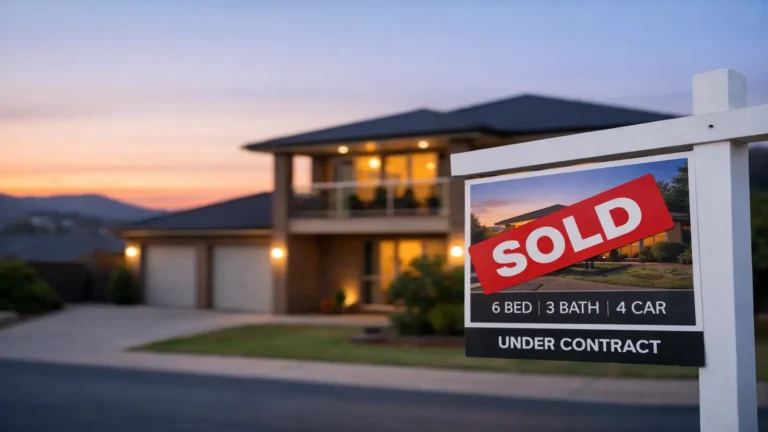
A Sydney property settling at $1.88 million after three consecutive rate hikes illustrates a pattern most vendors miss until it’s too late: buyer sentiment shifts faster than price indices suggest, and the gap between early and late sellers in a tightening cycle can exceed 10 percent of sale value within a single quarter.
The mechanics are straightforward. When the RBA signals a rate-rise cycle, borrowing capacity contracts immediately, serviceability calculators reset overnight, pre-approvals shrink, and buyers who could stretch to $2 million last month can now bid $1.8 million. Vendors who list before the first hike face competition from buyers still operating on old assumptions. Vendors who wait three months face buyers recalculating every offer through a serviceability filter that’s already tightened three times.
The timing wedge
Consider two identical properties in the same suburb. Property A lists two weeks before the first rate rise and sells at $1.95 million. Property B waits until after the third hike and achieves $1.75 million. The $200,000 gap isn’t explained by fundamental value deterioration, it reflects the lag between when rates move and when vendor expectations adjust.
Borrowing capacity falls faster than advertised prices. A buyer earning $200,000 household income could service a $1.5 million loan at 5.5 percent. At 6.25 percent after three 25-basis-point hikes, the same buyer qualifies for $1.35 million. The property hasn’t changed. The buyer’s income hasn’t changed. But their maximum bid just dropped $150,000, and they’re competing against other buyers facing identical constraints.
This creates a brief window where asking prices haven’t reset but buyer pools have already shrunk. Vendor expectations in Sydney show a $200k gap when sentiment shifts faster than price guides, vendors who catch that window preserve equity that late movers forfeit.
Who pays the hesitation premium
Vendors waiting for “the market to stabilise” after rate rises begin typically face three compounding headwinds:
- Shrinking buyer pools: each rate rise removes 8-12 percent of potential buyers from the qualified pool for properties above $1.5 million, based on standard serviceability buffers
- Negotiation leverage inversion: when listings outnumber active buyers, price discovery shifts from competition (auction premiums) to negotiation (private-treaty discounts)
- Expectation anchoring: buyers who’ve watched three months of rate rises now anchor offers to worst-case scenarios, pricing in further tightening even if the RBA pauses
The $1.88 million sale captures all three. A property that might have cleared $2.05 million before the cycle started faced a buyer cohort already pricing the next hike into their maximum bid, even if that hike never eventuates.
The catch
Rate-rise cycles don’t move in neat quarters, and vendors can’t time peaks perfectly. But the equity cost of waiting becomes measurable once the first hike lands: borrowing capacity falls faster than advertised prices, creating a wedge that grows with each subsequent move. Vendors who list during the “is this really happening?” phase, between the first signal and widespread acceptance, capture buyers still operating on pre-hike budgets. Vendors who wait for certainty face buyers who’ve already recalculated.
The downside case
If the RBA pauses or reverses within six months, early sellers forfeit potential upside. A vendor who sold at $1.88 million in month three of a rate-rise cycle watches the same street achieve $1.95 million six months later when cuts begin. The trade-off: locking in known equity versus gambling on policy reversal.
Historically, Australian rate-rise cycles last 12-18 months from first hike to pause. Vendors betting on a short cycle (three hikes then done) risk being wrong for a year, during which buyer sentiment continues tightening and every comparable sale resets the floor lower.
The alternative risk, listing immediately and undershooting value by 3-5 percent, hurts less than waiting through a full cycle and undershooting by 10-12 percent. Equity preservation favours early movement when the direction is clear, even if the endpoint isn’t.
What determines your window
Three variables control how much equity vendors preserve during rate-rise cycles:
- Listing timing relative to first hike: listings in the 30-60 day window after the initial move face buyers whose pre-approvals haven’t expired yet, creating brief pricing overlap
- Price bracket: properties above $1.5 million face sharper buyer-pool contraction because higher loan amounts hit serviceability limits faster, a $200k income can absorb a $50k loan reduction more easily at $800k than at $1.8 million
- Local supply response: suburbs where listings surge after the first hike see faster price resets than areas where vendors hold off, the former compresses the adjustment into weeks, the latter spreads it across months but doesn’t avoid it
Vendors in premium brackets ($1.8 million and above in Sydney) face the steepest timing penalty. A buyer qualifying for $2 million at 5.5 percent qualifies for $1.78 million at 6.25 percent, an 11 percent reduction that compounds with every incremental hike.
Bottom line for vendors
Once the RBA signals a tightening cycle, vendor equity erodes faster than price indices reflect, because buyer serviceability resets instantly while asking prices adjust over quarters. The window for preserving maximum equity closes within 60-90 days of the first hike, early enough that most vendors still doubt the cycle is real.
If you’re holding property and rate rises have begun: pressure-test your sale timeline against serviceability math, not price-growth history. Buyers are recalculating now. Your asking price will catch up, but the equity you preserve depends on listing before it does.
Subscribe to Australian Property Review’s newsletter for weekly updates on how rate moves affect real buyer behaviour, not just headline price trends.
General info, not financial advice.