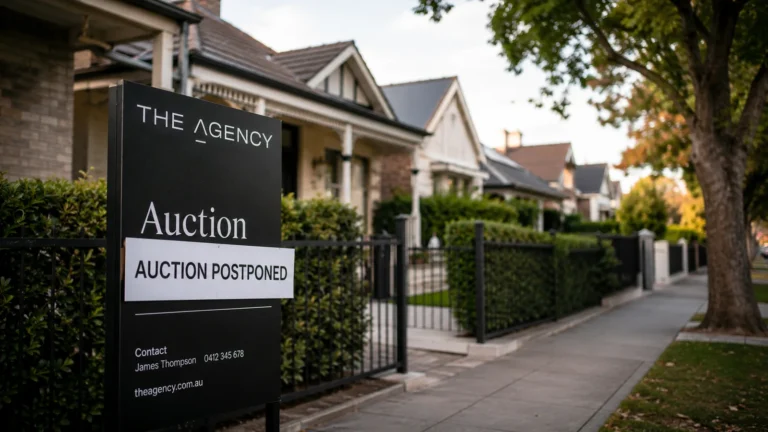
A two-storey terrace in inner Sydney went to auction expecting to match or beat its $3.15 million sale price from five years ago. It didn’t. The property passed in, with the gap reported at around $200,000.
This isn’t a story about one house. It’s a window into the mechanical problem slowing Sydney’s market right now: vendor expectations Sydney sellers carry into auctions are lagging the reality buyers are pricing in, and that gap takes months to close.
The lag between listing price and buyer appetite
When a property last sold in 2021, the seller remembers that number. They anchor to it. If they refinanced against it or used it to plan their next purchase, the number becomes even stickier.
Buyers in 2026 are working with different inputs: higher mortgage rates, tighter serviceability buffers, seven rate rises since mid-2022, and a year of flat to slightly negative price growth across most Sydney submarkets. They’re discounting for risk, unemployment, potential further rate moves, weaker rental yield in oversupplied pockets.
The result: a standoff. The seller lists at or near the 2021 figure. Buyers bid to a level that reflects today’s cost of capital and today’s risk appetite. The property passes in. The agent rings the vendor post-auction with the top bid. The vendor says no. Week two: minor price trim, same result. Week four: deeper cut, maybe a sale.
That cycle typically runs three to six months in a softening market, according to clearance and re-listing patterns tracked across major metros. Forced sales, divorce, relocation, financial stress, compress it to weeks. Discretionary sellers stretch it to quarters or pull the listing entirely.
Who moves first and what that tells you about liquidity
Price discovery in property is slow because most sellers can choose to wait. Unlike shares or bonds, a house doesn’t have a live bid-ask spread you can watch tick down in real time. The market only “finds” the price when someone actually transacts.
Forced sellers move the number first. They accept the market because they have to. That sets a floor. Discretionary sellers watch, recalibrate, and either follow or withdraw. If enough withdraw, volumes dry up, which is exactly what’s happening in parts of Sydney now, auction clearance rates have been retreating as vendors pull stock rather than accept lower bids.
The question for the next six months: does the share of forced sales rise enough to accelerate the reset, or do discretionary vendors hold the line and keep listings low?
Two scenarios:
-
Base case: forced-sale share stays around current levels (divorce, job loss, offshore relocation driven by visa/work changes). Price discovery continues at the current slow pace. Listings stay tight. Buyers who need to move pay close to ask; others wait. Clearance rates drift between 50-60 per cent. Time on market creeps up another 10-15 days over the next quarter.
-
Downside case: unemployment ticks up 0.5 percentage points, more mortgagees hit serviceability stress, forced-sale share rises. Vendors who were holding out start moving. Listings jump, clearance rates fall into the low 50s, time on market stretches past 60 days in some suburbs. Prices reset faster, but liquidity improves because the bid-ask gap narrows.
The suburbs where the gap is widest right now
Inner-ring markets that ran hardest in 2020-2021, Surry Hills, Redfern, Newtown, parts of the inner west, are seeing the largest expectation mismatches. Sellers remember 20-30 per cent gains compressed into 18 months. Buyers remember seven rate rises since.
Outer suburbs with higher median mortgage sizes (north-west growth corridors, south-west new estates) are seeing faster resets because serviceability is tighter and forced-sale share is higher. Buyers there have less equity buffer, so stress shows up sooner.
Leafy, low-turnover pockets with older ownership cohorts, lower north shore, eastern suburbs heritage streets, are seeing the slowest resets because owners can afford to wait and often do.
Key numbers
- Sydney median house price: $1.38 million as of Q4 2025 (CoreLogic), down 2.1 per cent year-on-year
- Average time on market: 42 days metro-wide, up from 34 days a year ago
- Auction clearance rate: 58 per cent over the past four weeks, versus 68 per cent same period 2024
- Median mortgage rate (variable, owner-occupier): 6.4 per cent, up from 2.4 per cent in April 2022
What would speed up the reset
Three things compress vendor-expectation lags:
-
Rate cuts. If the RBA moves in the next two quarters, buyers’ maximum borrowing capacity rises, which lifts the bid level and narrows the gap without the vendor having to drop as much. That’s the soft landing.
-
Rising forced-sale share. Job losses, divorce spikes, or a wave of fixed-rate refinances hitting higher variable rates. Sets a new price floor faster, but through pain.
-
Time. Vendors who sit on the market for three months without a sale start discounting expectations on their own. The longer a property sits, the more the anchor weakens.
Right now, we’re in scenario three. No rate cuts yet, forced-sale share not materially rising, so the reset is happening one exhausted vendor at a time.
What this means if you’re selling or buying this year
If you’re selling: price to the market that exists today, not the one you remember. Get three agent appraisals, then use the lowest as your guide price. If you’re not under time pressure, you can test higher and see, but expect longer days on market and a higher chance of a pass-in. If you are under pressure (moving for work, settling on another property, separation), price to clear and move on.
If you’re buying: the longer a property has been listed, the more likely the vendor is ready to move. Filter for listings over 30 days, especially in inner suburbs where the expectation gap is widest. Don’t assume a pass-in means the property is overpriced by the gap, some vendors will take the top bid a week later, others won’t move for months. Make your best offer, set a walk-away number, and mean it.
If you’re waiting to see which way this breaks: watch clearance rates and time on market over the next eight weeks. If clearance stays above 55 per cent and time on market stops rising, the reset is mostly done. If clearance drifts into the low 50s and time on market keeps climbing, expect another 5-10 per cent downward pressure on asking prices by mid-year.
Subscribe to the newsletter for the weekly market signal and the numbers that matter.
General info, not financial advice.